

How to Promote Your Affiliate Program and Attract Quality Affiliates
Launching an affiliate program is the easy part. Getting people to actually join and promote it? That is where most program owners get stuck. You set everything up, wait for affiliates to sign up, and then nothing moves.
This happens to almost everyone in the first few months. The good news is, promoting your affiliate program is not that complicated once you know where to focus.
Key Takeaways: Promote Your Affiliate Program
- Most affiliate programs fail because they are invisible, not because the product is bad.
- A dedicated affiliate program page with clear terms converts way better than a footer link.
- Recruit your existing customers and email subscribers first, since they are the warmest leads.
- Branded coupon codes make influencer outreach much easier because they feel natural in content.
- Custom landing pages for top affiliates make your program look more professional than competitors.
- Ready-made creatives, banners, and QR codes remove friction and get affiliates to actually promote.
- Around 90% of your sales will come from 10% of your affiliates, so reward and re-engage your top performers.
Why Most Affiliate Programs Fail to Grow
Here is something most blogs will not tell you. A lot of affiliate programs fail not because the product is bad, but because the program itself is invisible.
Owners often think, “I have launched the program, now affiliates will find it.” But affiliates are not searching for your brand. They are searching for products that fit their audience and pay them fairly. If your program is hidden behind a tiny footer link or buried inside your terms page, nobody will discover it.
The other big reason is friction. Even when affiliates find your program, they hit roadblocks like unclear commission rates, missing creatives, no clear signup page, or no easy way to track their performance. So they leave.
Promoting your affiliate program is really about two things. Making it visible. And making it easy to join.

Launching Affiliate Program? Explore Complete 101 Guide!
What Promoting Your Affiliate Program Actually Means
When people say “promote your affiliate program,” they usually mean two different things, so let us clear that up.
This guide is not about helping affiliates promote your products. That is a separate topic. This guide is about you, the program owner, attracting more affiliates to join your program in the first place.
In simple terms, you are doing recruitment marketing. You are trying to convince content creators, bloggers, YouTubers, customers, influencers, and partners to sign up and share your product. Once they join, you also want them to be active, not just sit in your dashboard collecting dust.
So everything below is about getting more of the right affiliates into your program, and keeping them engaged enough to actually promote.
Set Up the Foundation Before You Promote Anything
Before you start sending emails or running campaigns, your program needs to be ready to convert visitors into affiliates. Otherwise, you are pouring traffic into a leaky bucket.
Build a Dedicated Affiliate Program Page That Converts
Your affiliate program needs its own page. Not a tiny link in the footer. A real page that sells the opportunity.
Include these on the page:
- A short, clear pitch like “Earn 30% on every sale”
- Who the program is for, such as bloggers, course creators, or agencies
- Commission rate and cookie duration
- What makes your program worth promoting, like a high conversion rate, recurring commissions, or good support
- Real proof, like top affiliate earnings or testimonials if you have them
- A signup button that stands out
- A short FAQ section to handle common doubts
If you are on WordPress, you can build this page in minutes and embed your affiliate registration form on it. With FluentAffiliate, you can create a full affiliate portal using a simple shortcode, so signups happen right on your site without redirects.
Make Commissions and Terms Crystal Clear
Vague terms & conditions scare affiliates away. Spell out:
- Commission rate, whether percentage or flat
- Cookie duration in days
- Payout schedule and minimum payout amount
- Approved payment methods like PayPal or bank transfer
- What counts as a valid referral, and what does not
The clearer you are, the more trust you build. And trust is what makes serious affiliates sign up.
Read More: Affiliate Commission Structure: Choose the best model for your Business
Prepare Creatives and Swipe Copy in Advance
Here is a mistake I see all the time. Owners launch the program, attract affiliates, and then leave them with nothing to promote. No banners. No swipe emails. No images. No sample posts.
Affiliates are busy. If you make them create everything from scratch, most will not bother. Give them ready-to-use materials like banners, social media graphics, sample email copy, product images, and QR codes.
Inside FluentAffiliate, there is an Affiliate Creatives feature where you can upload images, text links, and QR codes that affiliates can grab from their dashboard with one click. Every creative is automatically tagged with the affiliate’s tracking link, so attribution never breaks.
Set this up before you start promoting. It changes the experience for affiliates completely.
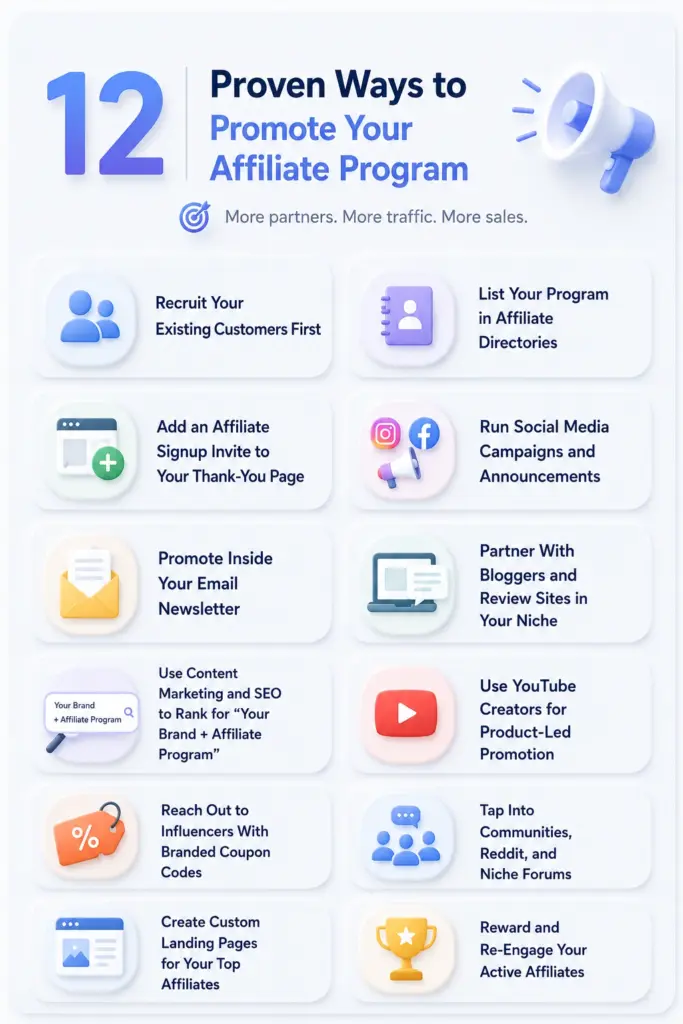
12 Proven Ways to Promote Your Affiliate Program
Now to the part you came for. These are practical promotion channels, ranked roughly by how warm the audience is and how quickly you can see results. Start at the top and work your way down.
1. Recruit Your Existing Customers First
This is the single best place to start. Your existing customers already love your product. They already use it. They already trust you. Turning them into affiliates is way easier than convincing a stranger to promote you.
Send them a simple invite email. Tell them they can earn money by sharing the product they already use. Most owners skip this step and chase cold influencers, which is a huge waste of warm leads.
If you run an ecommerce store, course platform, or SaaS, look at your most active customers, your most positive reviewers, and your repeat buyers. Those are your easiest signups.
Read In-depth: How to Recruit Affiliates for Your Business
2. Add an Affiliate Signup Invite to Your Thank-You Page
Right after someone buys from you, they are in the happiest mood they will ever be in with your brand. That post-purchase moment is gold.
Add a small section to your thank-you page or order confirmation email that says something like, “Loved your purchase? Earn 25% by sharing it with friends. Join our affiliate program.”
This converts well because the buyer is already invested. They do not need to be sold on the product. They just need a nudge.
3. Promote Inside Your Email Newsletter
If you have an email list, you already have a built-in promotion channel for free. Run a dedicated email campaign once a quarter inviting subscribers to join your affiliate program. And drop it as a small footer link in every regular newsletter too.
You can segment your list and target only the most engaged subscribers first. Those who open and click often are far more likely to sign up than passive subscribers.
If you use FluentCRM with FluentAffiliate, the two plugins talk to each other. You can automatically tag new affiliates, send onboarding sequences, and re-engage inactive affiliates with email automations. That kind of setup saves hours of manual work every week.
4. Use Content Marketing and SEO to Rank for “Your Brand + Affiliate Program”
Try this. Search “your brand name + affiliate program” on Google. Does anything show up? If not, you are missing serious recruitment traffic.
Write a long, helpful blog post titled something like “Your brand Affiliate Program: How It Works and How to Join.” Include commission details, payout info, FAQ, and a strong call to action.
Also publish related articles like “How to earn money with Yourbrand” or “Best ways to promote Yourbrand to your audience.” These articles attract people who are already curious about joining.
This is a slow channel, but it brings free, recurring signups for years once you rank.
5. Reach Out to Influencers With Branded Coupon Codes
Influencer outreach usually fails because of one issue. Influencers do not want to share a tracking link in their video, post, or story. It feels awkward and breaks the flow.
The fix is simple. Offer them a branded coupon code. Something like “ALEX20” that gives their audience a 20% discount and credits the influencer with a commission on every sale.
Coupon codes feel natural in social content. Influencers can say them on camera. Their audience saves money. You get sales tracked properly. Everybody wins.
FluentAffiliate supports branded coupon codes through WooCommerce, Easy Digital Downloads, and FluentCart. You create a normal discount code, assign it to an affiliate, and every purchase that uses that code automatically counts as their referral.
6. Create Custom Landing Pages for Your Top Affiliates
This one is underrated. Big affiliates and influencers want their links to look professional, not like generic tracking URLs full of question marks and IDs.
You can create a custom branded landing page for them. So instead of sharing yoursite.com/?ref=42, they share something clean like yoursite.com/partner/alex. Same tracking under the hood, but way more clickable.
In FluentAffiliate, you do this with the affiliate landing page shortcode. Drop it on any WordPress page, assign an affiliate ID or username, and the page automatically tracks visitors to that affiliate. You can also add a personal welcome message, the affiliate’s photo, or an exclusive discount on that page.
When you offer this to top affiliates, it makes your program stand out. Most programs cannot offer this kind of personalization.
7. List Your Program in Affiliate Directories
There are directories where serious affiliates browse for new programs to join. Listing yours is usually free and brings in a steady trickle of signups.
A few worth listing on:
- AffPaying
- Affscanner
- OfferVault
- AffiliatePrograms.com
- Niche-specific directories in your industry
For each listing, write a clear pitch covering your commission rate, cookie length, niche, and what makes your program attractive. Treat the listing like an ad, not a form to fill out.
8. Run Social Media Campaigns and Announcements
Most brands forget to actually announce their affiliate program on social media. Do not assume people know it exists.
Post about it on every channel you use, at least once a month. Mix it up:
- A simple announcement with the commission rate
- A success story from an existing affiliate
- A short tutorial on how someone can promote your product
- A behind-the-scenes look at how the program works
LinkedIn is great for B2B and SaaS programs. Instagram and TikTok work better for lifestyle, ecommerce, and creator-focused products. X and Threads are good for niche communities.
9. Partner With Bloggers and Review Sites in Your Niche
Bloggers and review site owners are some of the best affiliates you can land. They already have SEO traffic that fits your product. One ranking article can drive sales for years.
Search your niche on Google. Look at who ranks for “best [product type]” or “[your category] review.” Reach out to those site owners directly. Pitch them your affiliate program, offer a slightly higher commission for them, and give them early access to product info.
Be patient here. Bloggers get pitched constantly. A short, personal email beats a long, salesy template every time.
Explore More: Affiliate Outreach: How to Find, Pitch, and Onboard Partners Who Actually Sell
10. Use YouTube Creators for Product-Led Promotion
YouTube affiliates can be incredibly valuable because their content keeps converting long after upload. A single tutorial or review video can send sales for years.
Look for creators whose audience overlaps with your customer base. They do not need millions of subscribers. A creator with 10,000 highly engaged viewers in your niche often outperforms a generic creator with a million.
Offer them a free account, a higher commission tier, or a custom landing page. YouTubers love clean tracking links and exclusive discounts they can offer their audience.
11. Tap Into Communities, Reddit, and Niche Forums
Communities are where real affiliates hang out. Facebook groups, Discord servers, Slack communities, Reddit, and niche forums often have members looking for products to recommend.
Do not spam. That is the fastest way to get banned and ruin your reputation.
Instead, become an active member first. Answer questions. Help people. After a while, when it makes sense, mention your affiliate program in a relevant thread. Or contact group admins directly to ask if you can share it with members.
This is slow and very manual, but the affiliates you find through communities tend to be highly motivated and active.
12. Reward and Re-Engage Your Active Affiliates
Here is something that surprises new program owners. Around 90% of your sales will come from 10% of your affiliates. The Pareto rule shows up hard in affiliate marketing.
So when you promote your program, do not just chase new signups. Take care of your existing top performers too. Increase their commission rate. Send them early access to new products. Give them custom creatives. Feature them in your newsletter.
Active affiliates often refer other affiliates to your program when they feel valued. It creates a flywheel where your best people bring more good people in.
Also re-engage inactive affiliates. Send them a quick email reminding them about the program, their unique link, and any new creatives or commission bumps. A small percentage will wake up and start promoting again.
Also Read: How Do Affiliate Marketers Promote Products [12 Proven Ways That Actually Work]
Common Mistakes That Kill Affiliate Program Growth
Here are the patterns I see kill most affiliate programs. Watch out for these.
- Setting commissions too low. If you pay 5% when your competitors pay 30%, affiliates will skip you. Look at what others in your niche pay before setting your rate.
- Slow or unclear payouts. Affiliates talk to each other. If you delay payments or change rules without warning, your reputation tanks fast.
- Approving anyone. Letting random or low-quality signups in clogs your dashboard and makes reporting messy. Require approval and review applications.
- No onboarding. New affiliates need to know what to promote, where to find creatives, and how to get help. A short welcome email or onboarding page makes a huge difference.
- Ignoring tracking issues. If sales are not getting attributed properly, affiliates lose trust. Test your tracking regularly using your own affiliate link in incognito mode.
- Treating affiliates as cheap marketing. Affiliates are partners, not free labor. Communicate like a teammate, not a vendor.
Avoid these and your program will already be ahead of most.
Also Read: 10 Key Affiliate Program Challenges [How to Overcome]
A Simple 30-Day Plan to Promote Your Affiliate Program
If you are starting fresh, here is a clean 30-day plan you can follow.
Week 1: Foundation
- Build a dedicated affiliate program page
- Write clear terms and FAQ
- Upload 5 to 10 creatives (banners, text links, QR codes)
- Set up your registration form and approval workflow
Week 2: Warm outreach
- Email your top 100 customers inviting them to join
- Add the affiliate invite to your thank-you page and order email
- Mention it in your weekly newsletter
- Reach out to 5 to 10 existing partners or business contacts
Week 3: Content and SEO
- Publish a blog post about your affiliate program
- Write a “how to make money with [your product]” guide
- Add the program to your homepage and main nav
- Post about it on all your social channels
Week 4: External outreach
- List your program in 3 to 5 affiliate directories
- Reach out to 10 bloggers or YouTubers in your niche
- Offer custom coupon codes to 2 to 3 influencers
- Set up custom landing pages for 1 or 2 big affiliates
After 30 days, review your numbers. Which channel brought the most signups? Which brought the most active affiliates? Double down on what worked and drop what did not.
How FluentAffiliate Makes Promotion Easier
Most of the strategies above are easier when your affiliate platform supports them out of the box. Here is where FluentAffiliate fits in.
You can build your affiliate portal page with a single shortcode, no extra dev work needed. The Affiliate Creatives module lets you store banners, text links, and QR codes that auto-tag every affiliate, so onboarding is faster. Branded coupon codes work with WooCommerce, Easy Digital Downloads, and FluentCart, which makes influencer outreach much smoother.
Custom affiliate landing pages give your top partners professional-looking URLs. And the FluentCRM integration handles welcome emails, automation, and re-engagement campaigns from one dashboard.
You can also run a multi-domain setup if your blog and store live on different sites, so affiliates can promote your blog and still get credited when the sale closes on your store.
If you are running an affiliate program on WordPress and you want all of this in one place, FluentAffiliate is built exactly for this kind of workflow. Set it up once, and the promotion side gets a lot less painful.

Get the Best Affiliate Plugin for WordPress
Wrapping Up
Promoting your affiliate program is not about one magic channel. It is about being consistent across a few smart ones. Start with your existing customers and email list, because those are the warmest leads you will ever have. Then layer in content, influencers, and directories over time.
Most importantly, take care of the affiliates you already have. A small group of loyal, active partners will do more for your revenue than a thousand inactive signups. Give them creatives, pay them on time, and treat them like real partners.
If your foundation is solid, your program will grow on its own momentum within a few months.
Frequently Asked Questions
How do I promote my affiliate program for free?
Start with channels you already own. Email your customers, add a signup invite to your thank-you page, mention the program in your newsletter, post about it on social media, and write a blog post that ranks for “your brand + affiliate program.” These cost nothing and bring in the warmest, highest-converting affiliates.
How long does it take to grow an affiliate program?
Most programs take 3 to 6 months to gain real momentum. The first 30 days are mostly setup and warm outreach. By month 3, content and directory listings start bringing in signups. By month 6, you should have a small group of consistently active affiliates if you have stayed consistent.
What is the best commission rate to attract affiliates?
It depends on your niche and margins. Digital products and SaaS often pay 20% to 40%. Physical ecommerce usually pays 5% to 15%. Course creators often pay 30% to 50%. Check what your top competitors pay, then aim slightly higher or offer a better cookie duration to stand out.
Do I need a big audience to launch an affiliate program?
No. Even small brands with a few hundred customers can run a successful program. Your existing customers and a handful of niche influencers are often enough to get started. Big audiences help, but they are not required.
How do I find affiliates for my WordPress affiliate program?
Look in three places. Your customer list, your email subscribers, and your industry. Use directories like AffPaying to attract experienced affiliates. Reach out to niche bloggers and YouTubers directly. And invite engaged subscribers from your newsletter. Tools like FluentAffiliate make tracking and onboarding much easier once they sign up.
Should I approve every affiliate that signs up?
No. Manual approval is usually better, especially in the early stage. It keeps your dashboard clean, prevents fraud, and helps you build relationships with real partners. As your program grows, you can switch to auto-approval if signup quality stays consistent.
How do I keep affiliates active after they sign up?
Onboard them properly with a welcome email, share creatives they can use immediately, send a monthly update with tips and top performers, pay them on time, and reward your best ones with higher commissions or exclusive offers. Active affiliates need attention, not just access.


Add your first comment to this post