
How to Set Up Affiliate Terms and Conditions for Your Affiliate Program

Running an affiliate program without proper terms and conditions is like handing out keys to your house without rules about who can come in or what they can do. It sounds harmless until something goes wrong.
A clear affiliate agreement protects your business, sets expectations, and keeps your program running smoothly. In this guide, you will learn exactly how to set yours up in WordPress.
Key Takeaways: Affiliate Terms & Conditions
- Affiliate terms and conditions are a written agreement between you and your affiliates that explains how the program works, what is allowed, and how commissions are paid.
- A solid affiliate agreement protects your business legally, sets clear expectations, builds trust with serious affiliates, and helps you handle disputes fairly.
- Every affiliate agreement should include clauses on eligibility, commission structure, cookie duration, promotional rules, self-referral policy, refund handling, account termination, and update notifications.
- Write your terms in plain language so affiliates actually read and understand them, but still have a lawyer review the final document for legal accuracy.
- With FluentAffiliate, you can set up your terms page in WordPress, link it to the registration form, and configure all program rules (commission, cookie duration, self-referral) inside one dashboard.
What Are Affiliate Terms and Conditions
Affiliate terms and conditions are basically the rulebook for your affiliate program. It is a written agreement between you (the program owner) and your affiliates (the people promoting your products) that explains how the partnership works.
It tells your affiliates what they can do, what they cannot do, how they will earn commissions, when they will get paid, and what happens if something goes off track.
In simple terms, this document answers questions like:
- Who can become an affiliate?
- How much commission do they earn?
- When and how do they get paid?
- What promotional methods are allowed?
- What happens if a customer asks for a refund?
- How can either party end the partnership?
Without a proper agreement, you are leaving these answers open to interpretation. And trust me, when money is involved, that is never a good idea.
Why Your Affiliate Program Needs Terms and Conditions
You might be wondering, do I really need a formal agreement for my affiliate program? Well, yes. And here is why this is non-negotiable.
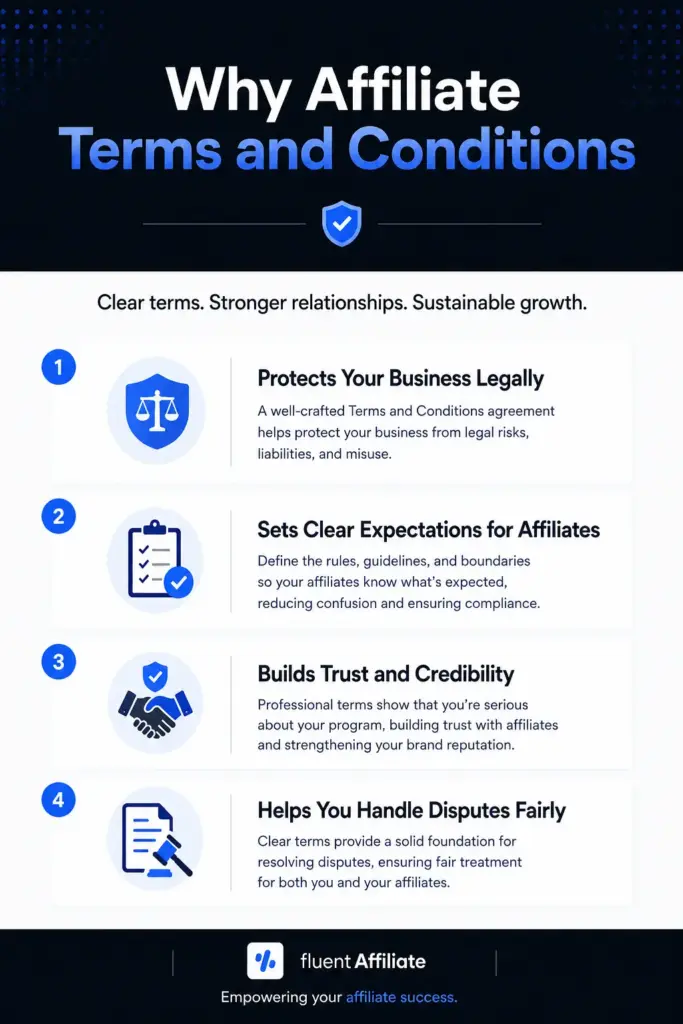
Protects Your Business Legally
A solid affiliate agreement is your first line of defense if a disagreement ever turns into a real legal issue. It defines the relationship clearly so affiliates cannot claim they are employees, contractors, or business partners. This separation matters for tax purposes, liability, and how you handle payouts.
If an affiliate uses shady marketing tactics or violates trademark rules, your terms give you the legal grounds to terminate their account and reverse any commissions earned through bad practices.
Sets Clear Expectations for Affiliates
Affiliates want to know what they are signing up for. When the rules are clear from day one, you avoid awkward conversations later. They will not be surprised when a commission gets reversed due to a refund, or when their account gets paused because they spammed their links on forums.
Clear expectations also mean affiliates feel more confident promoting your products. They know exactly how the program works and what they can earn.
Builds Trust and Credibility
A well-written terms page shows you take your program seriously. Serious affiliates (the kind who actually drive sales) want to work with professional brands. If your agreement looks thin or missing, they might assume your program is unreliable.
A polished terms page signals authority and tells potential partners that you have thought through the details.
Helps You Handle Disputes Fairly
Disputes happen. An affiliate might claim they did not get credit for a sale. Another might argue that their commission was reversed unfairly. With clear terms in place, you can point to the specific clause that applies and resolve the issue quickly without it turning into a personal argument.
This protects both you and your affiliates from misunderstandings.
Essential Clauses to Include in Your Affiliate Terms and Conditions
Now let us get into the meat of it. These are the core clauses every affiliate agreement should cover. You do not need to make this complicated, just thorough.
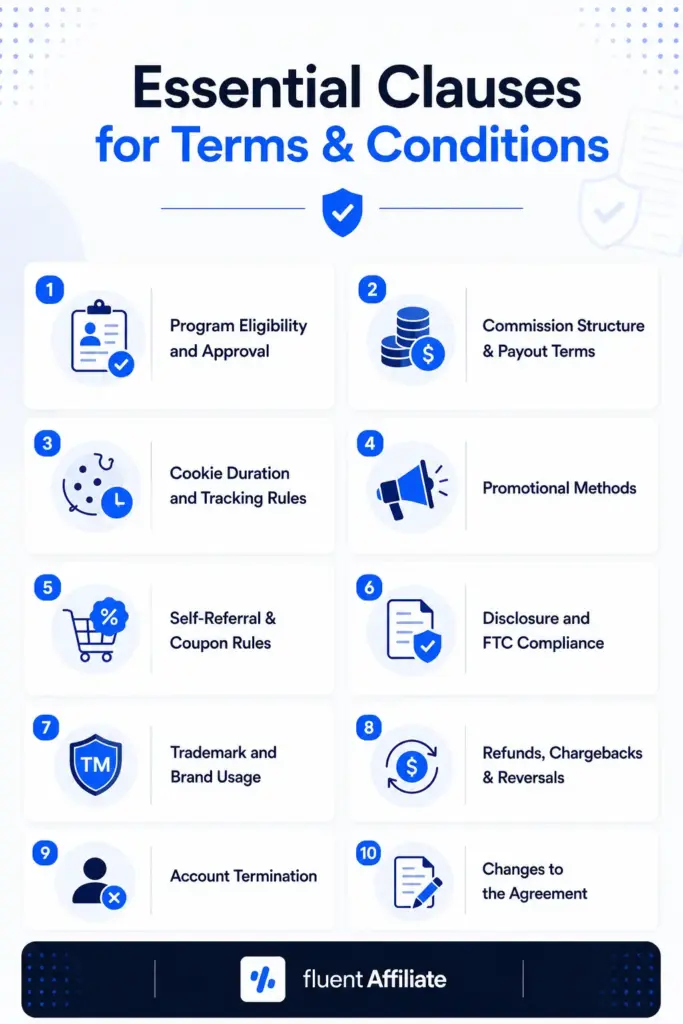
Program Eligibility and Approval
Spell out who can apply to your program and how the approval process works. Mention things like:
- Age requirements (usually 18 or older)
- Country restrictions if any
- Whether approval is automatic or manual
- What kinds of websites or platforms you accept
For example, you might say only website owners with active content related to your niche can join. Or you might accept anyone but reserve the right to reject low-quality applications.
Commission Structure and Payout Terms
This is the section affiliates will read most carefully. Be crystal clear about:
- The commission rate (percentage or flat amount)
- Whether different products have different rates
- The minimum payout threshold
- The payout schedule (monthly, quarterly, on request)
- The payment methods you support (PayPal, bank transfer, etc.)
- How long it takes for commissions to become payable
For instance, you might say commissions are paid monthly via PayPal once an affiliate earns at least $50. You can also mention any waiting periods, like commissions becoming payable 30 days after the sale, to account for refunds.
Cookie Duration and Tracking Rules
Explain how your tracking works. Most affiliate programs use cookies to credit the right affiliate when a sale happens. Mention:
- The cookie duration (for example, 30 days or 60 days)
- Whether the first or last affiliate gets credit
- What happens if the customer clears their cookies
This helps affiliates understand exactly how they earn and removes confusion later.
Promotional Methods (Allowed and Prohibited)
This part is huge. You need to tell affiliates what they can and cannot do when promoting your brand.
Allowed methods usually include:
- Blog content and reviews
- Social media posts
- Email marketing to their own list
- YouTube videos and podcasts
- Paid ads (with your approval)
Prohibited methods often include:
- Spam emails to purchased lists
- Bidding on your branded keywords in Google Ads
- Misleading claims about your product
- Coupon stacking or fake discount codes
- Using copyrighted content without permission
- Creating fake reviews
If you do not list these clearly, affiliates might assume anything goes. And that can hurt your brand reputation fast.
Self-Referral and Coupon Stacking Rules
Some affiliates try to game the system by buying your products through their own referral links to earn commission on their own purchases. Others use coupon-stacking sites to insert their codes at the last second on someone else’s sale.
Both are common issues. Decide your policy and write it into your terms. Most programs ban self-referrals and require affiliates to drive genuine traffic.
The good news is that with FluentAffiliate, you can disable self-referrals directly inside your referral settings so the rule is enforced automatically.
Disclosure and FTC Compliance
If you have affiliates in the United States, they are legally required to disclose their relationship with your brand under FTC guidelines. Many other countries have similar rules.
Add a clause that requires affiliates to clearly disclose their affiliate relationship in any content they create. A simple disclosure like “I may earn a commission if you buy through my link” usually does the trick.
Note that this is general guidance, not legal advice. A lawyer in your region can help you write a disclosure clause that fits your local laws.
Trademark and Brand Usage
Tell affiliates how they can (and cannot) use your brand assets. This includes:
- Your logo and brand name
- Product images
- Marketing copy and screenshots
- Tagline or slogan
Some programs let affiliates use approved banners and creatives only. Others allow more flexibility but ban modifications to the logo. Whatever your rule is, write it down.
With FluentAffiliate, you can actually give affiliates ready-made promotional assets through the Affiliate Creatives feature. This saves you from worrying about random brand misuse since affiliates can just grab approved banners, text links, and QR codes from their dashboard.
Refunds, Chargebacks, and Commission Reversals
This one is important. What happens if a customer asks for a refund after the affiliate has already earned commission?
Most programs reverse the commission in this case. Some hold commissions for a refund window (like 30 or 60 days) before paying them out. Whatever your approach is, make it clear.
Also, explain how chargebacks are handled. If a customer disputes a charge with their bank, the commission usually gets reversed, too.
Account Termination
Explain the conditions under which you can suspend or terminate an affiliate account. Common reasons include:
- Violating the terms of the agreement
- Using prohibited promotional methods
- Damaging your brand reputation
- Inactivity for an extended period
- Fraud or suspicious activity
Also, explain whether terminated affiliates lose pending commissions, and how they can appeal a termination if they think it was unfair.
Changes to the Agreement
Your business will evolve, and your terms might need updates too. Add a clause that explains:
- You reserve the right to update the terms
- How affiliates will be notified of changes (usually email)
- Whether continued participation counts as acceptance
This gives you flexibility without blindsiding your affiliates.
How to Write Your Affiliate Terms in Plain Language
Here is something most program owners get wrong. They copy a long, scary-looking legal template from another website and slap it on their page. The result? Nobody reads it.
Write your terms in plain English. Use short sentences. Skip the legalese where possible. Treat your affiliates like adults who deserve clear explanations.
For example, instead of writing:
“The Affiliate hereby acknowledges and agrees that any and all commissions earned in connection with the aforementioned program shall be subject to reversal in the event of customer-initiated refund requests.”
Just write:
“If a customer asks for a refund, the commission for that sale will be reversed.”
See the difference? Same meaning, much easier to understand. Clear writing is also better for SEO and helps your terms page rank for related searches.
That said, once you have a draft you are happy with, consider having a lawyer review it. Plain language is great, but legal accuracy still matters.
Common Mistakes to Avoid When Writing Affiliate Terms
A lot of new program owners make the same mistakes. Here are the ones to watch out for.
Copying terms from another website word for word. Every program is different. A SaaS company has different rules than a course creator or an ecommerce store. Use templates as inspiration, not as a final document.
Making the terms too vague. If your rules can be interpreted in five different ways, affiliates will pick whichever interpretation benefits them. Be specific about everything from commission rates to cookie durations.
Skipping the prohibited methods section. This one comes back to bite people fast. Without clear rules, affiliates will try everything from PPC bidding on your brand keywords to spammy email blasts. Spell out what is not allowed.
Forgetting about refunds and chargebacks. New program owners often forget this section, then get surprised when an affiliate disputes a reversed commission. Cover this from day one.
Not updating the terms regularly. Your business changes. New integrations, new products, new policies. Your terms should reflect that. Set a reminder to review them every 6 to 12 months.
Hiding the terms page. If affiliates have to dig through your site to find the agreement, you are setting yourself up for disputes. Link it directly from the registration form so they see it before signing up.
How to Set Up Affiliate Terms and Conditions in WordPress Using FluentAffiliate
Alright, now for the practical part. Let me walk you through how to actually set up affiliate terms and conditions inside WordPress using FluentAffiliate. The process is honestly pretty simple once you know where everything lives.
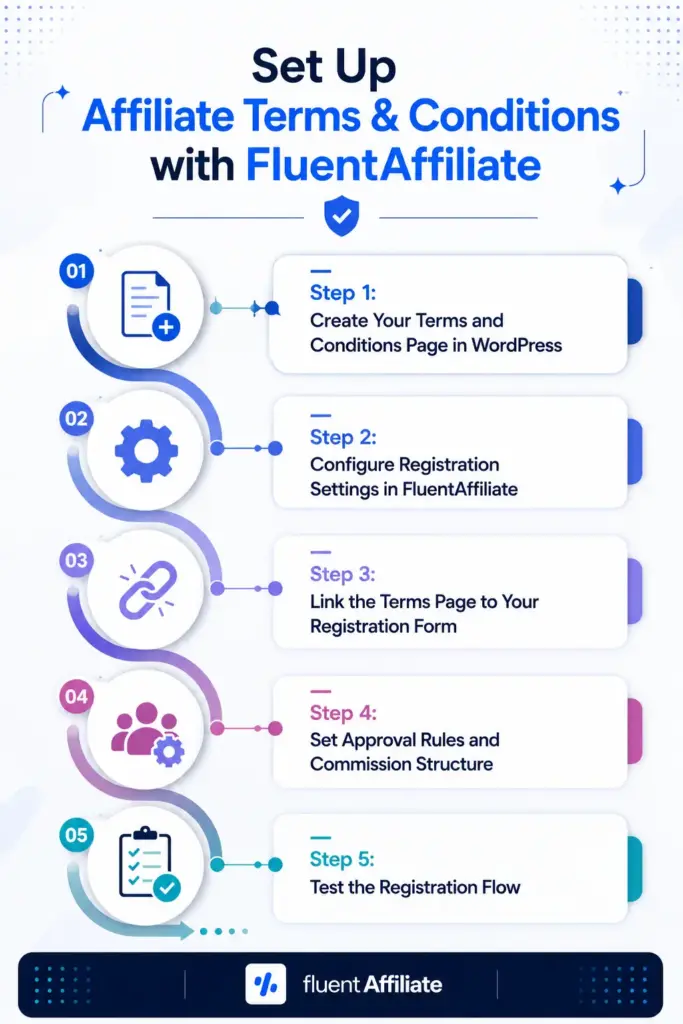
Step 1: Create Your Terms and Conditions Page in WordPress
Start by creating a dedicated page on your WordPress site for your affiliate terms.
- Go to your WordPress dashboard.
- Navigate to Pages, then click Add New.
- Give the page a clear title like “Affiliate Program Terms and Conditions” or “Affiliate Agreement”.
- Paste in your terms content using all the clauses we covered above.
- Set a clean URL slug like /affiliate-terms or /affiliate-agreement.
- Publish the page.
Keep the formatting clean. Use headings, short paragraphs, and bullet points where it helps readability. Avoid huge walls of text since most affiliates will skim before signing up.
Step 2: Configure Registration Settings in FluentAffiliate
Next, head over to FluentAffiliate to make sure your affiliate registration flow is ready.
- From your WordPress dashboard, go to FluentAffiliate, then Settings.
- Click on Registration Settings.
- Make sure Enable Affiliate Registration is turned on so new affiliates can sign up.
- Decide whether you want to require admin approval for new affiliates. If you want to screen applicants manually, enable this option. If you prefer hands-off automatic approval, leave it disabled.
For most programs, manual approval is the safer choice early on. It lets you review applications and make sure people understand the terms before joining.
Step 3: Link the Terms Page to Your Registration Form
Now you need to make sure new affiliates see and agree to your terms when they sign up. FluentAffiliate includes a terms agreement checkbox in the registration form by default.
According to the FluentAffiliate documentation, during the affiliate registration process, users must check a box confirming “I agree to the terms and conditions” before they can submit their application. This is exactly where your terms page comes in.
To link it properly, you can usually customize the registration field text or use the page slug in the agreement label. Check your registration field settings to make sure the link points to the terms page you just created.
If you are using a custom registration form built with Fluent Forms, you can also set it up to include a Terms checkbox tied to your dedicated page. The Fluent Forms integration gives you a lot of flexibility here.
Step 4: Set Approval Rules and Commission Structure
Once your terms are linked, set up the commission structure so it matches what your terms describe. Inconsistency between your terms page and your actual program settings is one of the fastest ways to create disputes.
- Go to FluentAffiliate, then Settings, then Referral Settings.
- Set your default commission rate. This can be a percentage or a flat amount.
- Choose your cookie duration so affiliates know how long their referral tracking lasts.
- Decide whether the first or last affiliate gets credit for a sale.
- Enable Disable Self Referral if your terms ban affiliates from earning on their own purchases.
- Set Exclude Shipping and Exclude Tax if your terms specify commissions are calculated on product price only.
Make sure every setting here matches what is written in your terms document. If your terms say 20 percent commission with 30-day cookies, that is exactly what should be configured in the settings.
Step 5: Test the Registration Flow
Before announcing your program, test the whole flow yourself.
- Open an incognito browser window.
- Go to your affiliate registration page.
- Try to register without checking the terms box. The form should block submission.
- Click the terms and conditions link. It should open your terms page in a new tab.
- Complete the registration. Then check your admin dashboard to see how the application appears.
If anything feels off, fix it before real affiliates sign up. A smooth, professional registration experience makes a huge first impression.

Get the Best Affiliate Plugin for WordPress
Real-World Examples of Affiliate Terms and Conditions
Let me show you what affiliate terms might look like in different business types. These are not full legal documents, just examples of how to think about the rules.
Example for a WooCommerce Store
A WooCommerce store selling physical products might include terms like:
- 10 percent commission on product price only (shipping and tax excluded)
- 30-day cookie window
- Commissions become payable 14 days after the order is delivered
- Refunds within 30 days reverse the commission
- Self-referrals not allowed
- No PPC bidding on the brand name
With FluentAffiliate’s WooCommerce integration, you can configure all these rules directly in your settings.
Example for a Course Creator
A course creator using TutorLMS, LifterLMS, or MemberPress might use terms like:
- 25 percent commission on initial course purchase
- 10 percent commission on subscription renewals (if applicable)
- 60-day cookie window
- Higher 40 percent rate for selected flagship courses
- Affiliates must disclose their relationship in any review video
- Banned: posting full course content or excessive spoilers
FluentAffiliate lets you set custom commission rates for specific courses, so flagship-product incentives are easy to implement.
Example for a Membership Site
A membership site using Paid Memberships Pro or MemberPress might use terms like:
- 20 percent commission on first-month membership fees
- 5 percent recurring commission for subscription renewals
- Higher rates for annual plans
- 90-day cookie window
- Commissions are paid monthly via PayPal once the affiliate earns at least $25
- Affiliates can promote on their own websites, email list, and social media only
These are just templates to spark ideas. Your actual terms should reflect your real business model and pricing.
Tips for Keeping Your Affiliate Terms Updated
Setting up your terms is not a one-and-done task. Markets change, integrations evolve, and your program will grow. Here are some practical tips to keep your terms relevant.
Review your terms every six to twelve months. Block out an hour twice a year to read through your agreement and check if anything is outdated.
Update your terms when you add new integrations. If you start using FluentAffiliate’s multi-domain management or roll out new product tiers, your terms should mention these.
Communicate changes clearly. When you update the terms, send an email to all active affiliates highlighting what changed and when the new version takes effect.
Keep a version history. Save older versions of your terms so you can refer back to what was active during a specific dispute. Some program owners include a “last updated” date at the top of the terms page.
Watch for new affiliate marketing regulations. FTC guidelines, GDPR, and other regional rules can affect what you need to include in your terms. Stay informed or work with a lawyer who tracks these changes.
Listen to your affiliates. If multiple affiliates keep asking the same question, that is a sign your terms need a clarity update.
Final Thoughts
Setting up affiliate terms and conditions might feel like the boring part of launching an affiliate program. But honestly, it is one of the most important steps. It protects your business, sets the tone for your partnerships, and shows affiliates that you run a serious operation.
The good news is that you do not need to be a lawyer to get this right. Start with the core clauses, write them in plain language, and match the rules to what you actually configure in your affiliate plugin.
If you are using WordPress, FluentAffiliate makes this whole process pretty easy. You can configure your registration settings, set custom commission rates, manage payouts, and link your terms page directly to the signup flow all from one dashboard.
Ready to set up your affiliate program the right way? Install FluentAffiliate, get your terms page in place, and start growing your affiliate network with confidence.
Frequently Asked Questions
Do I legally need affiliate terms and conditions for my program?
While the law does not always require a formal affiliate agreement, it is highly recommended. Terms and conditions protect your business legally, clarify expectations, and reduce disputes. Many regions also have specific affiliate disclosure laws (like the FTC in the United States) that you should address in your terms.
Can I copy affiliate terms from another website?
It is fine to use other programs’ terms as inspiration, but copying them word for word is risky. Every business has different rules, products, and commission structures. Plus, copyright laws may apply to legal documents. Always customize your terms to fit your actual program.
Where should I put my affiliate terms and conditions page?
Create a dedicated page on your WordPress site with a clean URL like /affiliate-terms. Then link to it directly from your affiliate registration form so new affiliates must acknowledge it before signing up. FluentAffiliate includes a built-in terms checkbox in the registration form for this exact purpose.
How often should I update my affiliate terms?
Review your terms every six to twelve months, or whenever you make major changes to your program (new commission rates, new integrations, new product lines). Notify your existing affiliates of any updates via email and add a “last updated” date at the top of the terms page.
What is the most important clause in an affiliate agreement?
Honestly, it depends on your business. But the most commonly disputed sections are commission structure, refund handling, and prohibited promotional methods. Make sure these three are crystal clear, specific, and match the actual settings in your affiliate plugin.
Can FluentAffiliate enforce my affiliate terms automatically?
FluentAffiliate cannot enforce every rule (like banning PPC bidding), but it can automate many policies. For example, you can disable self-referrals, set custom commission rates per product, control cookie duration, and require admin approval for new affiliates. The plugin handles enforcement of the technical rules while you manage the rest manually.
Do I need a lawyer to write my affiliate terms?
It is not mandatory, but it is a smart investment. You can draft the terms yourself using this guide, but having a lawyer review the final document ensures it complies with your local laws and protects your business properly. Think of it as insurance against expensive disputes down the road.






Add your first comment to this post