

The Complete Guide to E-Commerce Affiliate Marketing (2026)
You’ve probably heard affiliate marketing works for online stores. What nobody mentions is that the way you set it up decides how much of the profit you actually keep.
Pick the wrong tool, and you’ll hand over a slice of every sale for as long as the program runs.
This guide shows you how ecommerce affiliate marketing works, what it really costs, and how to launch one on WordPress without that leak.
Key Takeaways: Affiliate Commission Structure
- E-commerce affiliate marketing is a performance model where you pay partners a commission only after they drive a real sale, so your cost scales with revenue.
- Affiliate is now the third-largest performance channel behind paid search and paid social, with global spend hitting $19.4 billion in 2026.
- The three ways to run a program cost very differently: networks take a percentage cut, SaaS tools charge a percentage of affiliate revenue, and self-hosted WordPress plugins charge a flat fee.
- Typical e-commerce commission rates run 5 to 15 percent, but the right number depends on your margin, not an industry average.
- A 30-day cookie window is the common default, and shorter windows like 24 hours often scare good affiliates away.
- Branded coupon codes let influencers promote you without a clunky link, and the right affiliate still gets credited automatically.
- Running your program in-house on WordPress means you own the data, the payouts, and the affiliate relationships from day one.
What Is E-Commerce Affiliate Marketing?
E-commerce affiliate marketing is a performance-based strategy where an online store pays outside partners, called affiliates, a commission for each sale they bring in through their unique tracking link or coupon code.
That is the whole idea in one sentence. Now let me unpack it.
Think of it like hiring a salesperson who only gets paid when they actually sell something. An affiliate shares your product with their audience. Someone clicks the link, lands on your store, and buys. Your system records who sent that customer, and the affiliate earns a slice of the sale. No sale, no payout.
Affiliates come in many shapes. Some are bloggers who write reviews. Some are YouTubers and TikTok creators. Some are coupon and deal sites. And honestly, some of your best affiliates are your own happy customers who already love what you sell.
The reason this model fits e-commerce so well is simple. You are not gambling on ad spend and hoping for a return. You pay after the result happens. That flips the risk in your favor.

Starting From Scratch? Kickstart
with Affiliate Marketing 101 Guide!
Why E-Commerce Affiliate Marketing Works So Well
Let me back this up with real numbers, because the growth here is hard to ignore.
Global affiliate spend reached an estimated $19.4 billion in 2026, climbing from $17.1 billion in 2025, and it is on track for $22 billion by 2027 according to Forrester’s 2026 Affiliate Marketing Forecast. The same data shows affiliate is now the third-largest performance channel, sitting right behind paid search and paid social.
It gets better for stores specifically. Retail dominates affiliate spend, accounting for roughly 48 percent of total affiliate-driven sales according to Publift. And over 84 percent of brands now run an affiliate program of some kind.
So why does it work?
Here is the short version:
- You only pay for results. Your customer acquisition cost is tied directly to actual revenue, not clicks or impressions you hope convert.
- Affiliates bring warm traffic. When a trusted creator recommends you, their audience arrives already half-sold. That third-party endorsement does the convincing for you.
- You reach niches you could never buy your way into. A skincare blogger has spent years building an audience that trusts them on skincare. You get access to that trust the day they join.
- It scales with you. One affiliate or five hundred, the model is the same. You add partners over time without rebuilding anything.
There is even strong ROI data floating around. Some sources report businesses earning around $12 to $15 in revenue for every $1 spent on affiliate marketing, based on figures compiled by Marketing LTB. Treat those as ballpark, not promises, since they vary a lot by program. But the direction is clear.
Read More: Why Performance-Based Affiliate Marketing Drives Growth
The Real Cost: Networks vs SaaS vs Self-Hosted
Here is the part most guides skip. Before you pick a tool, you need to understand that the way you run your program changes how much it costs you, sometimes by thousands of dollars a year.
There are three paths.
Affiliate networks like ShareASale, CJ, or Impact connect you with a marketplace of affiliates. Convenient, but they usually charge a setup fee, a monthly fee, and an override, which is an extra percentage on top of every commission you pay. That override quietly eats your margin forever.
SaaS affiliate tools are hosted platforms you connect to your store. Many of them are priced based on a percentage of your affiliate-driven revenue, or on monthly affiliate volume. The more successful your program gets, the more you pay. As Rewardful itself points out in a piece on affiliate software transaction fees, some tools even add a cut on top, which they fairly describe as a tax on your own success.
Self-hosted plugins run on your own WordPress site. You pay a flat license fee, and that is it. Whether your affiliates drive $1,000 or $1 million, the software cost does not move. You also own all your data instead of renting access to it.
Here is the rough shape of it:
| Model | How you pay | What scales the cost | Who controls the data |
| Network | Setup + monthly + override % | Every sale, forever | The network |
| SaaS tool | Monthly fee, often % of affiliate revenue | Your program’s success | The platform |
| Self-hosted plugin | Flat annual license | Nothing, it stays flat | You |
None of these is automatically right. If you want a ready-made marketplace of affiliates and do not mind the override, a network can make sense. But if you already run your store on WordPress and want to keep your margins and your data, a self-hosted plugin like FluentAffiliate is usually the cheaper path as you grow. The math just works in your favor over time.
Explore more: Self-Hosted Affiliate Tracker for Your Business
How to Start an E-Commerce Affiliate Program on WordPress
Alright, let’s get practical. If your store runs on WordPress, you can launch a full program without sending a percentage of your revenue to anyone. Here is the flow.
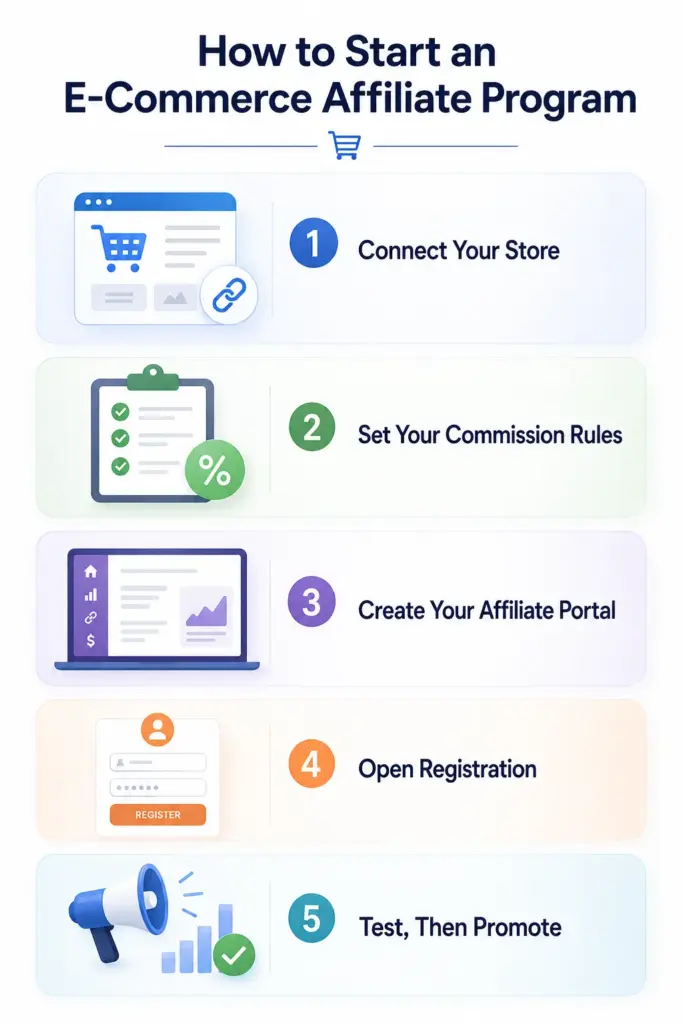
Step 1: Connect Your Store
First, your affiliate plugin needs to talk to whatever you use to sell. FluentAffiliate connects with the major WordPress e-commerce tools, including WooCommerce, Easy Digital Downloads, SureCart, and FluentCart.
During the onboarding setup, you simply check the boxes for the plugins you already use. That is what lets the system know when a real sale happens and who should get credit for it.
Step 2: Set Your Commission Rules
Next, you decide what affiliates earn. In your referral settings, you set a default rate that applies across the board. You choose whether it is a percentage of the sale or a flat amount per order.
For example, you might set 15 percent as your default. Sarah, one of your affiliates, drives a $100 order, so she earns $15. Clean and simple.
You can get more specific later with custom rates per product or category, but a single global rate is a perfectly good place to start.
Step 3: Create Your Affiliate Portal
Your affiliates need somewhere to log in, grab their links, and check their earnings. FluentAffiliate creates this for you. During setup, you pick or create a page, and the plugin drops in a shortcode that turns it into a full affiliate dashboard.
This is where partners will track their visits, referrals, and payouts on their own, which saves you a mountain of email questions.
Step 4: Open Registration
Now let people in. In your registration settings, you turn on the public signup form and decide whether new affiliates need your approval first.
Honestly, I would turn on manual approval at the start. It lets you screen out the spammy applicants and keep your program clean while it is small. You can always loosen up later once you trust the flow.
Step 5: Test, Then Promote
Before you announce anything, run a test. Generate an affiliate link, make a small purchase through it, and confirm the referral shows up in your dashboard. Once it tracks correctly, start inviting partners.
That’s the core setup. You can have this running in an afternoon.
Read In-depth: How to Set Up an Affiliate Program on WordPress (Step-by-Step Guide)
Setting Commission Rates That Actually Work
This is where store owners freeze up. How much should you pay?
The honest answer is that there is no magic number. Your commission rate has to fit your profit margin, not some chart you found online. A 20 percent commission is generous on a product with 60 percent margins and a disaster on one with 25 percent margins.
That said, benchmarks help you stay in the right neighborhood. Here is a rough guide pulled from commission ranges reported by LeadDyno and general 2026 industry data:
| E-commerce niche | Typical commission range |
| Fashion and apparel | 5 to 15 percent |
| Beauty and cosmetics | 5 to 12 percent |
| Health and wellness | 5 to 12 percent |
| Home, furniture, decor | 4 to 10 percent |
| Electronics | 2 to 8 percent |
| Digital products and courses | 20 to 40 percent |
Notice the spread. Electronics sit low because margins are thin. Digital products sit high because once they are made, each extra sale costs almost nothing to fulfill.
A few ways to structure it:
- Percentage of sale is the default and the easiest. It scales naturally with order value.
- Flat rate per sale works when all your products cost about the same. Ten dollars per order, no math.
- Tiered rates reward your best partners. An affiliate might earn 10 percent on their first 20 sales, then 15 percent after that.
Before you lock anything in, calculate your true margin first. Factor in product cost, shipping, payment processing, and returns. A commission that looks fine on paper can quietly turn a sale unprofitable if you skip that step.
If you want different rates for different products, FluentAffiliate lets you set custom rates per product or category inside each integration, and you can use affiliate groups to give certain partners their own rate tier.
Explore More: Affiliate Commission Structure: Choose the best model for your Business
Cookie Duration, Attribution, and Getting Credit Right
Quick scenario. Someone clicks your affiliate’s link on Monday but does not buy until Thursday. Does the affiliate still get paid?
That depends on your cookie duration. It is the window of time after a click during which a sale still counts for the affiliate. If your window is 30 days and the purchase lands on day three, the affiliate gets credit. If your window were 24 hours, they would get nothing, and they would be annoyed.
The common standard is 30 days. As LeadDyno notes in their e-commerce guide, cookie windows as short as 24 hours can discourage good affiliates from even signing up. People rarely buy the instant they click. They think about it. A reasonable window respects that.
In FluentAffiliate, you set your cookie duration in referral settings, in days. Thirty is a safe starting point.
There is one more attribution choice worth knowing. When two affiliates touch the same customer, who wins? You can credit either the first affiliate who referred them or the last affiliate before the sale. Most stores use last-click, but the choice is yours, and you set it in the same settings panel.
Explore In-depth: Cookie Duration in Affiliate Marketing: Find What, Why, and How
Recruiting the Right Affiliates for an Online Store
Here is a truth that surprises new program owners. Quality beats quantity, almost every time. A small group of well-matched affiliates usually drives most of your revenue, while a huge list of random signups mostly drives noise.
So where do good affiliates come from?
- Your own customers. People who already bought and loved your product are your warmest recruits. Add an invite to your post-purchase emails.
- Niche bloggers and content creators. Search for people already writing about your category. A personalized message about why you fit their audience goes a long way.
- Influencers and creators. Micro-influencers with small but engaged followings often outperform big names on conversions.
- Review and comparison sites. These capture buyers who are already deciding between options.
- Coupon and deal platforms. These grab demand right at the finish line, though watch your margins with them.
A balanced mix is healthier than betting everything on one type. Content creators tend to bring higher-value, longer-term customers, while coupon sites tend to capture people who were close to buying anyway.
When you bring people in, make onboarding clear. Tell them the commission, the cookie window, the payout schedule, and what they can and cannot do. Clear terms upfront prevent disputes later.
Learn More: How to Recruit Affiliates for Your Business
Giving Affiliates What They Need to Sell
Even a motivated affiliate underperforms with nothing to work with. Your job is to make promoting you effortless.
FluentAffiliate has a feature for exactly this called affiliate creatives. Think of it as a shared toolbox. You upload banners, images, text links, and QR codes once, and every affiliate can grab them from their dashboard with their tracking link already baked in. You add the asset; the system handles the credit.
You can make creatives public to everyone or private to specific affiliates or groups, which is handy for exclusive campaigns. You can even schedule them to turn on and off automatically, so a holiday banner appears and disappears on its own.
Then there is the feature I think too many stores overlook: branded coupon codes.
Instead of asking an influencer to share a long tracking URL, you give them a clean code like SARAH20. Their audience gets a discount, the influencer looks generous, and FluentAffiliate automatically credits the right affiliate when the code is used at checkout. This works with WooCommerce, Easy Digital Downloads, and FluentCart.
For your very best partners, you can go a step further with custom landing pages. A clean URL like yourstore.com/partner/sarah feels more trustworthy than a link full of question marks and numbers, and it still tracks perfectly.
Tracking, Payouts, and Keeping the Program Honest
Once sales start flowing, you need to see what is happening and pay people on time. Both build trust, and trust is what keeps affiliates loyal.
Your admin dashboard gives you the big picture at a glance: total paid, total unpaid, active affiliates, visits, referrals, conversion rate, and total order value from referrals. The managing referrals section lets you review every individual sale, approve or reject it, and filter by status.
This approval step matters. It is your defense against fraud and returns. Before a referral gets paid, you can confirm the sale was real and stuck. If someone refunds an order, you reject that referral so you are not paying commission on revenue you no longer have.
When it is time to pay, head to payout management. One important thing to understand: FluentAffiliate records and tracks payouts but does not push money through a gateway itself. It generates a clean report of who is owed what, and you send the actual payments using the PayPal or bank details in each affiliate’s profile. You can export the whole thing as a CSV for your records.
Want to delegate this? Permission management lets you appoint a team member as a manager with access to only the parts you choose, without handing over full admin keys to your site.
Common Mistakes That Kill E-Commerce Affiliate Programs
I will keep this blunt because avoiding these saves you real pain.
- Setting commissions before knowing your margin. This is the big one. A rate that ignores your true costs can make every affiliate sale a small loss.
- A cookie window that is too short. Twenty-four hours feels safe but quietly drives away the good affiliates who know better.
- Recruiting everyone. A pile of low-quality signups creates work and fraud risk without revenue. Vet people.
- Going silent after signup. Affiliates forget you exist if you never talk to them. Share new products, promotions, and seasonal campaigns.
- Paying late or paying wrong. Nothing burns affiliate trust faster. Approve referrals promptly and stick to a payout schedule.
- No clear terms. Vague rules lead to disputes about brand bidding, coupon abuse, and traffic sources. Write it down before you launch.
Get these right and you are already ahead of most programs out there.
Final Thoughts
E-commerce affiliate marketing is one of the few growth channels where you pay only after the result shows up. That alone makes it worth your time. But the way you run it decides how much of the upside you actually keep.
Networks and percentage-based SaaS tools work, yet they keep taking a bite as you grow. If your store already lives on WordPress, running your program in-house lets you own the data, the payouts, and the relationships while keeping your software cost flat.
Ready to launch your own program? FluentAffiliate connects with WooCommerce, Easy Digital Downloads, SureCart, and FluentCart, and you can have it tracking sales in an afternoon. Start small, recruit a few good partners, and let the channel grow with you.
Frequently Asked Questions
What is e-commerce affiliate marketing in simple terms?
It is a setup where your online store pays outside partners a commission only when they drive an actual sale through their tracking link or coupon code. You pay for results, not for ad clicks.
How much commission should an e-commerce store pay affiliates?
Most e-commerce programs pay between 5 and 15 percent, though digital products often pay 20 to 40 percent. The right rate depends on your profit margin, not the industry average, so calculate your true costs first.
Do I need an affiliate network to start a program?
No. If your store runs on WordPress, you can run an in-house program with a self-hosted plugin and avoid the override fees and revenue cuts that networks and many SaaS tools charge.
What is a good cookie duration for an e-commerce affiliate program?
Thirty days is the common standard. Windows as short as 24 hours tend to discourage affiliates because most customers do not buy the moment they click.
Can influencers use coupon codes instead of links?
Yes. With branded coupon codes, an influencer shares a simple code, their audience gets a discount, and the system automatically credits the right affiliate when the code is used at checkout.
How do affiliate payouts work in FluentAffiliate?
FluentAffiliate tracks and records who is owed what and generates an exportable report, but you send the actual payments manually using each affiliate’s PayPal or bank details. It does not move money through a gateway on its own.


Add your first comment to this post