
Affiliate Attribution Models Explained (For WordPress Owners)
You read a few articles about affiliate attribution, and now you feel confused. They talk about linear models, time-decay, algorithmic credit splitting, and thousands of monthly conversions feeding a machine learning model.
Then you open your own affiliate plugin and see two options: first affiliate or last affiliate.
Yeah, that gap is confusing, and this guide exists to close it.
Key Takeaways: Affiliate Attribution Models
- FluentAffiliate supports two attribution models: credit to the First Affiliate or credit to the Last Affiliate, set once in Referral Settings.
- Most self-hosted WordPress affiliate programs do not have the transaction volume that multi-touch or algorithmic attribution needs to work reliably.
- Last-click attribution is the industry default and the easiest to explain to affiliates, though it can undervalue content creators who introduce the sale early.
- First-click attribution rewards discovery-focused affiliates like bloggers and reviewers, which fits content-heavy WordPress programs well.
- Cookie duration, commonly 30 days, works alongside your attribution model to define how long a click stays eligible for credit.
- Disabling self-referral and writing clear program rules prevent more disputes than any advanced attribution model would.
- You can only run one program-wide model in FluentAffiliate, so pick it based on your dominant affiliate type, not a theoretical mix you do not actually have.
What Is Affiliate Attribution
Affiliate attribution is the rule that decides which affiliate gets paid when a customer clicks more than one affiliate link before buying. In simple terms, it answers one question: if two affiliates both touched the same sale, who gets the commission?
Every affiliate program needs some form of attribution, even a small one. If your affiliate program only ever sees one affiliate link per customer, attribution barely matters.
But the moment a customer clicks affiliate A’s link on Monday, forgets about it, then clicks affiliate B’s link on Friday and buys, something has to decide who earns the commission. That something is your attribution model.
Why Attribution Models Matter for a WordPress Affiliate Program
Attribution is not really about tracking technology. It is about fairness and trust. Affiliates talk to each other.
If two affiliates compare notes and realize the program paid the “wrong” one for a sale they both worked on, you get a support ticket, a complaint in your Facebook group, or worse, an affiliate who quietly stops promoting you.
For a WordPress site owner running your own affiliate program instead of renting space on Amazon Associates or ShareASale, this matters even more.
You do not have a huge affiliate management team smoothing over disputes. You are probably the one answering the email. A clear, documented attribution rule means fewer of those emails in the first place.
The good news is you do not need a complicated system to get this right. You need one rule, applied consistently, and explained clearly to your affiliates before they join.
The Six Attribution Models You Will See Mentioned
If you search around, you will run into six models over and over. It helps to know what they mean, even the ones that will not apply to your setup, because affiliates coming from bigger networks may ask about them.
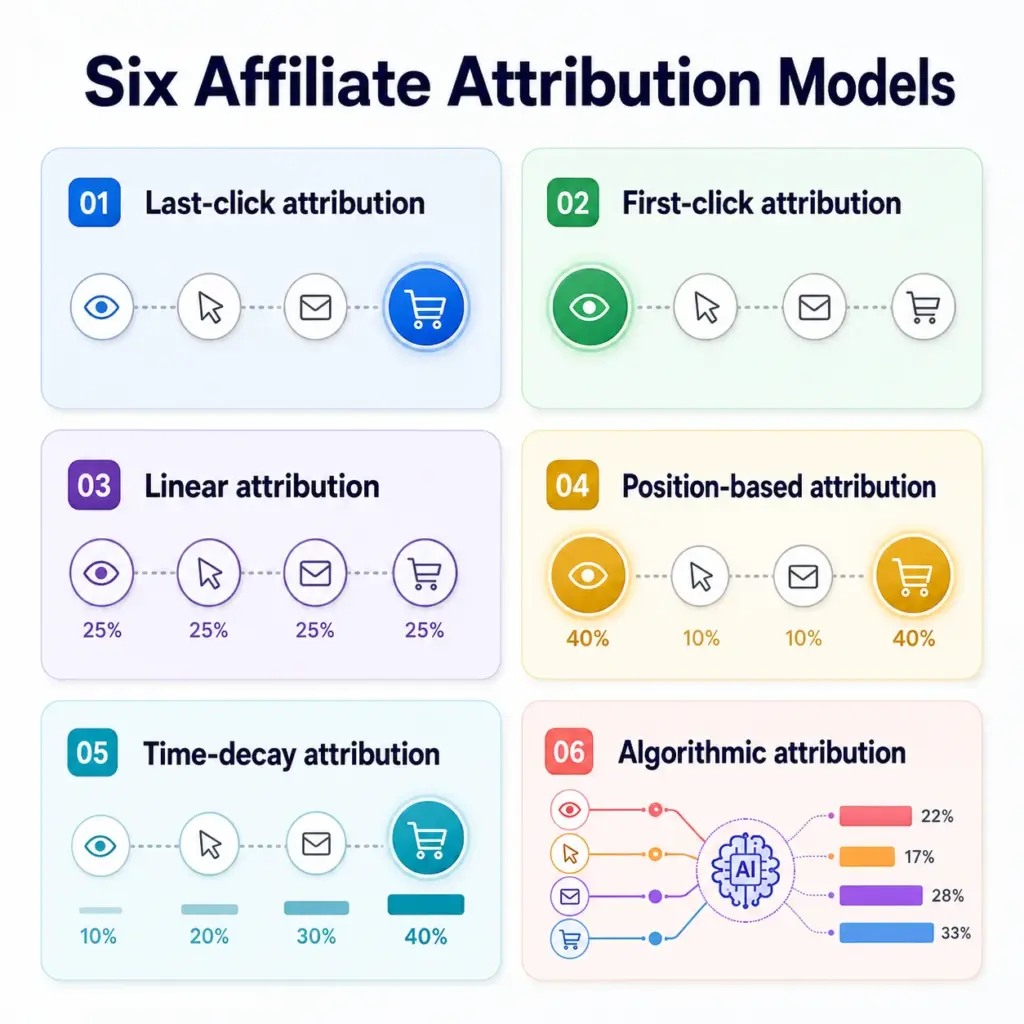
- Last-click attribution gives full credit to whichever affiliate link the customer clicked last before buying. It is the oldest, simplest, and still the most common model across the industry.
- First-click attribution gives full credit to the first affiliate link the customer ever clicked, even if they clicked five more links from other affiliates afterward.
- Linear attribution splits credit equally across every affiliate touchpoint in the customer’s journey. If three affiliates touched a sale, each gets a third.
- Position-based attribution (sometimes called U-shaped) gives a heavier share to the first and last touch, with a smaller amount split among whatever happened in between.
- Time-decay attribution gives more credit to touches that happened closer to the sale and less credit to touches further back in time.
- Algorithmic or data-driven attribution uses machine learning on historical conversion data to work out how much credit each touchpoint actually deserves, instead of applying a fixed rule.
That last one needs real scale to work. impact.com’s own guidance puts the minimum at several thousand conversions a month before an algorithmic model has enough data to be trustworthy.
Most WordPress affiliate programs, even healthy ones, are nowhere near that volume, and honestly, most never need to be.
What FluentAffiliate Actually Supports: First Affiliate vs Last Affiliate
Let’s cut through the theory. FluentAffiliate, like most self-hosted WordPress affiliate plugins, offers two attribution options under Referral Settings, in the Credit field: you can credit the First Affiliate or the Last Affiliate.
That’s it. There is no linear split, no position-based weighting, no algorithmic model built into the plugin.
This is not a limitation to apologize for. It is the right level of complexity for a program that is not processing thousands of conversions a month and does not have a dedicated data team to interpret a black-box credit split.
A rule your affiliates can understand in one sentence beats a sophisticated model nobody in your program can explain, including you.
Here’s what each option actually does inside FluentAffiliate:
First Affiliate credits whichever affiliate’s cookie was set first, for as long as that cookie stays valid based on your Cookie Duration setting. If someone clicks affiliate A’s link on day one and affiliate B’s link on day ten, and both cookies are still active, affiliate A gets the commission when the sale happens.
Last Affiliate credits whichever affiliate’s cookie was set most recently. In the same scenario, affiliate B would get the commission because their click came last, overwriting affiliate A’s earlier cookie.
You set this once, program-wide, at FluentAffiliate > Settings > Referral Settings, under Tracking & Credit Rules.
First Affiliate or Last Affiliate: How to Decide
This is the actual decision you need to make, so let’s work through it practically instead of abstractly.
Choose Last Affiliate
If most of your affiliates are doing similar work, like coupon sites, deal roundups, or general promotion where the final push toward checkout matters most.
Last-click is also simply easier to explain. New affiliates understand “whoever sent the customer right before they bought gets the sale” almost instantly.
Choose First Affiliate
If your program leans heavily on content creators, bloggers, YouTubers, or course instructors who introduce your product through in-depth reviews, tutorials, or comparisons.
These affiliates do the hard work of building trust early in the journey, and a last-click model can quietly hand their commissions to whoever happened to link the same product later, even a coupon extension the customer installed without thinking about it.
A quick gut check
Think about your last ten affiliate-driven sales. Did most customers click one affiliate link and buy right away?
Last Affiliate is fine, and honestly the simpler default. Did several sales come from someone reading a detailed blog review days before they eventually bought through a different link? First Affiliate probably protects your best-performing content partners better.
One more thing worth saying plainly: whichever you pick, put it in writing on your affiliate terms page. Affiliates should not have to guess or find out the hard way after a dispute.
Why Multi-Touch and Algorithmic Attribution Usually Do Not Fit Self-Hosted Programs
It is worth being honest about why the fancier models you read about on enterprise platforms are not just “missing” from FluentAffiliate, but genuinely not a good fit for most WordPress-based programs.
Multi-touch and algorithmic attribution exist to solve a problem that mostly shows up at scale: a large, mixed roster of creators, content publishers, coupon sites, and ad networks all touching the same customer journeys, with enough volume to make statistical credit-splitting meaningful.
Interestingly, even at that scale, the tools built for it acknowledge the tradeoff.
impact.com’s own research found that 94 percent of brands using these advanced platforms are actively reconsidering their attribution setup, because sophistication brought its own headaches around transparency and partner trust.
At the other end, a well-known EMARKETER and Snap survey of 282 senior US marketers found that 78.4 percent still default to last-click attribution and basic web analytics, even while only 21.5 percent are confident it reflects long-term impact accurately.
Read that again: even brands with enterprise budgets mostly stick with the simple model, because it is workable and explainable, not because it is theoretically perfect.
If large advertisers with dedicated analytics teams are still leaning on simple attribution most of the time, a WooCommerce store or course site with a few dozen affiliates does not need to feel behind for using First Affiliate or Last Affiliate.
You are using the same practical logic the majority of the industry actually runs on day to day.
Save the algorithmic model conversation for the day your program is processing thousands of referrals a month, and even then, weigh whether the added complexity actually earns you anything over a well-run single-touch rule.
Cookie Duration: The Setting That Works Alongside Your Attribution Model
Your attribution model decides who wins when two affiliates both touch a sale. Cookie Duration decides how long an affiliate’s click even stays in the running. The two settings work together, and getting one wrong undercuts the other.
FluentAffiliate lets you set Cookie Duration in days under Referral Settings, with a typical example being 30 days.
Here is why the number matters more than people expect.
If your cookie window is too short, say three days, and your product has a longer buying cycle, like an online course someone thinks about for two weeks before enrolling, you will quietly lose attribution on legitimate referrals simply because the cookie expired before the sale happened.
Neither First Affiliate nor Last Affiliate can credit a click that already fell out of the window.
If your window is too long, say 90 days, you risk the opposite problem: an affiliate gets credit for a sale that happened so long after their click that their actual influence on the purchase decision is questionable.
A reasonable starting point is to match your cookie duration to how long people typically take to decide. Impulse purchases and low-cost products can run shorter windows, 14 to 30 days. Higher-consideration purchases like courses, memberships, or software subscriptions often justify 30 to 60 days.
There is no universal correct number here, only a number that matches your actual buying behavior.
Setting Up Your Attribution Model in FluentAffiliate
Getting this configured takes about two minutes once you know what you are looking for.
- From your WordPress dashboard, go to FluentAffiliate > Settings > Referral Settings.
- Scroll to the Tracking & Credit Rules section.
- Find the Credit field and choose either First Affiliate or Last Affiliate based on the decision guide above.
- In the same section, set your Cookie Duration in days, matched to your typical buying cycle.
- While you are there, consider enabling Disable Self Referral, which prevents affiliates from earning commission on their own purchases, a common and avoidable source of disputes.
- Click Save Settings to apply the changes.
Because this is a program-wide setting, it applies to every affiliate the same way. There is no per-affiliate override, which is exactly the kind of simplicity that keeps the rule easy to explain and easy to defend if anyone questions a payout.
A Practical Example: Same Sale, Two Different Outcomes
Let’s walk through one scenario so the difference stops feeling abstract.
Say you run a WooCommerce store selling a $200 course bundle. On Monday, an affiliate named Sarah publishes a detailed review comparing your course to two competitors. A reader clicks her link, gets curious, but does not buy that day.
On Thursday, the same reader sees a short mention of your course in a Facebook group, posted by a different affiliate, Marcus, who simply dropped his link with no real context. The reader clicks Marcus’s link out of habit and completes the purchase that afternoon.
Under Last Affiliate, Marcus gets the full commission, even though Sarah did the actual work of convincing the customer. Under First Affiliate, Sarah gets the commission, recognizing that her content is what moved the customer toward buying in the first place.
Neither outcome is objectively wrong. It depends entirely on what you want to reward. If your program leans on affiliates like Sarah, people who write real reviews, build comparison content, or record walkthroughs, First Affiliate protects the incentive to keep doing that work.
If your program is closer to a network of quick-share promoters like Marcus, Last Affiliate rewards the behavior that actually drives most of your sales.
This is also why documenting your rule matters so much. If Sarah finds out after the fact that Marcus got paid for a sale she clearly influenced, and there was never a stated rule, that conversation gets awkward fast.
If she knew going in that your program runs on Last Affiliate credit, she can decide for herself whether that arrangement still makes sense for her.
Common Attribution Mistakes WordPress Program Owners Make
A few patterns show up again and again in self-hosted affiliate programs, and most of them have nothing to do with which model you picked.
Not documenting the rule anywhere. Affiliates should be able to find your Credit setting and Cookie Duration written in plain language on a terms page, not have to ask support or guess.
Setting the cookie window without thinking about the buying cycle. Copying a competitor’s 30-day default without checking whether your own customers actually take that long to decide.
Switching models mid-program. Changing from Last Affiliate to First Affiliate after affiliates have already built expectations around the old rule creates confusion and, sometimes, disputes over sales made during the transition.
Forgetting self-referral protection. Without it enabled, some affiliates will buy through their own link, whether out of curiosity or intent, and you will end up manually reversing commissions later.
Assuming the model fixes underlying tracking problems. If your cookies are not firing correctly because of a caching plugin or a broken integration, no attribution model will fix that. Check your tracking works before worrying about which affiliate gets the credit.
Not checking the Visits log when a dispute comes up. If an affiliate questions why they were not credited for a sale, FluentAffiliate’s Visits page shows the click history, including which URL the visitor landed on and the referrer. That log is usually enough to settle the question without guesswork on either side.
How to Explain Your Attribution Model to Affiliates
The best attribution model in the world does nothing if affiliates do not know it exists.
A short, plain paragraph on your program terms page solves most future disputes before they happen.
Something like: “Commissions are credited to the [first/last] affiliate whose link the customer clicked, within [X] days of that click.”
That single sentence, visible before someone joins your program, sets expectations correctly from day one.
It also helps to mention it during onboarding, whether that’s an automated welcome email or a quick note when you approve a new affiliate. Affiliates who understand the rule upfront rarely dispute it later. Affiliates who find out about it only after losing a commission almost always do.
Conclusion
Attribution does not have to be complicated to be fair. FluentAffiliate gives you First Affiliate or Last Affiliate credit, paired with a cookie duration you control, and for the overwhelming majority of WordPress affiliate programs, that combination covers everything you actually need.
Pick the model that matches how your affiliates really work, set a cookie window that matches your buying cycle, write the rule down where affiliates can see it, and move on to growing your program instead of chasing enterprise features you do not need yet.
Ready to configure this properly? Head to FluentAffiliate > Settings > Referral Settings and set your Credit rule and Cookie Duration today. If you are still evaluating a plugin for your affiliate program, FluentAffiliate gives you this attribution control without the enterprise price tag or the learning curve.
FAQs
What is affiliate attribution?
Affiliate attribution is the rule that decides which affiliate receives credit for a commission when a customer interacts with more than one affiliate link before making a purchase.
What is the difference between first-click and last-click attribution?
First-click attribution credits the affiliate whose link the customer clicked first, while last-click attribution credits the affiliate whose link the customer clicked most recently before buying.
Does FluentAffiliate support multi-touch attribution?
No. FluentAffiliate supports single-touch attribution only, letting you credit either the First Affiliate or the Last Affiliate, program-wide, under Referral Settings.
What cookie duration should I use for affiliate tracking?
A common starting point is 30 days, though shorter windows of 14 to 30 days suit impulse purchases and longer windows of 30 to 60 days suit higher-consideration products like courses or subscriptions.
Can I change my attribution model after affiliates have joined?
Yes, you can change the Credit setting at any time in Referral Settings, but switching models after affiliates have built expectations around the old rule can create confusion, so document any change clearly.
Is last-click attribution unfair to affiliates?
It can undervalue affiliates who introduce customers early in the buying journey, such as content creators and bloggers, since it only rewards whoever sent the final click before purchase.
Do I need algorithmic attribution for a small affiliate program?
No. Algorithmic attribution typically needs several thousand conversions a month to produce reliable results, a volume most self-hosted WordPress affiliate programs do not reach or need.





Add your first comment to this post