

Best Affiliate Marketing Solution for Ecommerce (2026)

Here is a quiet way money leaks out of an ecommerce store. You sign up for a hosted affiliate app, pay a monthly fee, then hand over a percentage of the very affiliate revenue the app is supposed to grow.
Meanwhile, your customer and sales data live on someone else’s server. This guide breaks down what the best affiliate marketing solution for ecommerce actually means, the three types you can pick from, and how to choose based on where your store lives.
Key Takeaways: Affiliate Marketing Solution for Ecommerce
- The best affiliate marketing solution for ecommerce is the one that integrates natively with your store platform and fits how you want to own data and pay.
- Affiliate solutions fall into three buckets: networks, hosted SaaS apps, and self-hosted plugins.
- Hosted apps often charge a monthly fee plus a cut of affiliate sales, which quietly raises your cost as you grow.
- Self-hosted WordPress plugins keep your affiliate data and payouts inside your own site.
- Coupon code attribution matters as much as link tracking when you work with influencers.
- For WooCommerce, EDD, SureCart, or FluentCart stores, a self-hosted plugin like FluentAffiliate is usually the cleanest fit.
- Match the solution to your platform and stage first, then worry about extra features.
What Counts As The Best Affiliate Marketing Solution for Ecommerce
The best affiliate marketing solution for ecommerce is the tool that connects directly to your store platform, tracks every sale to the right affiliate automatically, and gives you full control over commissions and payouts without charging you a slice of your own revenue.
That definition matters because “best” is not a single product. It depends on where your store actually lives. A Shopify seller, a WooCommerce store owner, and a brand listing on a marketplace all have different needs. The wrong choice means missed commissions, frustrated affiliates, or paying for features you will never touch.
So instead of crowning one winner, this guide sorts the options by type, shows who each one fits, and helps you land on the right answer for your store.
Why Ecommerce Stores Run Affiliate Programs At All
Affiliate marketing has stopped being a side channel. Within the United States alone, total affiliate marketing spending is projected to reach nearly $12 billion in 2025, an 11.9% rise from the previous year (Post Affiliate Pro).
For ecommerce specifically, the channel pulls real weight. In the U.S., affiliate channels account for around 16% of all e-commerce orders (Business Research Insights). That is roughly one in six orders attributed to a partner instead of a paid ad.
The appeal is simple.
You only pay when a sale happens. Affiliate programs deliver an average ROI of $12 to $15 for every $1 spent (Post Affiliate Pro). Compare that to ad spend where you pay for clicks that may never convert.
Adoption backs this up.
Over 90% of ecommerce businesses are expected to leverage affiliate marketing by 2026, and 80% of brands already run affiliate programs (Post Affiliate Pro). If most of your competitors are doing it, the question is not whether to run a program. It is what to run it on.
The Three Types of Ecommerce Affiliate Solutions
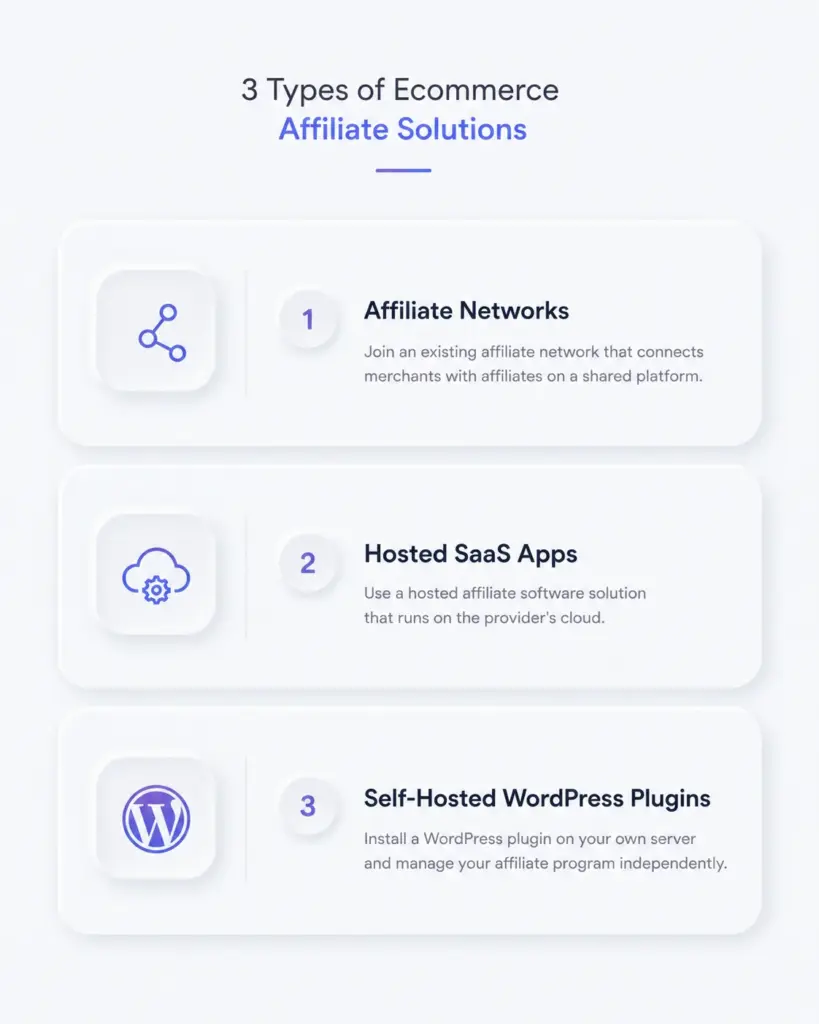
Almost every option you will find online fits into one of three buckets. Understanding the buckets is more useful than memorizing brand names, because the trade-offs are baked into the model, not the logo.
Affiliate Networks
Networks like ShareASale and Rakuten Advertising are marketplaces. You list your program, and their pool of existing affiliates can discover and apply to promote you. The big draw is access. You tap into thousands of publishers without building a network from scratch.
The catch is cost and control. Networks usually charge setup fees, ongoing fees, and a commission override on top of what you pay affiliates. Your program also lives inside their ecosystem, which means you follow their rules and your data sits with them.
Networks fit established brands that want reach fast and have the margin to pay for it. For a bootstrapped store, the fees can eat the savings affiliate marketing is supposed to deliver.
Also Read: Affiliate Network vs Affiliate Program: Differences Explained
Hosted SaaS Apps
Hosted apps like Refersion and UpPromote are software you rent monthly. They plug into your store, handle tracking, give affiliates a dashboard, and automate a lot of the busywork. Setup is usually quick, and the interfaces are clean.
The trade-off is the pricing model. Many hosted apps charge a monthly subscription, and some add a percentage of affiliate-driven revenue once you cross a threshold. So the more successful your program gets, the more the tool costs. Your affiliate and customer data also lives on the vendor’s servers, not yours.
Hosted apps fit stores that want speed and do not mind paying a recurring fee that scales with success. They are especially common in the Shopify world.
Self-Hosted WordPress Plugins
A self-hosted plugin installs directly on your WordPress site. The tracking, the affiliate records, the commission rules, and the payout logs all live in your own database. There is no per-sale revenue cut going to a third party, and your data never leaves your server.
The trade-off is that you own the maintenance. You handle updates and hosting like any other plugin, and you usually send payouts yourself rather than relying on a gateway built into a network.
Self-hosted plugins fit WordPress store owners who want control, predictable cost, and data ownership. If your store already runs on WooCommerce, EDD, SureCart, or FluentCart, this is often the most natural home for your program.
Explore More: Self-Hosted Affiliate Tracker for Your Business
A Quick Comparison
| Factor | Affiliate Network | Hosted SaaS App | Self-Hosted Plugin |
| Where data lives | Network servers | Vendor servers | Your own site |
| Typical cost model | Fees plus commission override | Monthly fee, sometimes plus revenue share | One-time or annual license |
| Built-in affiliate pool | Yes | Sometimes | No |
| Cost as you scale | Rises | Often rises | Stays predictable |
| Setup speed | Slower, approval based | Fast | Fast |
| Best for | Established brands wanting reach | Stores wanting speed | WordPress owners wanting control |
Features That Actually Matter for an Ecommerce Program
Once you know which bucket you are in, the next step is checking for the features that genuinely move the needle for a store. Plenty of tools list dozens of features. Only a handful change your results.
Native integration with your store platform is non-negotiable.
Your affiliate tool needs to read orders from WooCommerce, Easy Digital Downloads, SureCart, or whatever runs your checkout, then assign each sale to the right affiliate automatically. Manual tracking is where commissions go missing and trust breaks down.
Flexible commission rates let you reward partners fairly.
You might pay an influencer more than a coupon site, or set a higher rate on a new product to push it. Look for the ability to set rates by product or category, not just one flat number for everyone.
Coupon code attribution is the feature most store owners underrate.
Influencers love sharing a clean code more than a long link. The tool should let you assign a discount code to a specific affiliate so the sale credits them automatically when a customer uses it.
Recurring and subscription handling matters if you sell memberships or anything that renews.
Decide early whether affiliates earn on renewals or only the first sale, and make sure your tool can enforce that rule.
Cookie duration and self-referral controls protect your margins.
A longer cookie window gives affiliates fair credit for sales that take a few days. A self-referral block stops affiliates from buying through their own link just to pocket a commission.
Data ownership is easy to forget until you want to leave a platform.
If your affiliate history lives on a vendor’s server, migrating later can be painful. Owning your data keeps you free to move.
Payout control and reporting close the loop.
You need a clean record of who earned what, the ability to filter by date and status, and an export you can hand to your accountant.
Why WordPress Store Owners Should Look At A Self-Hosted Plugin
If your store runs on WordPress, you have an option the typical “best ecommerce affiliate” roundup skips over. You can run your entire program from inside your own site with a self-hosted plugin like FluentAffiliate. Here is why that fits an ecommerce owner well, told straight, including the parts that are not perfect.
- It connects to the platforms you already sell on.
FluentAffiliate integrates with WooCommerce, FluentCart, Easy Digital Downloads, and SureCart. When a sale happens through one of these, it can track the referral and assign commission without you touching a spreadsheet.
- It handles the commission flexibility ecommerce needs.
In the referral settings, you set a global rate, choose flat or percentage, and pick your currency. Then per integration you can set custom rates for specific products or categories. Say you sell a $40 t-shirt and a $400 jacket. You can pay 20% on the shirt and 8% on the jacket so a single rate does not wreck your margins.
- It does coupon codes the way influencers want.
For WooCommerce, EDD, and FluentCart, you can assign a branded coupon code to a specific affiliate. When a customer uses that code, the affiliate gets credited automatically. That is perfect for a creator who would rather share a code than a tracking link.
- Manages renewals and upgrades.
If you sell subscriptions through FluentCart, FluentAffiliate Pro can award commission on subscription renewals, and you can cap how many renewals an affiliate earns from. You can also disable referrals on upgrades so affiliates are paid for the first sale, not for an existing customer moving up a tier.
- Protects your margins.
You can set cookie duration in days, block self-referrals so affiliates cannot commission their own orders, and exclude shipping or tax from the commission calculation.
- Scales with structure.
You can sort partners into affiliate groups with their own rates, hand out ready-made banners and codes through affiliate creatives, and track every click in the visits log with UTM data.
- Keeps your data and your money in-house.
Your affiliate records, referrals, and payout history sit in your own WordPress database. There is a free core plugin on WordPress.org, with a Pro version for the ecommerce integrations, so the cost is a license rather than a slice of your sales.

Get the Best Affiliate Tracker for E-commerce!
How To Choose The Right Solution For Your Store
There is no universal winner, so run your store through a few simple filters. Honestly, this is faster than reading twenty tool reviews.
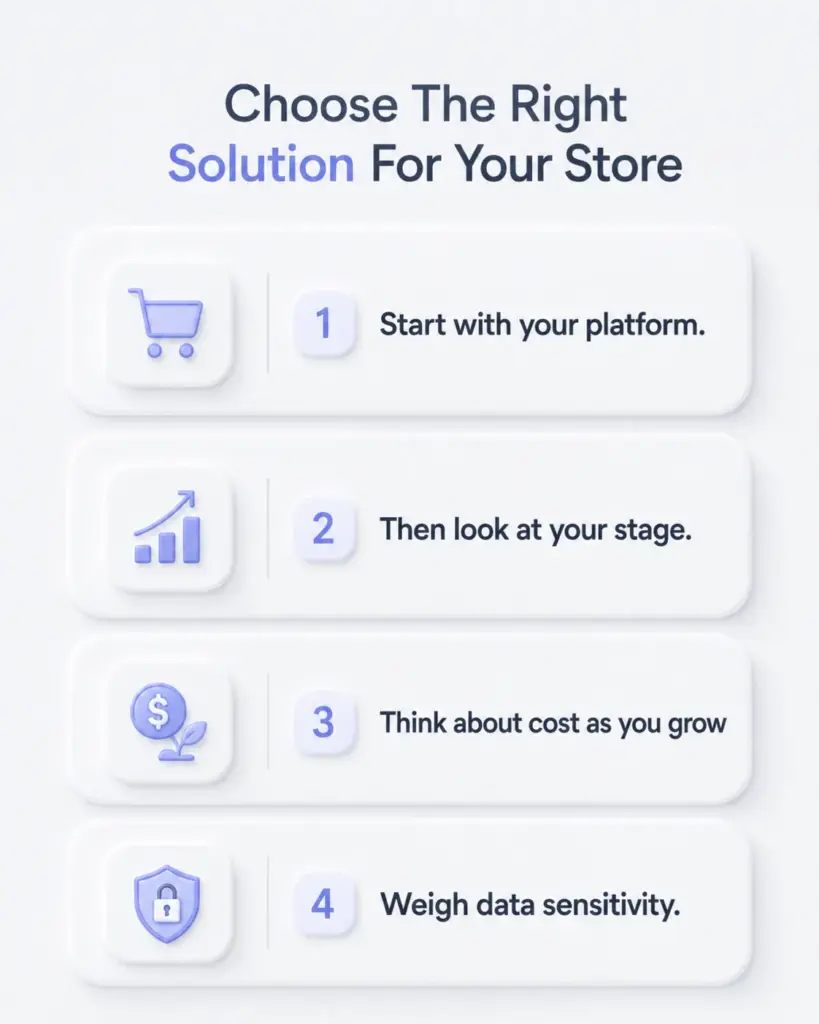
Start with your platform.
If you sell on Shopify, hosted apps built for that ecosystem are the path of least resistance. If you sell on WordPress with WooCommerce, EDD, SureCart, or FluentCart, a self-hosted plugin will feel more at home and cost less over time.
Then look at your stage.
A brand new store testing the idea wants low cost and quick setup. An established brand with healthy margins can justify a network’s fees for the reach. A growing store in the middle usually wants control and predictable cost, which points toward owning the program.
Think about cost as you grow, not just today.
A tool that charges a percentage of affiliate revenue looks cheap at ten affiliates and expensive at a hundred. A flat license looks the same whether your program is small or thriving.
Weigh data sensitivity.
If keeping customer and sales data on your own server matters to you, that alone can rule out hosted options.
Finally, match features to your actual plan. If influencers are central, prioritize coupon attribution. If you sell subscriptions, prioritize renewal handling. Do not pay for enterprise analytics you will never open.
How To Launch Your Ecommerce Affiliate Program
Once you have picked a solution, getting live is more about discipline than difficulty.
Here is a clean order to work in.
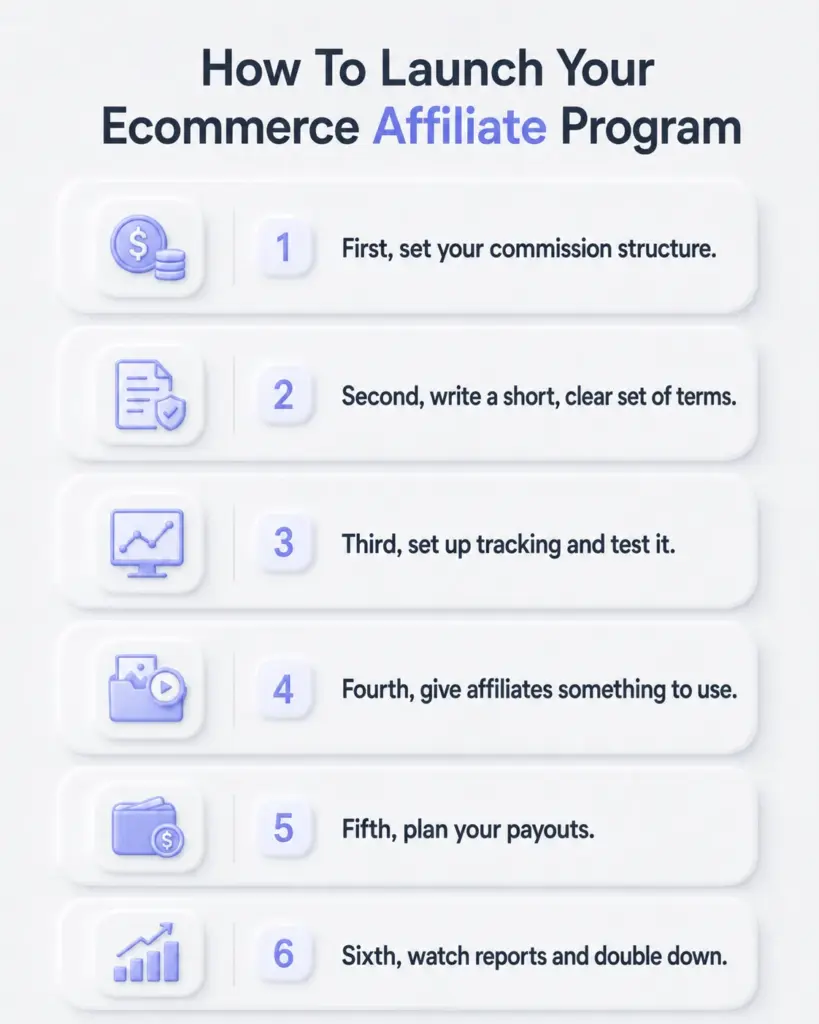
First, set your commission structure before you invite anyone. Decide your default rate, then add any product or category exceptions so your margins stay safe.
Second, write a short, clear set of terms. Spell out how commissions are earned, your cookie window, and what counts as a valid sale. Affiliates trust programs that are upfront.
Third, set up tracking and test it. Place a real test order through an affiliate link or coupon code and confirm the referral lands in your dashboard before you go public.
Fourth, give affiliates something to use. Ready-made banners, text links, and coupon codes lower the friction so partners can start promoting the day they join.
Fifth, plan your payouts. Pick a schedule, a minimum payout amount, and a payment method, then stick to it. Late payments are the fastest way to lose good affiliates.
Sixth, watch your reports and double down. Find your top partners, learn what they do, and reward them so they keep going.
Explore In-depth: How to Set Up an Affiliate Program on WordPress (Step-by-Step Guide)
Final Thoughts
The best affiliate marketing solution for ecommerce is not a trophy you hand to one brand. It is a fit decision. Networks buy you reach. Hosted apps buy you speed. Self-hosted plugins buy you control and predictable cost. Match the choice to where your store lives, how you want to handle data, and what your program will cost once it actually grows.
If your store runs on WordPress, you already have the foundation to own your program end-to-end. FluentAffiliate lets you track sales from WooCommerce, EDD, SureCart, and FluentCart, set smart commission rates, run branded coupon codes, and keep every record on your own site. Start with the free core plugin, test it with a real order, and grow from there. The partners you build today compound into a channel you fully own tomorrow.
Frequently Asked Questions
What is the best affiliate marketing solution for ecommerce?
The best solution is the one that integrates natively with your store platform, tracks sales to the right affiliate automatically, and gives you control over commissions and payouts. For WordPress stores, a self-hosted plugin usually fits best. For Shopify stores, a hosted app is the simpler path.
Is affiliate marketing worth it for a small ecommerce store?
Yes, because you only pay when a sale happens. With an average return reported around $12 to $15 per $1 spent, the channel rewards small stores that recruit even a handful of genuine partners. You avoid paying for clicks that never convert.
How much does an ecommerce affiliate solution cost?
It depends on the type. Networks charge setup and ongoing fees plus a commission override. Hosted apps charge a monthly subscription, sometimes plus a share of affiliate revenue. Self-hosted plugins charge a one-time or annual license with no cut of your sales.
Can I run an affiliate program on WooCommerce without a network?
Yes. A self-hosted plugin like FluentAffiliate runs the whole program inside your WordPress site. It tracks WooCommerce orders, assigns commissions, manages payouts, and keeps your data on your own server, with no network required.
What is the difference between an affiliate network and an affiliate plugin?
A network is a marketplace that connects you to existing affiliates and hosts your program on its servers for a fee. A plugin installs on your own site, so you own the data and recruit your own affiliates without a revenue share going to a third party.
How do affiliate coupon codes work for ecommerce?
You assign a unique discount code to a specific affiliate. When a customer checks out with that code, the system credits the sale to that affiliate automatically. This suits influencers who prefer sharing a short code over a long tracking link.
Do affiliate plugins handle subscription renewals?
Some do. FluentAffiliate Pro can award commission on subscription renewals for WooCommerce and FluentCart, and lets you cap how many renewals an affiliate earns from. Always confirm renewal handling before launch if recurring revenue is part of your model.



Add your first comment to this post