
Customer Affiliate Marketing: Turn Your Buyers Into Your Best Sales Team
You already have people who love your product. They just have not been asked to promote it yet.
Customer affiliate marketing is how you turn your quietest fans, the ones leaving five-star reviews and telling their friends anyway, into a paid channel that brings you new sales without a single ad dollar spent.
Key Takeaways: Customer Affiliate Marketing
- Customer affiliates convert better than cold influencers because they already use and trust your product.
- You do not need an expensive affiliate network to run this. A self-hosted WordPress plugin handles tracking, links, and reporting on your own site.
- Manual approval lets you vet who gets in, so you are not opening the program to anyone who signs up.
- Affiliate Groups let you give your best customer affiliates a higher rate without changing your default commission for everyone else.
- Branded coupon codes give customers a reason to convert on the spot, and the admin assigns them, not the affiliate.
- Payouts in FluentAffiliate are recorded, not automated through a gateway, so budget time for a manual review each cycle.
- Start with your existing buyers before you go looking for outside influencers. It is the cheapest customer acquisition channel you already own.
What Is Customer Affiliate Marketing
Customer affiliate marketing is the practice of recruiting your own existing customers, rather than outside influencers or strangers, to promote your products in exchange for a commission on the sales they generate.
In simple terms, instead of hunting for new affiliates from scratch, you look inside your own customer list first.
This works differently from a referral program, even though people mix the two up constantly. A referral program usually rewards a customer for sending someone they personally know, often with a discount or credit instead of cash. A customer affiliate program treats that same customer more like a small-scale marketing partner.
They get a trackable link or coupon code, they can promote it publicly on a blog, YouTube channel, or social page, and they earn a real commission, tracked automatically, for every sale that link brings in.
Why Your Existing Customers Make Better Affiliates
Word of mouth is still the most trusted form of marketing there is, and that is not just a hunch. Various sources citing Nielsen research put the trust gap in stark terms, with consumers reporting that they trust recommendations from people they know far more than they trust any paid ad.
Other widely cited compilations tied to McKinsey research suggest word of mouth plays a role in a large share, somewhere between 20 and 50 percent, of purchasing decisions overall.
Here is why that matters for your WordPress business specifically.
A customer who bought your WooCommerce product or finished your course already has proof it works. They do not need training on your value proposition because they lived it. When they tell someone about it, that recommendation lands with a kind of authenticity that a rented influencer post rarely has, because the influencer usually has not actually used your product before the sponsored post went live.
There is also a cost angle worth being honest about.
Influencer partnerships often mean upfront fees, negotiated flat rates, or free product plus a fee, regardless of whether a single sale happens.
Customer affiliate programs, on the other hand, are performance-based by nature. You only pay when a sale actually closes. For a bootstrapped WordPress store or a solo course creator, that is a much safer way to test whether affiliate driven growth works for you at all.
The Enterprise Playbook Does Not Fit Most WordPress Businesses
If you study this topic, most of what comes up assumes you are running a mid size or enterprise brand. The advice usually goes something like this: hire an affiliate manager, budget for an affiliate network subscription with monthly and override fees, draft formal legal agreements, and only recruit customers who already have a large content following.
That advice is not wrong, it is just built for a different size of business. If you are running a single WooCommerce store, a membership site on MemberPress, or selling courses through TutorLMS, you probably are not going to hire a full-time affiliate manager this year.
You do not need to be listed on a public affiliate network where you are competing with a hundred other programs for the same affiliates. And plenty of your best potential customer affiliates are not professional content creators at all.
They are regular buyers with a decent email list, a small but engaged Instagram following, or a niche Facebook group where people actually ask them for recommendations.
What you actually need is simpler: a way to give a customer a trackable link or coupon code, a dashboard where they can see what they have earned, and a system on your own site that logs every visit and referral so nobody has to guess who gets credit.
That is what a self hosted, one time cost plugin like FluentAffiliate is built to do, right inside the WordPress dashboard you already use every day.
Is Customer Affiliate Marketing Right for Your Store
Before you open this up to your customer list, run through a quick gut check.
- Do you have customers who talk about your product without being asked, in reviews, comments, or DMs?
- Is your profit margin healthy enough to support a commission, even a modest one, on top of your normal costs?
- Do you sell something with a wide enough appeal that more than a handful of customers could realistically promote it?
- Are you willing to spend a bit of time each month reviewing new applicants and processing payouts?
If you answered yes to most of these, you are in a good spot to start small. If your margins are thin or your product is very niche, a simple referral discount might make more sense before you build out a full affiliate structure.
What Makes a Good Customer Affiliate Candidate
Not every happy customer will make a good affiliate, and it helps to know the difference before you start reaching out. Look for a few specific signals rather than just picking your biggest spender.
- They already mention your product somewhere public, in a review, a comment, a forum post, or a social caption, without being asked.
- Their audience, even a small one, actually overlaps with the kind of person who buys from you. A customer with two thousand followers in your niche can outperform one with twenty thousand followers in an unrelated space.
- They have used the product long enough to speak about it with real detail, not just a first impression.
- They respond to your outreach with genuine enthusiasm rather than only asking about the commission rate.
If a customer checks two or three of these boxes, they are worth inviting. You do not need everyone in the program to be a content creator. Someone who runs a small local Facebook group for your niche, or who answers questions about your category in a forum, can bring in steady referrals without ever posting a formal review.
How to Turn Customers Into Affiliates on WordPress
Here is the practical, step-by-step version, built around what you can actually configure inside FluentAffiliate.
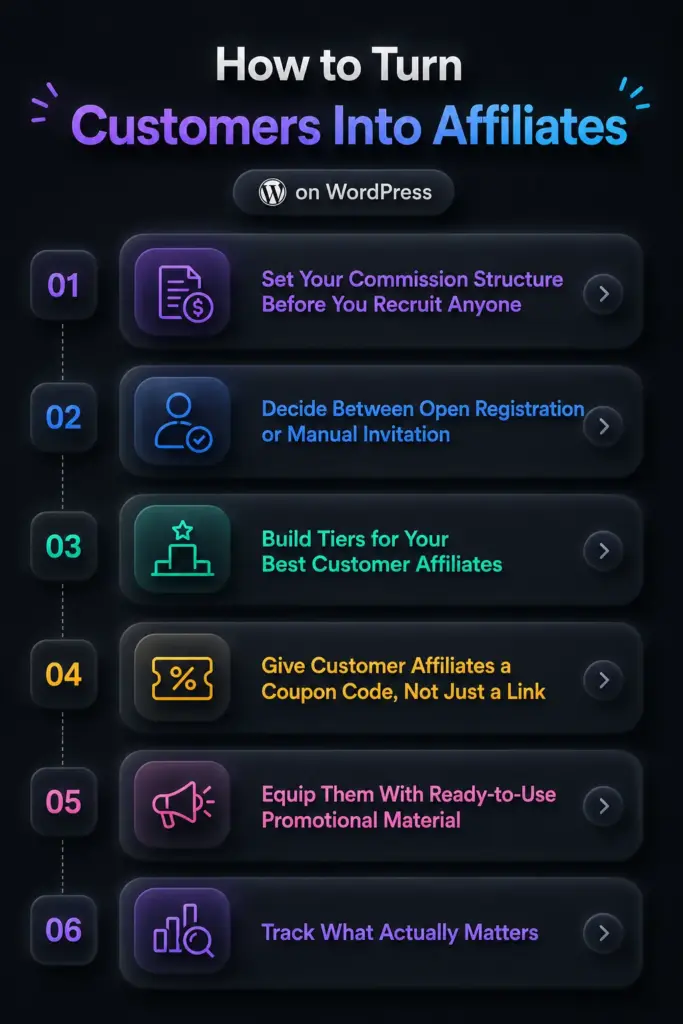
Set Your Commission Structure Before You Recruit Anyone
Decide on a flat amount or a percentage rate first. This lives in your Referral Settings, where you set the default rate that applies to every affiliate unless you override it later. Do not skip this step and figure it out later. Nothing turns off a good customer affiliate faster than unclear commission terms.
While you are there, also set your cookie duration, which determines how long a customer affiliate stays credited for a visitor after they click the link, and decide whether you want to credit the First Affiliate or the Last Affiliate when more than one link is involved in a sale. Both are program wide settings, so pick the one that matches how you actually want credit assigned.
Read More: Affiliate Commission Structure: Choose the best model for your Business
Decide Between Open Registration or Manual Invitation
You have two real options here. You can turn on public registration and let any customer apply through your affiliate portal, or you can hand pick people and add them manually.
If you want quality control, which most small WordPress businesses do when they are just starting, turn on the option that requires admin approval for new affiliates in your Registration Settings. Every new applicant lands in a pending state until you review them. This matters more than it sounds.
You do not want your program open to anyone who stumbles onto the signup form, especially early on when your reputation with affiliates is still being built.
Explore More: Affiliate Onboarding: How to Turn New Signups Into Active Promoters
Build Tiers for Your Best Customer Affiliates
Not every customer affiliate performs the same, and your commission structure should not pretend otherwise. FluentAffiliate lets you create Affiliate Groups, each with its own commission rate, then assign any affiliate to the group that fits. A customer who consistently sends five sales a month deserves a better rate than someone who sends one every few months.
In practice, this looks like starting everyone at your default program rate, then manually moving your top performers into a higher tier group once you see consistent results. It is a manual process, you assign the group yourself rather than the system auto promoting people, but it gives you full control over who earns what.
Give Customer Affiliates a Coupon Code, Not Just a Link
A generic referral link works, but a coupon code often converts better because it gives the customer’s audience an immediate reason to buy right now. If you are running WooCommerce, EDD, or FluentCart, you can create a standard discount code and assign it to a specific approved affiliate from the coupon editor.
When that code gets used at checkout, the assigned affiliate is automatically credited with the referral.
One thing worth being clear about here. The admin creates and assigns the coupon, the affiliate does not get to pick their own code or set their own discount. That keeps your discounting strategy consistent even as more customer affiliates join the program.
Equip Them With Ready-to-Use Promotional Material
Do not expect every customer affiliate to know how to design a banner or write compelling copy. Most will not, and that is fine. Use Affiliate Creatives to prebuild a small library of banners, text links, or QR codes that already carry each affiliate’s tracking link automatically. When someone logs into their affiliate portal, they can just grab what is there and paste it into their blog or social bio.
For your very best affiliates, consider going a step further with a custom landing page built around their affiliate ID.
It is more work upfront since you create the page yourself, but a clean URL like yoursite.com/partner/their-name feels more professional than a generic query parameter link, and it can genuinely lift conversions for someone with real reach.
Track What Actually Matters
Once affiliates are live, resist the urge to obsess over vanity numbers like total clicks. Watch conversion rate and total order value instead.
The Visits log shows you every click, and cross referencing it against your Referrals list tells you which customer affiliates are actually driving revenue versus just traffic.
If someone sends a lot of clicks but almost no sales, that is worth a conversation, not a bigger commission.
Read More: Different Affiliate Tracking Methods
Common Mistakes to Avoid
A few mistakes show up again and again with new customer affiliate programs, so it is worth naming them plainly.
- Forgetting to disable self referrals. Without that setting turned on in Referral Settings, a customer affiliate could technically buy from themselves using their own link and collect a commission on their own purchase. Turn that guardrail on from day one.
- Opening registration to everyone with no review. A pending approval step costs you a few minutes per applicant but saves you from onboarding people who have no real connection to your brand.
- Treating payouts as an afterthought. FluentAffiliate records referrals and calculates what is owed, but payments themselves go out manually, usually via PayPal email or bank details listed in the affiliate’s profile. Build a recurring reminder into your calendar so affiliates are not left waiting weeks past when they expected to get paid.
- Never revisit commission tiers once you set them. A customer affiliate who joins quietly and turns into your top referral source six months later should not still be earning the same flat rate as someone who signed up and never sent a single sale. Check your Referrals dashboard every quarter and move your consistent performers into a higher paying group. It costs you very little and it keeps your best people motivated to keep going.
- Skipping the agreement entirely. You do not need a lawyer drafted contract to start, but a short written note covering the commission rate, how long the cookie lasts, what channels they can and cannot use to promote you, and when payouts happen protects both sides. Send it as part of your welcome email so there is no confusion later.
How to Reach Out to Customers Who Would Make Good Affiliates
Look through your customer list for people who already talk about you unprompted. That might be someone who left a detailed five star review, tagged you on social media, or emailed in just to say the product worked well for them.
Those are warmer leads than any cold influencer outreach will ever be.
When you reach out, keep it simple and personal.
Mention the specific thing they said or did that caught your attention, explain how the program works, walk them through the commission rate, and make it easy for them to say yes. If you use FluentCRM, you can tag new affiliates automatically as they join so you can keep them in a dedicated nurture sequence separate from your regular customer emails.
Paying Your Customer Affiliates the Right Way
Once referrals start rolling in, plan a regular payout cadence, whether that is monthly or every two weeks.
Inside the Payout section, you can filter by date range and set a minimum payout threshold so you are not processing tiny five dollar payments constantly. Export the transaction report as a CSV for your own bookkeeping before sending payments manually through PayPal or bank transfer.
Being upfront about this with affiliates matters too.
Since payouts are not automatically pushed through a gateway, let your customer affiliates know exactly when to expect payment so nobody is left wondering if the program is legitimate.
Final Thoughts
Customer affiliate marketing is not about finding strangers to promote your brand. It is about noticing the customers already doing it for free and giving them a real reason to keep going.
Start small, pick a handful of your most vocal buyers, set clear commission terms, and track results for a month before scaling wider.
If you are running a WooCommerce store, a course, or a membership site on WordPress, FluentAffiliate gives you the tools to set this up without adding a new monthly software bill or hiring anyone.
Set your commission rate, turn on manual approval, and invite your first few customer affiliates this week. You already have the hardest part done. People who like your product enough to talk about it. Now just give them the link.
Frequently Asked Questions
What is the difference between a customer affiliate program and a referral program?
A referral program rewards a customer for sending people they personally know, often with a discount or credit. A customer affiliate program treats the customer more like a marketing partner who can promote publicly, using a trackable link or coupon, and earns a real commission for every sale.
Do I need a big following to become someone’s customer affiliate?
No. Some of the best customer affiliates are regular buyers with a modest but engaged audience, not professional influencers. What matters more is whether their audience trusts them and overlaps with your target customer.
How much commission should I offer a customer affiliate?
There is no single right number, but many small business programs start somewhere in a modest single digit to low double digit percentage range and adjust from there based on margin. Set your rate in Referral Settings first, then create higher tier groups for your top performers.
Can a customer promote themselves and earn a commission on their own purchase?
Not if you enable the Disable Self Referral setting in Referral Settings, which prevents affiliates from earning commissions on purchases made through their own link.
Do I need separate affiliate software or can I run this inside WordPress?
You can run a full customer affiliate program directly inside WordPress using a self hosted plugin like FluentAffiliate, without paying ongoing network fees or hiring a dedicated affiliate manager.
How do affiliates get paid?
Payouts are recorded and reported inside the plugin, but the actual payment is sent manually, typically to the PayPal email or bank details listed on the affiliate’s profile.
Should I approve every affiliate application automatically?
For most small to mid size WordPress businesses, manual approval is the safer starting point. It lets you review who is applying before they get access to links, coupons, and promotional material tied to your brand.



Add your first comment to this post