

Affiliate Marketing ROI: How to Calculate and Boost It
Most affiliate ROI guides hand you a formula and call it a day. The problem is that the formula is the easy part. The hard part is knowing which costs to plug in, where to find the numbers, and why two stores with the same sales can end up with wildly different returns.
If you run your program on WordPress, this guide fixes all three.
Key Takeaways: Affiliate Marketing ROI
- Program-owner ROI measures affiliate revenue against total costs, not what your affiliates earn on their end.
- True program cost has three parts: commissions, software, and management time, and skipping any one inflates your ROI.
- Self-hosted WordPress plugins keep software cost flat, while many SaaS tools take a percentage cut or per-affiliate fee that grows as you scale.
- Use basic ROI for stores, lead-value ROI for forms and bookings, and lifetime-value ROI for courses and subscriptions.
- A good affiliate ROI sits above 300%, while the 2026 industry average runs $6.50 to $15 per dollar and varies sharply by niche.
- Roughly 18% to 24% of attributed affiliate sales would have happened anyway, so your real ROI is often lower than your dashboard shows.
- Fraud and commission leakage drain an estimated 15% to 20% of affiliate spend, so reviewing referrals before payout protects real returns.
What Affiliate Marketing ROI Actually Means for Program Owners
Affiliate marketing ROI means how much profit you make from your affiliate marketing compared to how much you spend on it.
In simple words, it tells you whether your affiliate program is making money or costing you too much.
There are two people who care about affiliate ROI, and they mean different things by it.
An affiliate (the person promoting your products) thinks about ROI as the money they earn versus the money they spend on ads, content, and tools. That is not you.
You are the program owner. Your ROI is the revenue your affiliates bring in versus what it costs you to run the whole program. That cost includes commissions, your tracking software, and the time you spend managing it. This guide is for your side of the table.
Here is why this matters so much. Affiliate marketing runs on a pay-for-results model. You do not pay for clicks or impressions like you would with Google Ads. You pay a commission only after a real sale happens.
That single fact is why the channel posts returns that make paid ads look sleepy. Industry data for 2026 puts the average return around $15 for every $1 spent. Compare that to Google Ads, which sat around $8 per $1 in recent reporting, and you can see why over 80% of brands now run an affiliate program. Forrester data even ranks affiliate as the third-largest performance channel, behind only paid search and paid social.
But averages hide a lot. Your real number depends on choices most guides never mention. Let’s get into them.
The Simple Formula (And the Costs Most People Forget)
The math itself is not scary. Here is the standard formula every program owner uses:
ROI = (Revenue from affiliates − Total program costs) ÷ Total program costs × 100
Revenue from affiliates is the total order value of every sale your affiliates drove. Total program costs is everything you spent to make those sales happen. Most people get the revenue side right and the cost side badly wrong.
When folks calculate cost, they usually remember commissions and stop there. But your true cost has three buckets:
- Commissions paid to affiliates
- The software you use to track everything
- Your time, or the cost of whoever manages the program
Skip any of these and your ROI looks better than it really is. That feels nice until you realize you have been scaling a program that earns less than you thought.
Let’s run a clean example. Say you own a WooCommerce store. Last month your affiliates drove $20,000 in sales. You paid out $3,000 in commissions at a 15% rate. Your tracking tool cost $40 for the month. You spent maybe five hours managing it, which we’ll value at $250.
Total cost: $3,000 + $40 + $250 = $3,290.
Net profit: $20,000 − $3,290 = $16,710.
ROI: ($16,710 ÷ $3,290) × 100 = roughly 508%.
That is about $5 of profit for every $1 you put in. Healthy. Now watch what happens when one of those cost lines gets out of hand.
The Hidden Cost Line That Quietly Kills Your ROI
Notice how small the software cost was in that example. That is not an accident. It is the whole point of running your program on WordPress.
A lot of popular affiliate platforms are hosted SaaS tools.
They charge in one of two ways that get expensive fast. Some take a percentage of the revenue your affiliates generate, on top of the commissions you already pay. Others charge a monthly fee that climbs as you add more affiliates. Both models punish you for growing.
Think about that.
You recruit more affiliates, your program does better, and your tool quietly takes a bigger bite. In our example above, imagine the software wasn’t $40 but instead took 2% of that $20,000 in affiliate revenue. That is $400, ten times more, and it grows every single month your program grows.
A self-hosted WordPress plugin flips this.
You pay a flat license fee that does not care whether you have 10 affiliates or 10,000, and it does not skim a cut off your sales. The cost stays put while your revenue climbs. That gap compounds month after month, and it is the single biggest reason two stores with identical sales can post very different returns.
This is exactly where FluentAffiliate sits. It runs inside your own WordPress install, so there is no per-affiliate pricing and no slice taken off the top. Your software cost is a known, fixed line item, which makes your ROI math both better and more predictable.
A Real ROI Comparison: Self-Hosted vs SaaS
Let’s make the difference concrete with two stores that look identical on paper.
Both run on WooCommerce. Both drove $20,000 in affiliate sales last month. Both paid $3,000 in commissions and spent the same five hours managing things.
Store A uses a SaaS tool that charges 2% of affiliate revenue plus a $99 base fee. Its software cost is $400 + $99 = $499.
Store B uses a self-hosted plugin with a flat monthly equivalent of about $40.
Store A total cost: $3,000 + $499 + $250 = $3,749.
ROI: about 433%.
Store B total cost: $3,000 + $40 + $250 = $3,290.
ROI: about 508%.
Same sales, same commissions, same effort. Store B keeps an extra $459 this month purely from tool choice. Scale that store to $100,000 in affiliate sales and the SaaS cut alone becomes $2,000 a month, while the self-hosted plugin still costs $40. That is real money walking out the door for nothing.
This is the part of the ROI conversation that gets buried because most ROI articles are published by the SaaS tools themselves. They are not going to highlight the line item that makes them look expensive.
Explore More: Self-Hosted Affiliate Tracker for Your Business
3 Ways to Calculate ROI Based on What You Sell
Not every WordPress business sells the same way, so the right calculation depends on your model. Here are the three that cover almost everyone.
1. Basic Sales ROI for Stores and Digital Products
This is the one we used above, and it fits WooCommerce shops, Easy Digital Downloads stores, and most physical or one-time digital sales.
ROI = (Affiliate revenue − Total costs) ÷ Total costs × 100
You already know how this works. Total order value in, all costs out, simple percentage. Use this when a sale is a sale and there is no long-term subscription attached.
2. Lead or Signup ROI for Forms and Bookings
If your affiliates send you leads instead of instant sales, like form submissions or service bookings, you need to value the lead, not just count it.
ROI = (Expected revenue from leads − Lead costs) ÷ Lead costs × 100
Here is a quick example. Say affiliates send you 50 leads through a paid Fluent Forms signup or a FluentBooking appointment, and you pay $20 per lead, so $1,000 in cost. Your average deal is worth $500 and you close 20% of leads, which is 10 deals. That is $5,000 in expected revenue. ROI: ($4,000 ÷ $1,000) × 100 = 400%.
Use this model for B2B, agencies, and service businesses. For reference, B2B service programs in 2026 pay around $187 per qualified lead on average, and finance lead-gen bounties sit near $52, so your cost per lead and close rate matter more than the headline commission.
3. Lifetime Value ROI for Courses, Memberships, and Subscriptions
This is the one course and membership creators get wrong most often, and it costs them. If you only count the first payment, you badly underrate your program.
ROI = (Customer lifetime value − Commission cost) ÷ Commission cost × 100
Picture a membership site running on MemberPress or a course on LifterLMS. Your plan is $30 a month and members stay about a year, so their lifetime value is $360. You pay an affiliate a $30 commission for that signup. Net value is $330. ROI: ($330 ÷ $30) × 100 = 1,100%.
That is a wildly different number from the 0% you might “see” if you only looked at the first month’s $30 against the $30 commission. The customer keeps paying long after the commission is done. This is also why SaaS recurring programs now pay a median of around 22.5% of first-year revenue. The lifetime value justifies it.
There is a bonus hiding here too. Affiliate-acquired customers tend to be better customers. Research from Awin and Forrester found they spend about 21% more per order than other buyers, and some SaaS programs report up to 33% lower churn among customers who came through affiliates. Higher AOV and longer retention both feed straight into your ROI.
If you sell recurring plans, this is where rewarding affiliates for renewals starts to make sense too. FluentAffiliate Pro can pay commission on subscription renewals for FluentCart users, which keeps your best partners motivated to send customers who actually stick around, not just sign up and bounce.
What a Good Affiliate ROI Looks Like
So what number should you actually aim for? Benchmarks help, as long as you treat them as a starting line and not gospel.
Across industries, recent data puts the average program return between $6.50 and $15 for every $1 spent, which works out to roughly 550% to 1,400% ROI. Some sources report returns as high as 12:1 or even 14:1 in strong niches.
For context, affiliate marketing now drives about 16% of all e-commerce sales in the US and Canada, and around 65% of retailers say it contributes up to a fifth of their annual revenue.
A few things worth keeping in mind as you read those figures:
- Anything above a 300% to 400% ROI is generally a healthy, scalable program.
- New programs often start lower because your time cost is spread over fewer sales. That improves fast as volume grows.
- Subscription and course businesses can post the highest numbers because lifetime value stacks up over months.
- Affiliate-acquired customers often spend more and stay longer, so your revenue line gets a quiet bonus.
ROI by Niche and Channel
Returns are not evenly spread. Your niche sets your commission norms, and your traffic channel changes how efficiently those commissions convert. Here is a rough picture to benchmark against.
| Niche or channel | Typical commission or ROI signal |
| E-commerce and retail | Median commission around 8.4% of order value, fashion 8 to 12% |
| Luxury goods | Around 15% commission |
| SaaS and software | Recurring commission near 22.5% of first-year revenue, sometimes 20 to 70% |
| Finance lead generation | Around $52 average flat bounty per lead |
| B2B services | Around $187 per qualified lead |
| Email-driven promotion | Among the highest returns, near 14:1 |
| Influencer-driven promotion | Around 10:1, with more upfront relationship work |
The takeaway is simple. A 10% commission is generous in retail but stingy in SaaS. Set your rates against your own niche, not a blanket number, and pay attention to which channels your affiliates use, because email and content tend to convert far more efficiently than cold social traffic.
Where to Find Every ROI Number in Your WordPress Dashboard
Here is the practical bit nobody else shows you. A formula is useless if you cannot find the inputs without a spreadsheet archaeology session. With FluentAffiliate, every number you need is already sitting on your admin dashboard.
- Total Order Value by Referrals is your affiliate revenue. That is the top line of the formula, no exporting required.
- Total Paid plus Total Unpaid is your commission cost. Add them and you have what your affiliates have earned, whether or not the money has gone out yet.
- Conversion Rate tells you how many visits turned into sales, which is your efficiency signal.
- Total Visits and Total Referrals show you the traffic and sales volume behind the revenue.
- Active Affiliates and Pending Affiliates tell you how much of your roster is actually doing the work.
So your ROI math becomes almost a glance. Take Total Order Value by Referrals, subtract Total Paid plus Total Unpaid, subtract your flat software cost and your time, then divide by total cost. The two big numbers are right there on one screen.
When it is time to pull exact commission figures for your records, the payout management area lets you export a CSV with affiliate IDs, names, and amounts. That gives you a clean cost record to drop into your books or a simple ROI sheet.
The Hidden Costs That Drain Affiliate ROI
We have covered software fees and demand interception. The third silent drain is fraud and leakage, and it is bigger than most owners think.
Affiliate fraud cost marketers an estimated $3.4 billion in 2025, which works out to roughly 17% of all affiliate spend. The reason the channel is such a target is the payout model. A fake click on a display ad wastes a few cents. A fake conversion in your affiliate program pays a full commission, maybe $50 or $100, straight to a fraudster. Estimates suggest somewhere between 17% and 25% of affiliate traffic can be invalid, and cookie stuffing alone touches an estimated 5% to 10% of affiliate transactions.
There is more. When experts audit affiliate programs, they routinely find 15% to 20% of commission spend is wasted on things like cookie stuffing, unauthorized brand-name bidding, and coupon leakage. That waste comes straight off your ROI.
You cannot stop fraud entirely, but a few habits inside FluentAffiliate plug the biggest holes:
- Review before you pay. Not every recorded referral deserves a payout. Approve pending referrals in the managing referrals area and reject the suspicious or reversed ones before money goes out. Every bad referral you catch is pure ROI saved.
- Turn off self-referrals. Without a guard, affiliates can buy through their own links just to pocket the commission. Disable self-referrals in your referral settings.
- Stop commissioning on tax and shipping. If you pay on the full order total, you are paying affiliates on money you never kept. Exclude both in referral settings so commissions come out of actual product revenue.
- Watch the visit patterns. The same referrer and UTM data that flags demand interception also surfaces bot-like traffic, such as floods of clicks with no genuine source behind them.
Explore More: 7 Best Affiliate Fraud Detection Software for WordPress
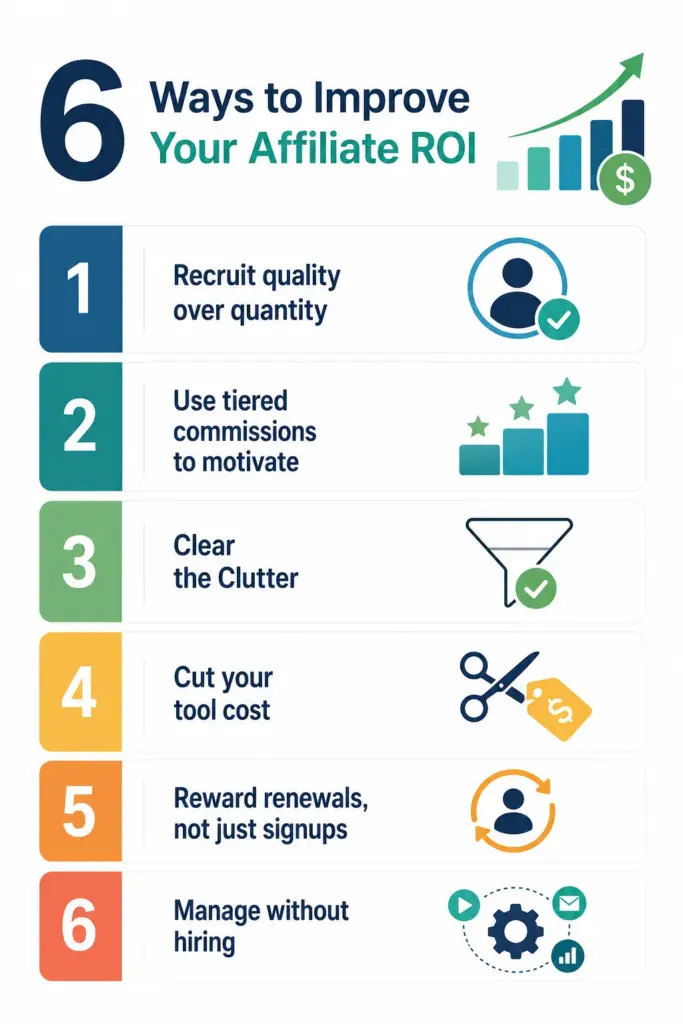
6 Ways to Improve Your Affiliate ROI Without Spending More
Better ROI usually comes from fixing leaks and making smarter choices, not from throwing more money at the channel. Here is where to focus.
1. Recruit quality over quantity
Affiliate programs follow the 80/20 rule hard. Your top 20% of affiliates usually drive around 80% of your revenue. Chasing hundreds of random signups just creates noise and management work. Find partners whose audience already matches what you sell.
2. Use tiered commissions to motivate your best people
Reward top performers with higher rates so they keep choosing you over your competitors. FluentAffiliate lets you set this up with affiliate groups, where each group gets its own rate. You might give your everyday affiliates 10% and your proven heavy hitters 15%, all without touching individual profiles.
3. Clear the Clutter
Plenty of affiliates sign up, never promote anything, and just clutter your list. Review your roster every quarter using the affiliate list and the activity on your dashboard. Re-engage the quiet ones with a quick message, and let go of the ones who never get going. A leaner roster is easier to manage, which lowers your time cost.
4. Cut your tool cost
We covered this, but it bears repeating because it is the lever with zero downside. Moving from a SaaS tool that takes a revenue cut to a self-hosted plugin with a flat fee can lift your ROI overnight, with no change to your sales or your affiliates’ experience.
5. Reward renewals, not just signups
If you sell subscriptions or memberships, paying affiliates for ongoing renewals through FluentAffiliate Pro nudges them to send customers who stay. Long-retained customers are pure ROI fuel.
6. Manage without hiring
Hiring a manager is a real cost that drags ROI down. FluentAffiliate’s permission management lets you hand limited dashboard access to a team member or freelancer without giving away full WordPress admin rights. You delegate the busywork without the salary of a dedicated hire.
Wrapping Up
Affiliate marketing earns its reputation as one of the highest-ROI channels in digital marketing, but the return you actually keep comes down to the costs you control. Track all three cost buckets honestly, calculate ROI the right way for what you sell, and stay alert to the quiet drains: demand interception, fraud, and creeping software fees.
The biggest edge for WordPress owners is keeping your program in-house, where your tool cost stays flat instead of scaling against you. If you want every ROI input on one screen and a flat, predictable software cost that never takes a cut of your sales, FluentAffiliate gives you exactly that. Install the free core, set your commission rules, and start measuring real returns from your own dashboard today.





Add your first comment to this post