
Affiliate Fraud: A Complete Awareness Guide

Affiliate fraud costs the industry billions every year, and most program owners don’t catch it until real money is already gone. Fake clicks, stuffed cookies, bogus leads, and chargeback scams are all happening right now across affiliate programs big and small.
This guide breaks down every major type of affiliate fraud, how to spot it fast, and exactly what to do to protect your program.
Key Takeaways: Affiliate Fraud
- Affiliate fraud, from fake clicks to chargeback abuse, costs programs billions annually, often going undetected for months.
- The 7 fraud types to know: click fraud, cookie stuffing, fake leads, chargeback abuse, brand bidding, typosquatting, and loyalty manipulation.
- A huge gap between an affiliate’s traffic and conversions is almost always your earliest fraud warning signal.
- Manual approval, commission holds, self-referral blocks, and clear program terms are your core fraud-prevention infrastructure.
- FluentAffiliate’s Visits dashboard and UTM tracking let you catch fraud at the click level, before a single commission is paid out.
- When fraud hits: pause the account, reject pending commissions, document everything, then audit similar affiliates.
- A curated, well-supported affiliate community is your best long-term fraud defense, trusted partners don’t cheat, and they help keep your program clean.
What Is Affiliate Fraud?
Affiliate fraud is any deceptive activity designed to manipulate your affiliate tracking system and generate commissions that weren’t earned through genuine customer actions.
Think of it this way. Imagine you hired a salesperson and agreed to pay them a commission for every real customer they brought in. Now imagine they started bringing in mannequins dressed as customers and billing you for each one. That’s essentially what affiliate fraud is: fake results dressed up to look real.
It matters because the damage goes beyond money. Fraudulent traffic pollutes your analytics, distorts your marketing decisions, wastes your budget, and can even damage your reputation with real customers if shady tactics are involved.
The good news? Once you know what to look for, affiliate fraud is far easier to catch and prevent.
The Most Common Types of Affiliate Fraud You Need to Know
Here are some of the most typical affiliate marketing frauds you must know in order to secure your affiliate program.
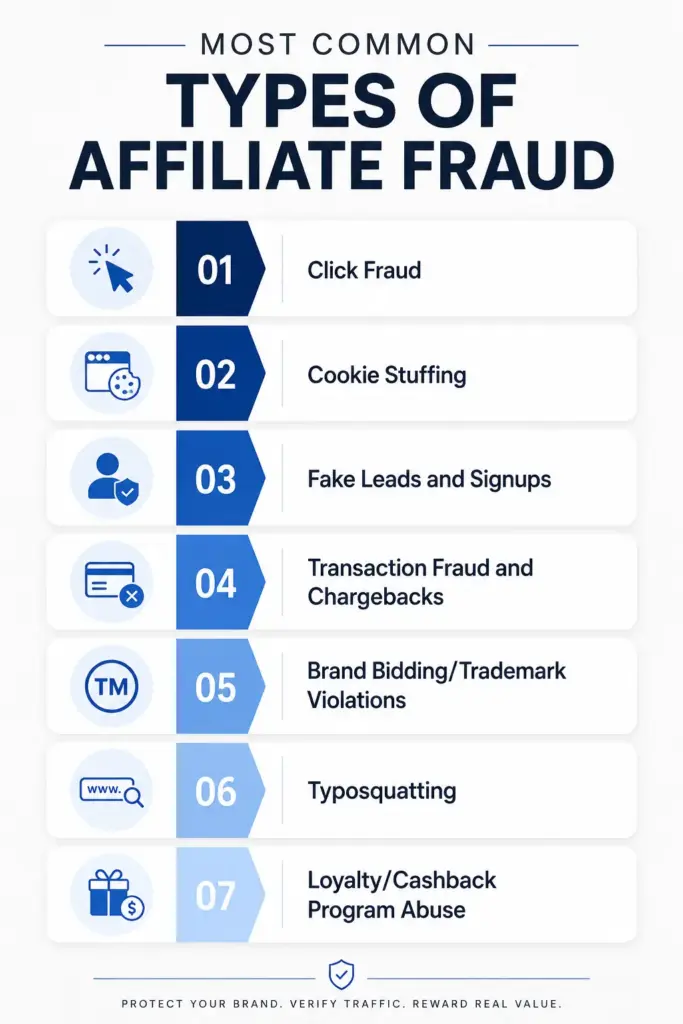
1. Click Fraud
This is probably the most widespread type of affiliate fraud, and it’s exactly what it sounds like.
A fraudulent affiliate generates massive volumes of fake clicks on their referral links. This can be done manually, through bots, or by using click farms, networks of low-paid workers, or automated tools that click links all day long.
The goal is simple: inflate traffic numbers to look like a high performer, sometimes hoping that a percentage of that traffic eventually converts, or just to meet threshold requirements in certain programs.
What it looks like in your data:
- Sudden, unexplained spikes in visit counts from a single affiliate
- Very high click volumes paired with extremely low or zero conversion rates
- Traffic coming from the same IP addresses or unusual geographic clusters
- Visits recorded in milliseconds; faster than any human could realistically click
If you’re using FluentAffiliate, the Visits dashboard gives you a granular, click-by-click log of every visitor that arrives through a referral link. You can see the referrer URL, UTM parameters, and whether that visit converted. This kind of visibility is your first line of defense.
2. Cookie Stuffing
Cookie stuffing is sneakier than click fraud, and arguably more damaging because it’s harder to spot at first glance.
Here’s how it works. A fraudulent affiliate places your tracking cookie on a user’s browser, without that user ever clicking their affiliate link. They might embed an invisible pixel, a hidden iframe, or a tiny zero-pixel image on their website. When someone visits that page, the cookie fires automatically.
Now when that visitor later goes to your site on their own and makes a purchase, your system attributes the sale to the fraudulent affiliate. They earn a commission for a sale they had absolutely nothing to do with.
This is particularly damaging because your legitimate affiliates lose credit for sales they actually drove, and you’re paying out commissions that were never earned.
Warning signs to watch for:
- An affiliate with very high referral commission earnings but suspiciously low recorded click traffic
- Commission credits appear for customers who swear they found you through Google or social media
- A mismatch between your last-click attribution records and the customer’s self-reported discovery story
Read In-Depth: Cookie Duration in Affiliate Marketing: Find What, Why, and How
3. Fake Leads and Signups
This type of fraud is especially common in programs that pay commissions for lead generation, such as email signups, free trial registrations, form submissions, and similar actions.
A fraudulent affiliate creates fake email addresses, uses temporary inbox services, or even hires people to fill out forms repeatedly. Each completed form triggers a commission payout. The affiliate earns money. You get a list of worthless fake contacts that will never convert into real customers.
For businesses using FluentAffiliate alongside form builders like Fluent Forms or Formidable, this type of fraud can feel particularly personal because it hits directly at your lead database quality.
Red flags for fake lead fraud:
- Large volumes of signups from a single affiliate in a short time window
- Email addresses that follow suspicious patterns (random strings of letters and numbers)
- No email engagement after signup; zero opens, zero clicks, zero replies
- Signups from disposable email domains like mailinator.com or guerrillamail.com
- Geographic clusters that don’t match your target market at all
4. Transaction Fraud and Chargebacks
This one is financially dangerous in a very direct way.
Here’s the scenario: a fraudster uses stolen credit card information to make purchases through their own affiliate link. They earn a commission. Then, when the real cardholder disputes the charge, you issue a refund, but the affiliate commission has already been paid out.
You lose the product cost, the transaction fees, and the commission. The fraudster walks away with free money.
In some variations, the fraudster themselves is the buyer, using their own card, with the intention of filing a chargeback after receiving the commission payout. This is sometimes called “self-referral fraud” combined with chargeback abuse.
Signs to watch for:
- An affiliate with a noticeably higher chargeback rate than your average
- Multiple orders from the same IP address or billing details across different customer accounts
- Purchases followed almost immediately by refund or dispute requests
- Self-referrals (an affiliate buying through their own link)
FluentAffiliate’s “Disable Self Referral” setting in Referral Settings is a simple, effective first step here. Enabling it prevents affiliates from earning commissions on their own purchases.
5. Brand Bidding and Trademark Violations
This type of fraud is less about fake data and more about unfair competitive tactics.
Some affiliates will run paid ads on Google or Bing using your exact brand name as a keyword. When someone searches for your brand and clicks that ad, the affiliate earns a commission, even though that user was already looking for you. They didn’t discover you through the affiliate. They were already your customer.
You end up paying commissions for traffic that was already yours, and in some cases, you’re competing against your own brand name in paid search.
How to spot it:
- Search your brand name and see if any affiliate ads appear above your own listing
- Monitor your branded search traffic for drops that coincide with affiliate commission spikes
- Check referrer data in your visits log for traffic originating from Google or Bing ads attributed to affiliates
6. Typosquatting
Typosquatting is when a fraudulent affiliate registers domain names that are slight misspellings of your brand; think “yoursite.cm” instead of “yoursite.com”; and redirects visitors who mistype your URL through their affiliate link.
These visitors were trying to come directly to you. Instead, they get briefly redirected through an affiliate link before landing on your site, and the affiliate earns a commission for zero effort.
It’s sneaky, it’s technically deceptive, and it’s surprisingly common for brands that have grown enough to be worth targeting.
7. Loyalty and Cashback Program Abuse
Legitimate cashback sites and loyalty programs are valid affiliate partners for many businesses. But some bad actors in this space engage in deceptive practices.
They might apply cashback discounts to purchases the customer was already going to make, regardless of the affiliate’s involvement. Or they stuff cookies during casual browsing, then claim credit for sales driven by completely different marketing channels.
The result: you’re paying double. Once to your customer through the cashback, and again through the affiliate commission, for a sale that was already happening.
Why Affiliates Turn to Fraud (Understanding the Motivation)
This might sound like a strange question, but it’s worth asking: why does affiliate fraud happen at all?
Understanding the motivation helps you build smarter systems.
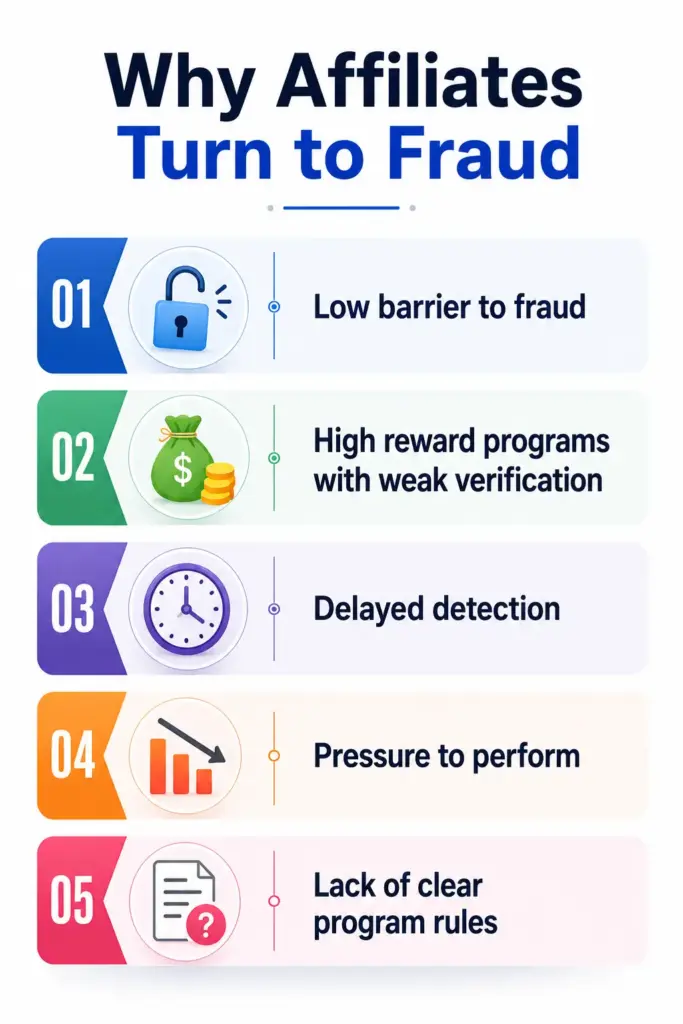
- Low barrier to fraud: Setting up bot traffic or using cookie stuffing techniques doesn’t require sophisticated technical knowledge anymore. Tools that enable fraud are unfortunately accessible.
- High reward programs with weak verification: Programs that offer generous commissions without robust verification are natural targets. Fraudsters look for the easiest payouts.
- Delayed detection: Many program owners don’t audit their affiliate data regularly. A fraudster can operate for months before anyone notices.
- Pressure to perform: Sometimes, even previously legitimate affiliates turn to shortcuts when they’re under pressure to hit commission targets or when organic performance drops.
- Lack of clear program rules: If your affiliate agreement doesn’t explicitly prohibit specific tactics, some affiliates will interpret that silence as permission.
How to Detect Affiliate Fraud Early
Early detection is everything. The longer fraud goes undetected, the more you pay out in illegitimate commissions and the harder it becomes to reverse.
Here’s a practical detection framework:
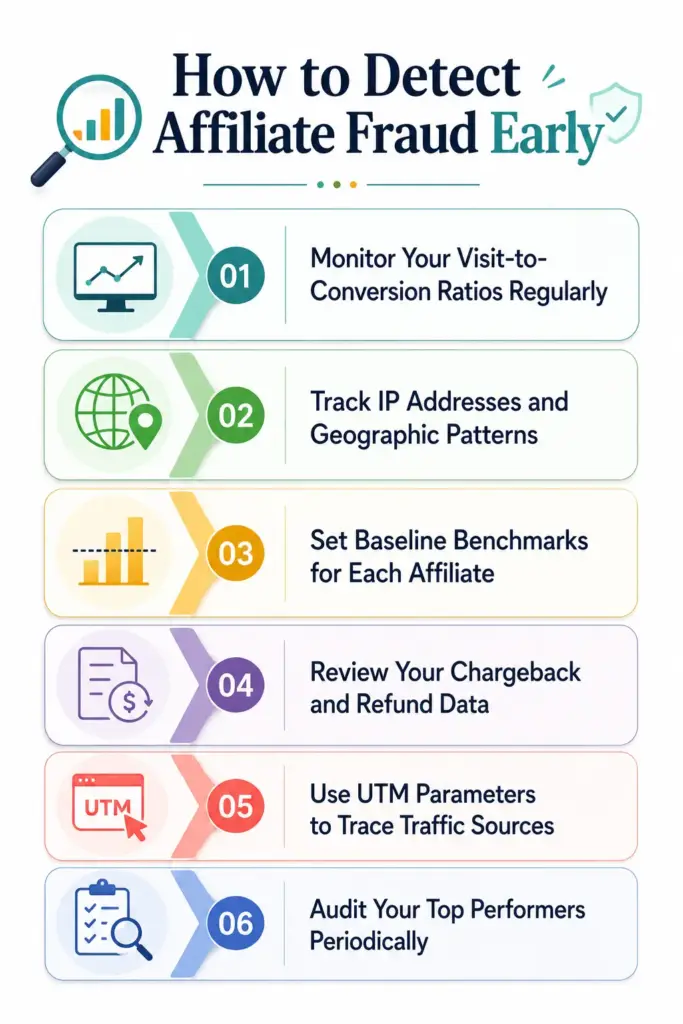
A. Monitor Your Visit-to-Conversion Ratios Regularly
A healthy affiliate program has conversion rates that generally align with your site’s overall performance. If one affiliate is sending 5,000 visits with zero conversions while another sends 200 visits and generates 15 sales, something is wrong.
In FluentAffiliate, the Visits page lets you filter by “Converted” and “Not Converted” visits. Make this a weekly habit. Look for affiliates with dramatically disproportionate visit-to-conversion gaps.
B. Track IP Addresses and Geographic Patterns
Genuine customers come from diverse IP addresses and realistic geographic locations. Fraudulent traffic often clusters. If you see 3,000 visits all originating from data center IP ranges in a country where you have no marketing presence, that’s a serious red flag.
C. Set Baseline Benchmarks for Each Affiliate
When an affiliate joins your program and generates their first few legitimate referrals, you establish a baseline for their typical performance pattern. Watch for sudden dramatic changes; a 10x spike in traffic overnight with no corresponding marketing campaign is worth investigating.
D. Review Your Chargeback and Refund Data
Cross-reference your payout data with your order refund records. Any affiliate whose referred orders have a significantly higher refund or chargeback rate than your program’s average deserves a closer look.
E. Use UTM Parameters to Trace Traffic Sources
FluentAffiliate captures UTM Campaign, UTM Medium, and UTM Source data in the Visits table. Legitimate affiliates running real campaigns will have consistent, meaningful UTM values. Fraudulent bot traffic often has blank, random, or nonsensical UTM data.
F. Audit Your Top Performers Periodically
It feels counterintuitive, but your highest-earning affiliates deserve the most scrutiny. Fraud that goes undetected for a long time usually does so because it’s hiding behind impressive-looking numbers. Schedule quarterly audits of your top 10% earners.
Explore More: 7 Best Affiliate Fraud Detection Software for WordPress
Proven Strategies to Prevent Affiliate Fraud
Detection is reactive. Prevention is where you really protect your program.
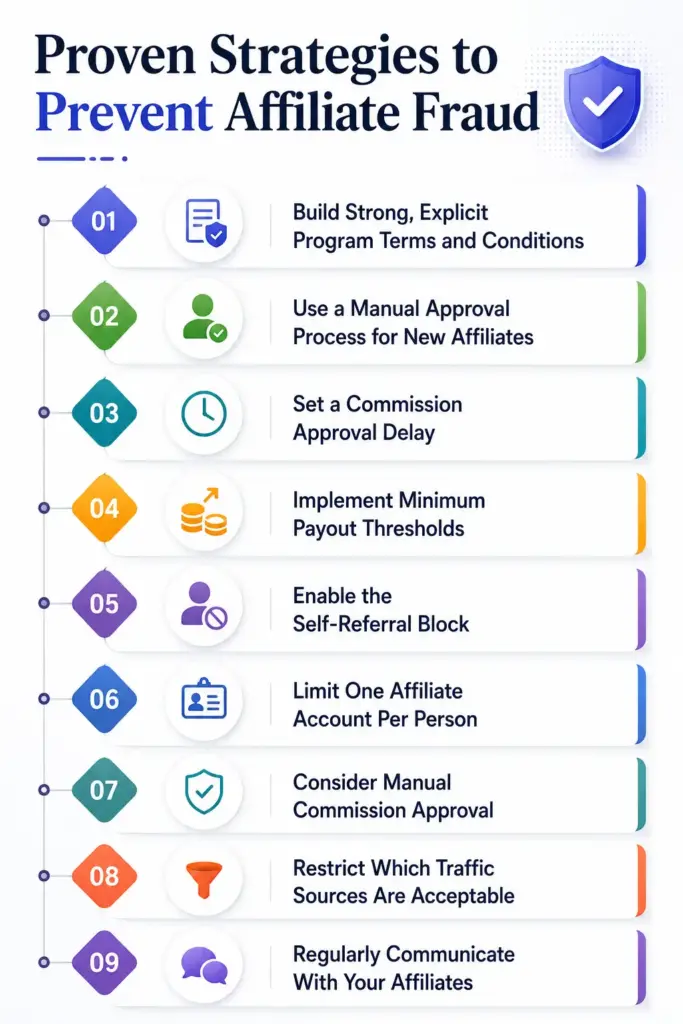
1. Build Strong, Explicit Program Terms and Conditions
Your affiliate agreement should explicitly prohibit:
- Fake clicks, bot traffic, and click fraud of any kind
- Cookie stuffing or any form of forced attribution
- Bidding on your brand keywords in paid search
- Self-referrals (unless you intentionally allow them)
- Fake leads or incentivized signups without disclosure
- Use of typosquatting domains
Make the consequences crystal clear, too. Violators should know their account will be terminated and any pending commissions forfeited. When fraud has explicit consequences in writing, some would-be fraudsters won’t bother.
2. Use a Manual Approval Process for New Affiliates
FluentAffiliate’s Registration Settings include a “Require admin approval for new affiliates” option for exactly this reason. Don’t let just anyone into your program automatically.
Review each application. Check their website, their social presence, and their promotional methods. Real affiliates are usually happy to share how they’ll promote you. Fraudsters often provide vague or suspicious answers.
3. Set a Commission Approval Delay
Rather than paying commissions instantly, implement a holding period, typically matching your refund window. If your refund policy is 30 days, hold commission approval for 30 days.
In FluentAffiliate, new referrals can be set to “Pending” status by default. You review and approve them before they become payable. This gives you time to verify that the associated orders haven’t been refunded or disputed before commissions are released.
4. Implement Minimum Payout Thresholds
Setting a minimum payout amount (available in FluentAffiliate’s Payout Management) means fraudsters can’t quickly extract small commission amounts and disappear. They’d need to accumulate a meaningful balance first, giving you more time to detect patterns before funds leave your system.
5. Enable the Self-Referral Block
This is a simple one-click protection in FluentAffiliate’s Referral Settings. Enable “Disable Self Referral,” and affiliates can no longer earn commissions on their own purchases. This eliminates one common low-effort fraud tactic immediately.
6. Limit One Affiliate Account Per Person
Establish and enforce a one-account-per-person policy. Some fraudsters create multiple affiliate accounts to spread suspicious activity and avoid triggering per-affiliate detection thresholds. Require a valid email and verify identities for high-commission programs.
7. Consider Manual Commission Approval for Unusually Large Referrals
Automated approval works fine for routine commissions. But for unusually large orders, say, anything above 3x your average order value, consider requiring manual review before marking the referral as approved. Large fraudulent transactions are particularly costly to discover after the fact.
8. Restrict Which Traffic Sources Are Acceptable
If you don’t want affiliates running paid ads, say so explicitly in your program terms and enforce it. Some affiliate program managers also restrict social ad placements, email spam, and specific types of incentivized traffic.
9. Regularly Communicate With Your Affiliates
Fraud often thrives in silence. Affiliates who feel connected to your program, heard, and valued are far less likely to cut corners. Build a real relationship with your affiliate community. A monthly email, a private community space, or even occasional personal check-ins go a long way.
What to Do When You Catch Affiliate Fraud
So you’ve spotted something suspicious. What now?
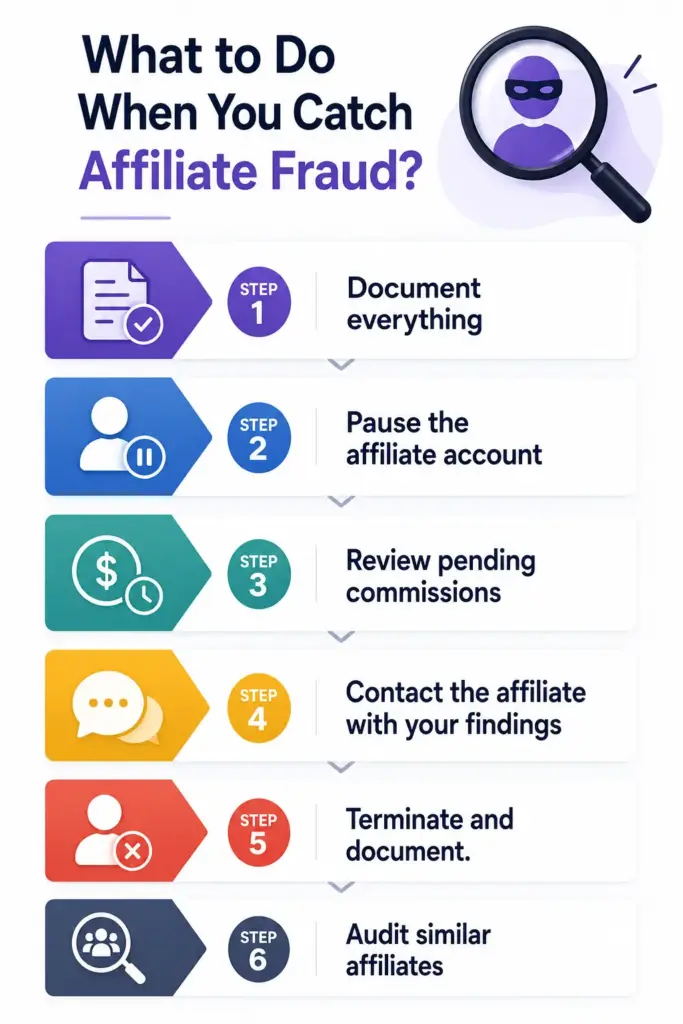
Step 1: Document everything
Screenshot data. Export your visit logs and referral records. Note dates, times, and specific patterns. You’ll need this if the affiliate contests your decision.
Step 2: Pause the affiliate account
In FluentAffiliate, you can change an affiliate’s status to “Inactive” immediately. This stops new referrals from being attributed to them while you investigate.
Step 3: Review pending commissions
Mark suspicious referrals as “Rejected” in your Referrals dashboard before they’re paid out. If commissions have already been paid, assess whether you have grounds for clawback based on your program terms.
Step 4: Contact the affiliate with your findings
In some cases, affiliates use third-party promotional services without fully understanding the tactics those services use. Give them an opportunity to respond, but be firm about your evidence.
Step 5: Terminate and document.
If fraud is confirmed, terminate the account. Update your records. In serious cases involving financial fraud or chargebacks, contact your payment processor and consider reporting to the appropriate authorities.
Step 6: Audit similar affiliates
Fraud rarely happens in isolation. Check whether other affiliates in your program exhibit similar behavioral patterns.
Building a Fraud-Resistant Affiliate Program From Day One
The cleanest path to fraud prevention is building the right foundations from the start.
Choose your affiliate management tool wisely. FluentAffiliate gives you granular control over every part of your program; visit tracking with UTM data, referral status management, manual approval workflows, self-referral prevention, payout thresholds, and permission-based access for managers who help you monitor things. These aren’t just nice features. They’re fraud-prevention infrastructure.
Start small and scale carefully. It’s tempting to open your affiliate program wide and let anyone join. But a smaller, curated network of verified partners you actually trust is worth far more than a massive open program riddled with bad actors.
Invest time in your analytics. Fraudsters rely on program owners being too busy to look closely at their data. Make a habit of reviewing your Visits and Referrals dashboards in FluentAffiliate at least once a week. Patterns that look suspicious usually become obvious with consistent monitoring.
Build relationships, not just transactions. Legitimate affiliates want a long-term partnership. They want to grow with you. Invest in those relationships. A well-supported affiliate community is your best natural defense against fraud, because real partners report suspicious behavior, help maintain program integrity, and don’t need to cheat to succeed.

Get the Most Secured Affiliate Plugin for WordPress
Protect Your Program; Starting Today
Affiliate fraud is a real threat, but it’s not an unbeatable one. With the right awareness, the right tools, and consistent monitoring habits, you can run a clean, high-performing affiliate program that rewards legitimate partners and protects your business.
FluentAffiliate gives you the visibility and control you need to do exactly that, from granular visit tracking and UTM data to manual approval workflows, referral status management, and role-based access permissions. Every feature is designed to help you run a program you can actually trust.
Ready to build a fraud-resistant affiliate program on WordPress? Explore FluentAffiliate and see how it helps you track, protect, and grow your affiliate partnerships the right way.
Because the affiliates doing real work for your business deserve a program that’s fair, and so do you.





Add your first comment to this post