

Affiliate Outreach: How to Find, Pitch, and Onboard Partners Who Actually Sell
Most affiliate outreach fails before the email is even sent. People grab a list, paste a template, hit send, and wonder why nobody replies. No, that’s not outreach. That’s spam in a suit.
Real affiliate outreach is about preparation, targeting, and follow-through.
In this guide, I’ll walk you through the full process, from getting your program ready to onboarding partners who actually drive sales.
Key Takeaways: Affiliate Outreach
- Affiliate outreach is about precision, not volume. Send fewer, better-targeted pitches instead of mass cold emails.
- Get your program ready before reaching out. Set competitive commission rates, prepare promotional materials, and make sure your affiliate dashboard works smoothly.
- The best affiliates are often your existing happy customers, niche bloggers, smaller engaged YouTubers, and community moderators, not big-name influencers.
- Always research a prospect before pitching. Spend 5 to 10 minutes checking their audience engagement, content style, and recent activity to confirm fit.
- A strong affiliate pitch is short, personal, and offers a clear, specific commission. Avoid templates that feel automated, vague promises, and demands for calls in the first email.
- Follow up a maximum of two times. First follow-up after 4 to 7 days, second after another 7 to 10 days. Then move on.
- Onboarding matters more than recruiting. Welcome new affiliates within 24 hours, walk them through the dashboard, and do a soft 30-day check-in to keep them active.
What Affiliate Outreach Really Means
Affiliate outreach is the process of finding the right people, reaching out to them, and convincing them to promote your product in exchange for a commission. Simple in theory. Messy in practice.
A few years ago, you could send 200 cold emails, get 20 replies, and sign up 5 affiliates. Those days are long gone. Creators and bloggers now get flooded with pitches every single week. Most of them sound the same. Most of them get deleted in seconds.
What changed?
- AI-generated pitches are everywhere, and people can spot them instantly
- Top creators have agents, managers, or strict partner policies
- Smaller creators have learned to say no to bad deals
- People care less about commission rates and more about brand fit
So the game shifted. Outreach today is less about volume and more about precision. You need fewer, better-targeted conversations. That means doing real research, writing real emails, and showing up with a real offer.
If your outreach still looks like “Hey {{FirstName}}, I love your blog about {{Niche}}”, you’ve already lost.
Before You Reach Out, Get Your Program Ready
This is the step almost everyone skips. They start outreach before their affiliate program is actually ready for affiliates. Then partners sign up, log in, find nothing useful, and disappear.
Don’t do that.
Before you send a single pitch, ask yourself a few questions:
- Is my commission rate actually competitive in my niche?
- Do I have promotional materials ready, like banners, swipe copy, or QR codes?
- Is there a clear dashboard where affiliates can track their performance?
- Do I have a smooth way to pay them on time?
- Is my offer something people would genuinely recommend?
If you can’t answer yes to all of those, fix that first.
This is where a solid affiliate management plugin saves you. If you’re on WordPress, FluentAffiliate gives you everything you need to set up a clean, partner-ready program. You can build commission tiers, create affiliate creatives like banners and QR codes that your partners can grab from their dashboard, and even set up custom landing pages for top affiliates with branded URLs.
When a potential affiliate visits your dashboard for the first time, they should think “okay, these people know what they’re doing.” If your program looks half-finished, they’ll move on.
Get the basics right first. Then start reaching out.
Affiliate Outreach Strategies for Your Niche
Before you start hunting, define your ideal affiliate profile. Who would naturally recommend your product? What do they create? Where does their audience hang out?
For example, if you sell a course on email marketing, your ideal affiliates might be:
- Email marketing bloggers
- YouTubers who teach freelancing or solopreneur skills
- Course creators in adjacent niches like copywriting
- Newsletter writers in marketing or SaaS
- Community admins in marketing Facebook groups
Now you have a target. Time to look for them.
Here are the best places to find quality affiliates:
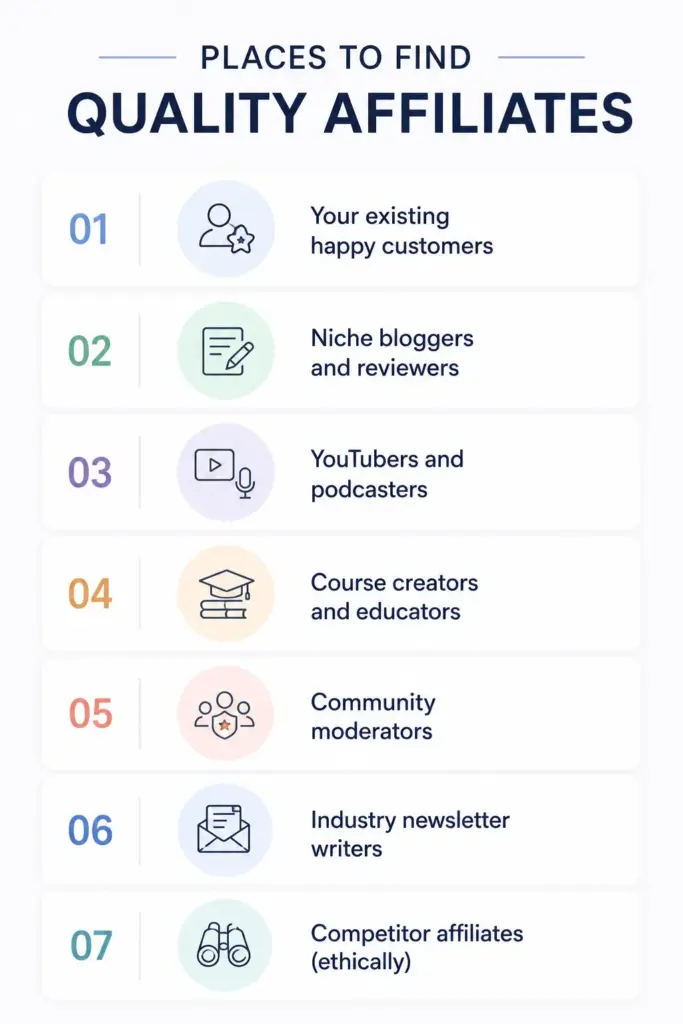
Your existing happy customers. This is the most underrated source. People who already love your product are halfway to becoming affiliates. Send them an invite. They’ll convert better than any cold prospect.
Niche bloggers and reviewers. Search Google for “best [your product category]” and see who already writes about your space. They’re already creating content that converts.
YouTubers and podcasters. Look for creators with engaged audiences, not just big numbers. A YouTuber with 8,000 subscribers and 1,200 views per video often beats one with 80,000 subs and 2,000 views.
Course creators and educators. If they teach something related to your product, your tool might fit perfectly into their workflow.
Community moderators. Reddit mods, Facebook group admins, Discord server owners. These people influence buying decisions every day.
Industry newsletter writers. Substack and Beehiiv have changed the game. A small newsletter with 3,000 engaged readers can outperform a big blog.
Competitor affiliates (ethically). Look at who promotes products similar to yours. If they already do affiliate marketing in your space, they understand the model and don’t need to be educated.
Cast a wide net for research, then narrow it down hard before pitching.
How to Research a Potential Affiliate Before Pitching
Don’t pitch anyone you haven’t researched. This is where most outreach falls apart.
Spend 5 to 10 minutes on each prospect. Look at:
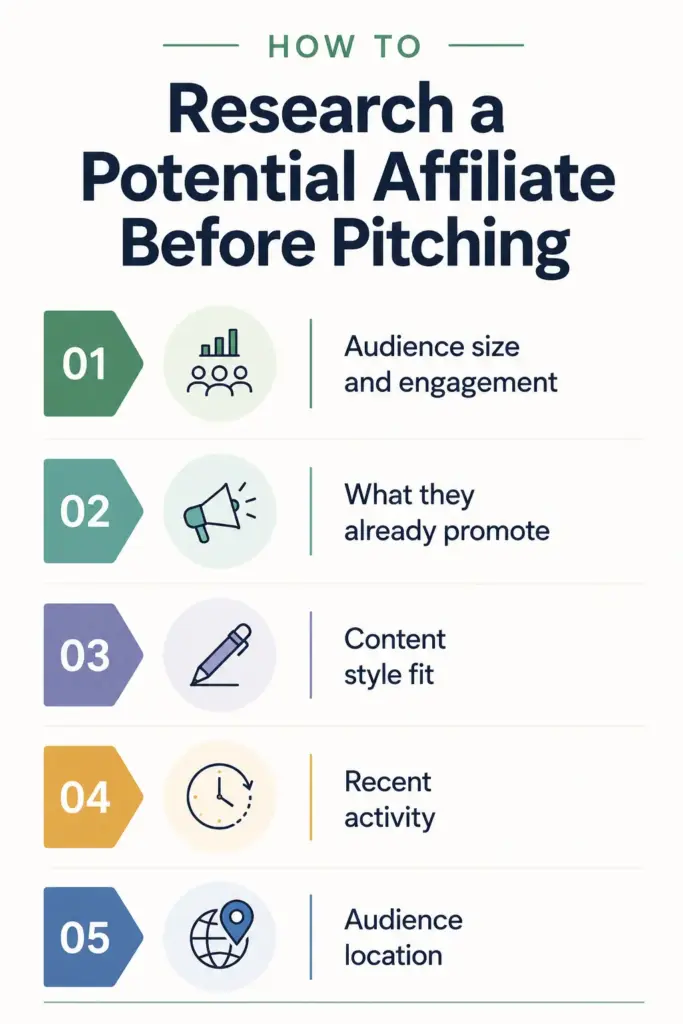
- Audience size and engagement. Followers don’t matter much anymore. Look at comments, shares, and replies. A blog with 500 monthly readers who comment beats one with 50,000 ghost readers.
- What they already promote. If they push 20 different products a month, your offer will get lost. If they rarely recommend anything, a recommendation from them carries weight.
- Content style fit. A no-nonsense, technical reviewer probably won’t promote a flashy, hype-driven product. Match the vibe.
- Recent activity. When was their last post? If they haven’t published in 6 months, they’re probably not active enough to drive sales.
- Audience location. If your product only ships or works in certain countries, make sure their audience matches.
Red flags to watch for:
- They promote too many competing products
- Their engagement looks fake (lots of generic comments like “great post”)
- They haven’t posted recently
- They’ve never recommended anything in your category before
- Their audience is the wrong size or demographic for your product
Research saves you from wasting time on pitches that were never going to work.
Writing an Affiliate Pitch That Actually Gets a Reply
Now the actual email. This is where most people mess it up.
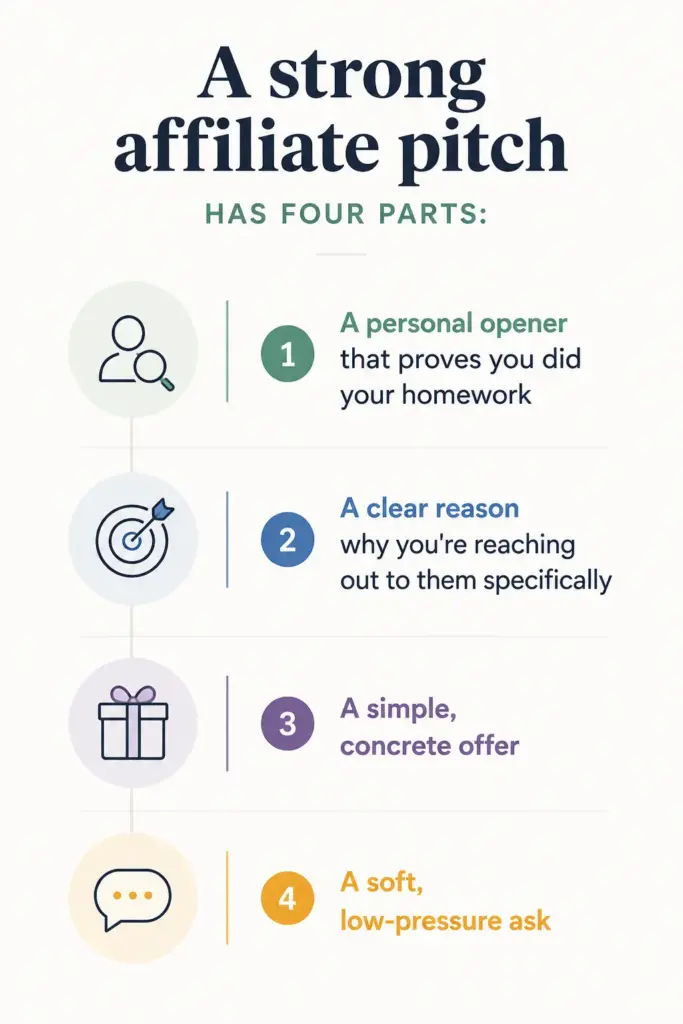
A strong affiliate pitch has four parts:
- A personal opener that proves you did your homework
- A clear reason why you’re reaching out to them specifically
- A simple, concrete offer
- A soft, low-pressure ask
Keep it short. Five short paragraphs maximum. Long emails get scrolled past.
Here’s an example pitch for a blogger:
Hey Sarah,
I just read your post on “How to Pick the Right CRM for Solo Founders.” The point about ignoring features you’ll never use was exactly what I needed to hear last year when I overspent on a bloated tool.
I run FluentAffiliate, a WordPress affiliate plugin for course creators and SaaS founders. Given your audience of solo founders, I think there’s a strong fit.
I’d love to invite you to our affiliate program. We pay 30% recurring on every sale, our cookie window is 60 days, and we provide custom landing pages and banners so you don’t have to design anything yourself.
Would you be open to taking a look? Happy to send over more details or set up a custom commission if your audience is a strong match.
Best, Alex
Now here’s a pitch for a course creator:
Hi Marco,
I came across your course on building paid newsletters. The module on subscriber retention was really sharp. I’ve shared it with a few founder friends already.
I’m reaching out because I run an affiliate program for a WordPress plugin called FluentAffiliate. A lot of your students probably already use WordPress to run their newsletters, so I thought there might be a natural fit.
Quick numbers: 25% commission on every sale, 60-day cookie, and a dedicated dashboard with banners, QR codes, and tracking links. We also do custom branded landing pages for our top affiliates.
No pressure. If it sounds interesting, I can send you our affiliate guide and a free license to test the plugin yourself.
Thanks for the great work, Marco.
Alex
Notice what’s missing from both?
- No “Dear sir/madam”
- No five paragraphs about your company history
- No vague promises like “great commissions”
- No demand for a 30-minute call
- No fake urgency
What to avoid in your pitches:
- Mass mail-merge templates that scream automation
- Vague offers like “competitive commissions” instead of an actual number
- Long company intros nobody asked for
- Asking for a meeting or call in the first email
- Sending the exact same email to every prospect
Personalize the opener. Be specific about the offer. Make it easy to say yes.
How to Follow Up Without Being Annoying
People miss emails. Inboxes are chaos. A follow-up isn’t pushy if it’s done right.
Here’s the timing I recommend:
- First follow-up: 4 to 7 days after the initial email
- Second follow-up: 7 to 10 days after the first follow-up
- Stop after that
Two follow-ups are the limit. If they haven’t replied by then, they’re either not interested or not the right fit. Move on.
What to say in your first follow-up:
Hey Sarah,
just bumping this in case it got buried. No pressure either way.
Let me know if it’s something worth exploring.
That’s it. Don’t repeat your whole pitch. Don’t apologize for emailing again. Keep it short and human.
For the second follow-up, add a small new piece of value:
Hi Sarah,
last note from me on this. We just published a comparison guide between our plugin and the top three alternatives, in case it’s useful for your readers.
Either way, I’ll stop pestering you. Door’s open if you want to chat.
After that, walk away. Add them to a list to revisit in 6 months with a new reason to reach out.
What to Do When an Affiliate Says Yes
This is where most programs fall apart. The affiliate signs up, logs into the dashboard, sees a confusing screen, and never comes back.
Don’t let that happen.
When someone agrees to join, send a welcome email within 24 hours. Include:
- A short “thank you, glad to have you” note
- A link to their affiliate dashboard
- Their unique referral link, ready to copy
- A walkthrough of where to find banners, QR codes, and creatives
- A simple list of 3 to 5 promo ideas they can try first
- Your direct email in case they get stuck
If you’re using FluentAffiliate, your new partners land in a clean affiliate dashboard where they can see their links, visits, referrals, and payouts at a glance. The affiliate creatives module also gives them ready-to-use banners, text links, and QR codes from day one, so they don’t have to design anything themselves.
Schedule a soft 30-day check-in. Just a quick “hey, how’s it going, anything I can help with?” message. Most affiliates ghost not because they don’t like your product, but because they got busy and forgot. A check-in pulls them back in.
The goal of onboarding is simple: make it as easy as possible for them to send their first referral. The faster they see their first commission, the more likely they are to stick around.
How to Keep Affiliates Active After Onboarding
Recruiting is half the job. Keeping affiliates active is the other half. Most programs ignore this and wonder why their referrals dry up.
Here’s what actually works:
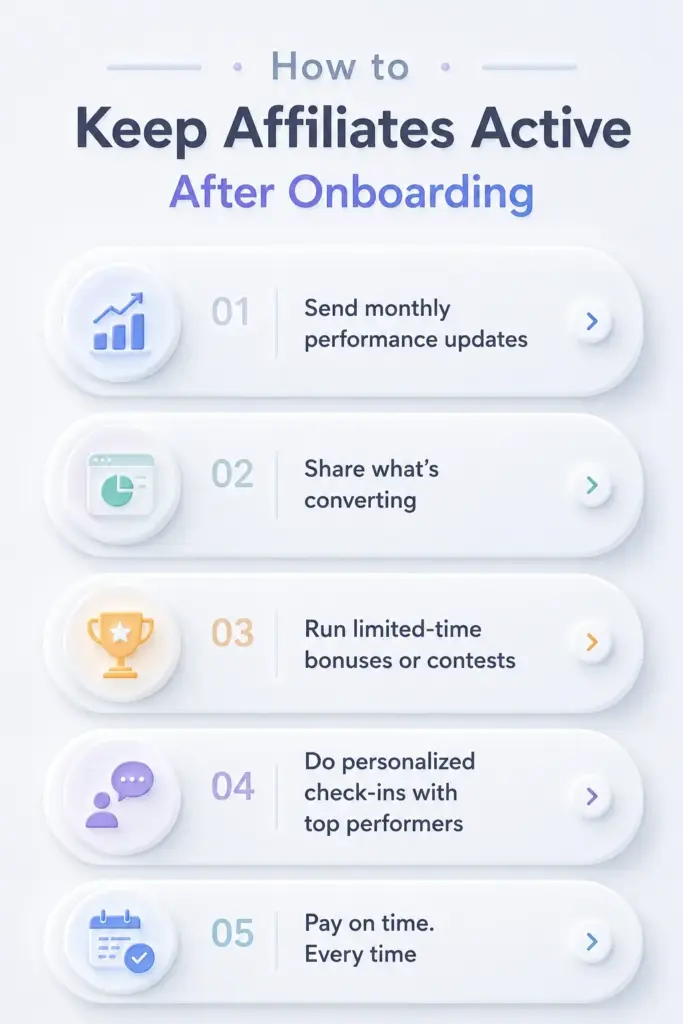
Send monthly performance updates. A short email with their stats. “You drove 12 visits and 2 sales this month. You’ve earned $47. Here’s what’s working for other affiliates.”
Share what’s converting. If a particular blog post, landing page, or email subject line is driving sales, tell your affiliates. They’ll copy it.
Run limited-time bonuses or contests. “Top affiliate this month wins an extra $500” works. So does “anyone who drives 5+ sales this quarter gets a 5% bonus.” Urgency drives action.
Do personalized check-ins with top performers. Your top 5 affiliates probably drive 80% of your revenue. Treat them like VIPs. A 15-minute call once a quarter goes a long way.
Pay on time. Every time. This sounds basic but it’s the number one reason affiliates leave programs. If your payouts are late or confusing, partners stop promoting. FluentAffiliate’s payout management lets you handle this cleanly with full reporting and CSV exports.
Treat your affiliates like partners, not numbers. The ones who feel valued will stick around for years.
Common Affiliate Outreach Mistakes to Avoid
Here are the mistakes I see again and again:
- Pitching before your program is ready. Affiliates sign up, find a mess, and leave.
- Treating outreach as a one-shot deal. You don’t recruit 50 affiliates in one week and call it done. It’s an ongoing process.
- Using the same template for everyone. Personalization isn’t optional anymore.
- Only chasing big names. A creator with 50,000 engaged readers often outperforms one with 500,000 disengaged ones.
- Bad commission structures. If your commission is below industry standard, top affiliates will pass.
- No follow-through after they join. Onboarding matters more than the pitch.
- Ignoring small wins. Five active affiliates earning small commissions can quietly build into your biggest revenue channel.
- Giving up too early. Outreach is a numbers game inside a quality game. You’ll get rejected. Keep going.
Most of these mistakes come from treating outreach as a transaction instead of a relationship. Fix that mindset first, and everything else gets easier.
Wrapping Up
Affiliate outreach isn’t about sending more emails. It’s about preparing better, targeting smarter, and following through after the yes. The people who win at this are the ones who treat affiliates like partners, not lead lists.
If you’re building or scaling an affiliate program on WordPress, FluentAffiliate gives you the full toolkit. Custom commission rates, creatives your partners actually want to use, branded landing pages, clean payout management, and integrations with WooCommerce, MemberPress, LearnDash, and more.
Get your program ready. Reach out with care. Onboard with intention. Pay on time. Do those four things consistently, and your affiliate channel will compound for years. Ready to set up an affiliate program that partners want to join? Try FluentAffiliate and get your program live in under an hour.


Add your first comment to this post