Affiliate Program 101: A Complete Beginner-to-Strategic Guide

An affiliate program is the system that allows businesses to reward partners for promoting their products. Affiliates share referral links, recommend products to their audience, and earn a commission when a sale happens.
For many online businesses, this model has become one of the most reliable ways to grow revenue while keeping marketing costs performance-based.
In this guide, you will learn how affiliate programs work, why businesses start them, the different structures they use, and how to build one successfully.
What Is an Affiliate Program?
An affiliate program is a structured system that allows partners to promote your product in exchange for a commission. It provides the rules, tracking, and payouts that make partner-based promotion possible.
To understand it better, it helps to separate it from a closely related concept.
Affiliate marketing is the overall marketing model where businesses reward partners for driving sales or leads. It is the strategy behind the growth.
An affiliate program is the system you create to run that strategy. It defines how affiliates join, how their links are tracked, how commissions are calculated, and how payouts are handled.
Explore More: What Is an Affiliate Program & What It Means in 2026
Why Businesses Start Affiliate Programs
If you run an online business, you are always looking for ways to grow without burning cash on marketing. That is exactly where affiliate programs shine.
An affiliate program lets you turn partners into a distributed sales force. Instead of paying upfront for exposure, you reward partners only when they generate results, such as a sale or qualified lead. That performance-based structure is one of the main reasons businesses adopt affiliate programs.
Here are the key reasons companies launch them.
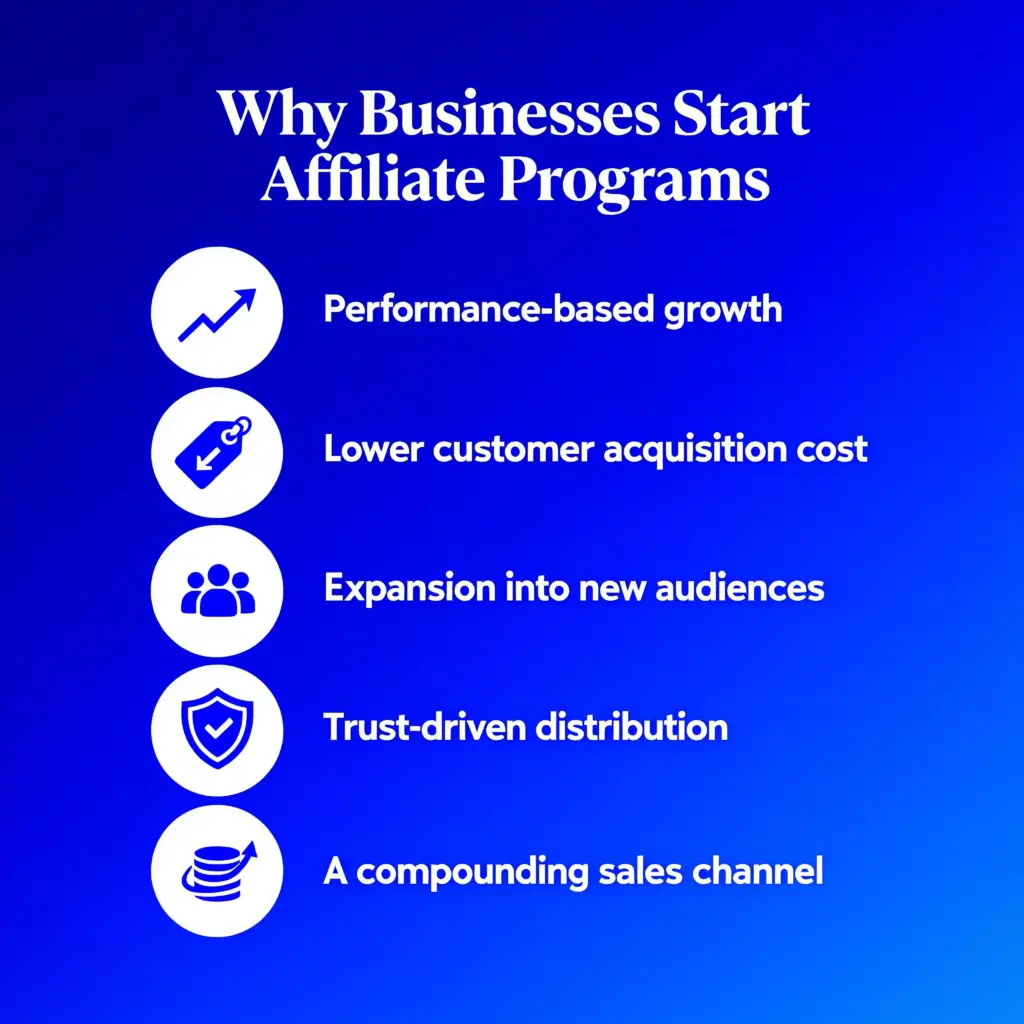
- Performance-based growth: With ads, you pay whether they convert or not. With an affiliate program, you usually pay only when a sale happens. That means your marketing spend ties to revenue directly, making growth far more predictable.
- Lower customer acquisition cost (CAC): Paid ads can quickly become expensive as competition increases. Affiliate programs often reduce customer acquisition cost because you share revenue only after the sale is completed.
- Expansion into new audiences: Affiliates already have their own audiences. These could be blog readers, YouTube viewers, email subscribers, or niche communities. When they promote your product, you instantly reach audiences you may never access through your own marketing channels.
- Trust-driven distribution: People trust recommendations from creators, educators, and industry experts more than traditional ads. When a trusted voice recommends your product, the promotion feels more like advice than advertising.
- A compounding sales channel: Unlike short-lived ad campaigns, affiliate programs often grow over time. The more affiliates join and promote your product, the more content, reviews, and recommendations exist online. This creates a compounding distribution channel that keeps bringing in customers.
Explore More: Affiliate Marketing Programs for Small Businesses
Affiliate Programs vs Other Growth Channels
To understand their value, it helps to compare them with other common marketing methods.
A. Affiliate program vs running ads
Ads give you immediate visibility, but they stop working the moment you stop paying. Affiliate programs are slower to start, but they often create long-term promotion through partner content and communities.
B. Affiliate program vs influencer sponsorships
Influencer sponsorships usually require upfront payment for exposure. With an affiliate program, influencers can promote your product and earn commissions based on actual sales, aligning incentives for both sides.
Because of this, many modern businesses combine multiple channels but rely on affiliate programs as a scalable, performance-driven growth engine.
Explore More: Affiliate Marketing vs Influencer Marketing
Affiliate Program vs Affiliate Network
When businesses explore affiliate marketing, one question appears very quickly: Should you run your own affiliate program or join an affiliate network?
Both approaches allow partners to promote your products and earn commissions, but the way they operate is quite different.
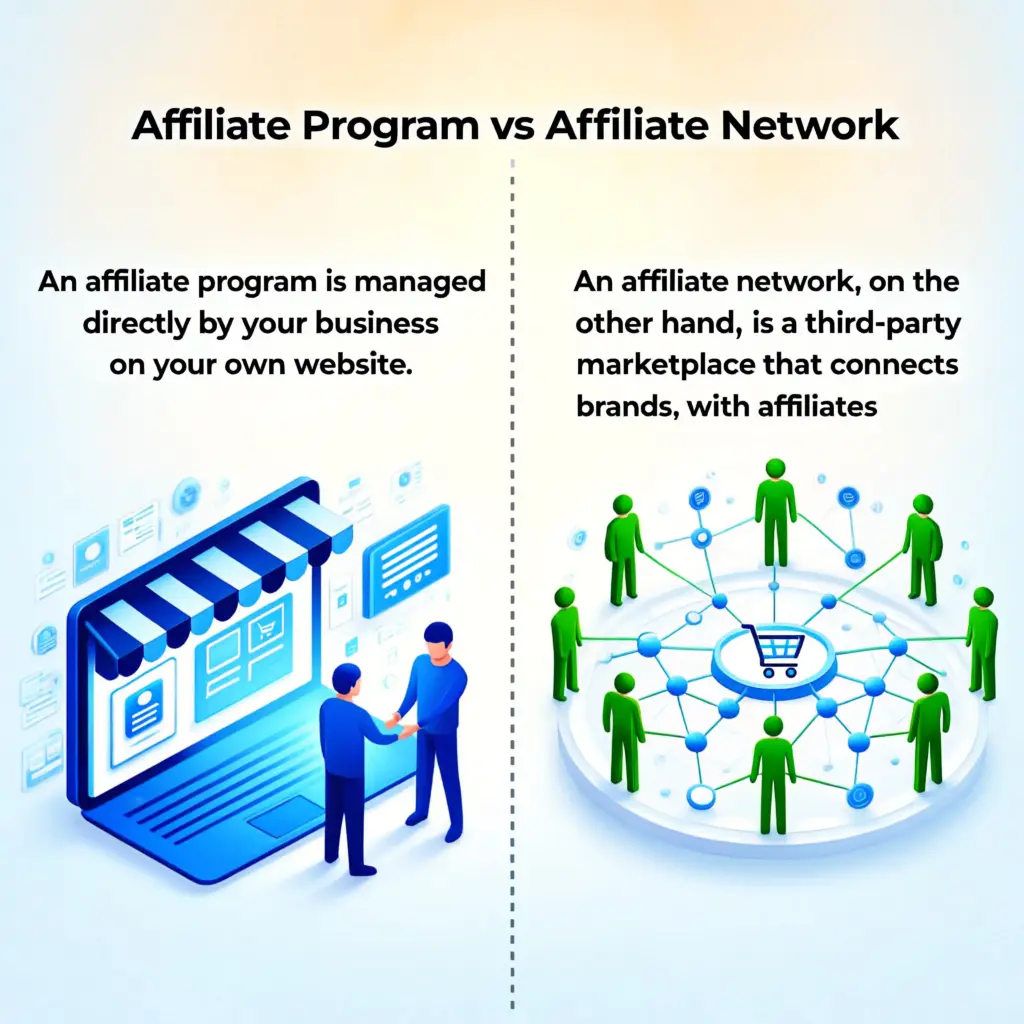
An affiliate program is managed directly by your business on your own website. You control the software, the rules, the commissions, and the relationships with your affiliates.
An affiliate network, on the other hand, is a third-party marketplace that connects brands with affiliates. Instead of running the program yourself, the network handles tracking, payments, and recruitment within its platform.
Some well-known affiliate networks include ShareASale, CJ Affiliate, and Impact. These platforms host thousands of brands and affiliates inside their ecosystems.
While both options enable affiliate marketing, they differ in several important ways.
| Factor | Affiliate Program | Affiliate Network |
| Control | Full control over tracking, commissions, and policies | Limited control since the platform manages the system |
| Cost | Lower long-term cost when managed on your own website | Network fees, platform fees, and sometimes transaction costs |
| Recruitment | Affiliates must be recruited manually through outreach or marketing | Built-in marketplace where affiliates can discover your program |
Running your own affiliate program gives you more control, flexibility, and long-term cost efficiency. However, it requires effort to recruit affiliates and manage the system.
Affiliate networks, on the other hand, can make it easier to discover affiliates quickly, but they often come with platform fees and less flexibility in how the program operates.
For many businesses, especially those running digital products or WordPress-based stores, starting with their own affiliate program provides a strong foundation before expanding into networks later.
Learn in-depth: Affiliate Network vs Affiliate Program
Types of Affiliate Programs
Not all affiliate programs work the same way. Businesses design them differently depending on their goals, products, and growth strategy.
Understanding the main types of affiliate programs will help you see how companies structure partnerships and incentivize promotion.
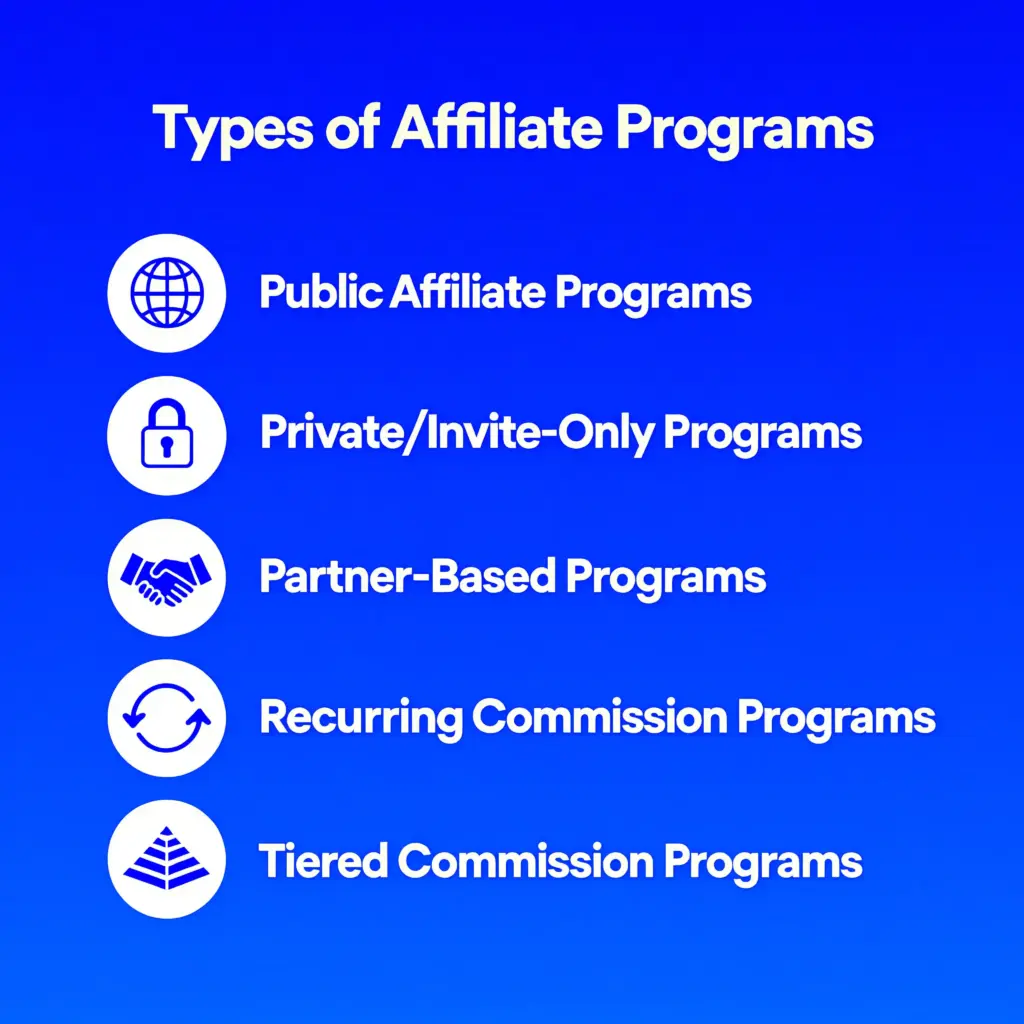
1. Public Affiliate Programs (Open Registration)
A public affiliate program allows anyone to apply and join. Typically, creators, bloggers, marketers, and customers can sign up through a registration page.
These programs focus on scale. The goal is to attract as many affiliates as possible so the product gets promoted across blogs, social media, YouTube, and email newsletters.
Many e-commerce brands and digital products use this model because it maximizes reach and discovery.
2. Private or Invite-Only Programs
Some businesses prefer to keep their affiliate programs exclusive. Instead of open registration, affiliates are carefully selected and invited.
This model is common for:
- High ticket products
- Premium SaaS tools
- Niche B2B software
- Brands that want strict control over messaging
Because the affiliate pool is smaller and curated, companies can maintain higher-quality promotions and stronger brand alignment.
3. Partner-Based Programs
A partner-based affiliate program focuses on strategic collaborations rather than mass recruitment.
These partners often include:
- Agencies
- Consultants
- Course creators
- Industry tools with complementary products
Instead of simple referrals, these partnerships often involve co-marketing, integrations, or bundled offers, making them a powerful distribution channel.
4. Recurring Commission Programs (Common in SaaS)
Many software companies offer recurring commissions, where affiliates earn a percentage every time the referred customer renews their subscription.
For example, if a SaaS tool pays 30% recurring commission, the affiliate earns a share of the subscription every month or year for as long as the customer remains active.
This model is attractive because it creates long-term passive income for affiliates, which motivates them to promote the product consistently.
5. Tiered Commission Programs
Tiered affiliate programs reward affiliates based on their performance.
The more sales an affiliate generates, the higher their commission rate becomes.
A typical structure might look like:
- 10 percent commission for the first 20 sales
- 15 percent commission after 20 sales
- 20 percent commission after 50 sales
This structure encourages affiliates to increase promotion effort and scale their results, while businesses reward their top performers.
Read More: Complete Guide to Types of Affiliate Marketing
How an Affiliate Program Works (Operational View)
From the outside, affiliate programs look simple. Someone promotes your product and earns a commission. But behind the scenes, there is a clear operational process that keeps everything organized and fair for both the business and the affiliates.
Here is how an affiliate program typically works from the merchant’s perspective.

Step 1: Choose Affiliate Management Software
The first step is choosing affiliate management software. This tool acts as the backbone of your program.
It helps you:
- Track affiliate links and referrals
- Monitor clicks, conversions, and sales
- Manage affiliates from a dashboard
- Calculate commissions automatically
- Handle payouts and reporting
Without proper software, managing affiliates manually can quickly become messy.
Step 2: Define the Commission Structure
Next, you decide how affiliates will get paid.
Common commission structures include:
- Percentage of each sale
- Fixed amount per sale or lead
- Recurring commissions for subscription products
- Tiered commissions for high performers
Your commission structure should be attractive enough to motivate affiliates while still leaving healthy profit margins.
Step 3: Set Terms and Policies
Every affiliate program needs clear rules and guidelines.
These usually include:
- Commission rates and payment schedule
- Cookie duration (how long referrals are tracked)
- Approved promotion methods
- Restricted traffic sources, such as spam or brand bidding
- Refund and chargeback policies
Clear policies prevent misunderstandings and protect your brand.
Step 4: Recruit Affiliates
Once the system is ready, the next step is bringing affiliates into the program.
Businesses usually recruit affiliates through:
- Affiliate signup pages on their website
- Outreach to bloggers and creators
- Existing customers and community members
- Partnerships with agencies or educators
- Affiliate marketplaces and networks
The goal is to find people who already reach the audience that would benefit from your product.
Step 5: Track Referrals
After affiliates join, they receive unique tracking links.
When someone clicks the link and completes a purchase or action, the affiliate software records the referral using tracking technologies such as cookies or referral IDs.
This ensures every sale is correctly attributed to the right affiliate.
Step 6: Approve Commissions
Before payouts happen, businesses usually review and approve commissions.
This step helps verify that:
- The sale is legitimate
- The order was not refunded
- The affiliate followed program policies
Many programs also include a short waiting period before commissions are approved.
Step 7: Process Payouts
Finally, approved commissions are paid to affiliates based on the program’s payout schedule.
Common payout methods include:
- PayPal
- Bank transfer
- Stripe
- Wise or other global payment platforms
Payments are often made monthly once affiliates reach a minimum payout threshold.
When these steps work together, the affiliate program becomes a smooth, scalable revenue channel. And this operational setup is exactly why businesses rely on dedicated tools and software to manage their affiliate programs efficiently.
Explore In-depth: How Do Affiliate Programs Work: A Step-by-Step Guide
How to Start an Affiliate Program
Starting an affiliate program may sound complex, but in reality, it follows a clear process. Once you set up the structure, the system can run as a scalable revenue channel for years.
Below is a practical framework many businesses follow when launching their first affiliate program. Each step can later become a deeper topic on its own.
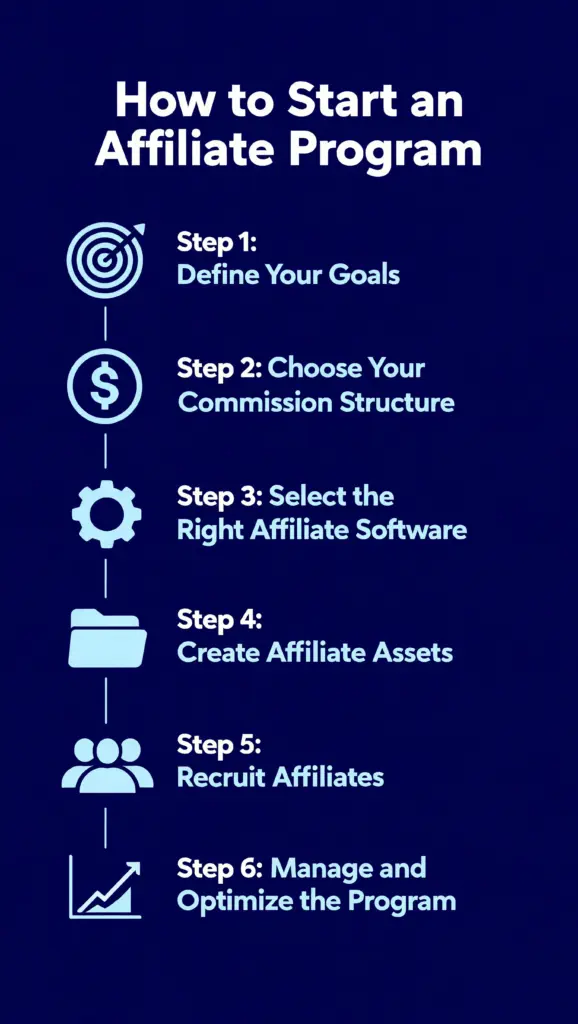
Step 1: Define Your Goals
Before setting up anything, clarify what you want the affiliate program to achieve. Different goals lead to different program structures.
Common objectives include:
- Revenue growth: Drive direct product sales through partners
- Brand reach: Get your product mentioned across blogs, YouTube channels, and communities
- Customer acquisition: Attract new audiences that your current marketing does not reach
- Retention and lifetime value: Encourage long-term promotion through recurring commissions
Your goals will influence your commission structure, partner strategy, and promotional materials.
Step 2: Choose Your Commission Structure
Next, decide how affiliates will earn money when they promote your product.
The most common structures include:
- Flat commission: A fixed amount for each sale or lead
- Percentage commission: Affiliates earn a percentage of the order value
- One-time commission: Paid once when the customer makes the first purchase
- Recurring commission: Affiliates earn a share of subscription payments
- Tiered incentives: Higher commissions for affiliates who generate more sales
The right structure balances two things. It must be attractive enough for affiliates while still protecting your profit margin.
Step 3: Select the Right Affiliate Software
To run an affiliate program effectively, you need a system that can track referrals, manage affiliates, and calculate commissions.
Most businesses choose one of two main paths.
- SaaS affiliate platforms
These are hosted platforms that manage everything for you. You pay a monthly fee, and the software handles tracking, reporting, and payouts. They are easy to start with, but often come with platform fees and limited customization.
- Self-hosted affiliate systems
This approach gives you more control. If your website runs on WordPress, you can use a self-hosted affiliate management plugin to run the program directly from your site.
This option offers several advantages:
- Data ownership: You control all affiliate and referral data
- Customization: You can tailor the program to your business model
- Cost control: No high recurring platform fees
For example, tools like FluentAffiliate allow WordPress-based businesses to run and manage their affiliate programs directly from their own website.
Choosing the right system early makes the rest of the program much easier to manage.
Step 4: Create Affiliate Assets
Affiliates promote better when you give them ready-to-use materials.
Common affiliate assets include:
- Unique tracking links for referrals
- Promotional banners and graphics
- Pre-written email swipes
- Product information sheets and key selling points
- Landing pages designed for affiliate traffic
These resources make it easier for affiliates to start promoting quickly and effectively.
Step 5: Recruit Affiliates
Once the program is ready, the next step is finding the right affiliates.
Many businesses start with audiences that already trust them:
- Existing customers who love the product
- Industry influencers and content creators
- Your email list and community members
- Partner networks such as agencies, educators, or complementary tools
The goal is not just to recruit many affiliates, but to attract partners who already reach your ideal audience.
Step 6: Manage and Optimize the Program
Launching the program is only the beginning. The real growth comes from ongoing management and optimization.
Key activities include:
- Monitoring for fraud or suspicious activity
- Tracking which affiliates generate the most sales
- Improving conversion rates on affiliate landing pages
- Offering bonuses and incentives for top performers
- Communicating regularly with affiliates to keep them engaged
Over time, these improvements turn a basic affiliate program into a consistent, compounding sales channel that grows alongside your business.
Explore In-depth: How to Start an Affiliate Program Effortlessly
Affiliate Program Commission Structures Explained
One of the most important decisions when creating an affiliate program is how you pay your affiliates. The commission structure you choose affects who joins your program, how motivated affiliates feel, and how sustainable the program is for your business.
Since different products and business models behave differently, companies often choose commission models that align with how they generate revenue.
Below are the most common commission structures used in affiliate programs.
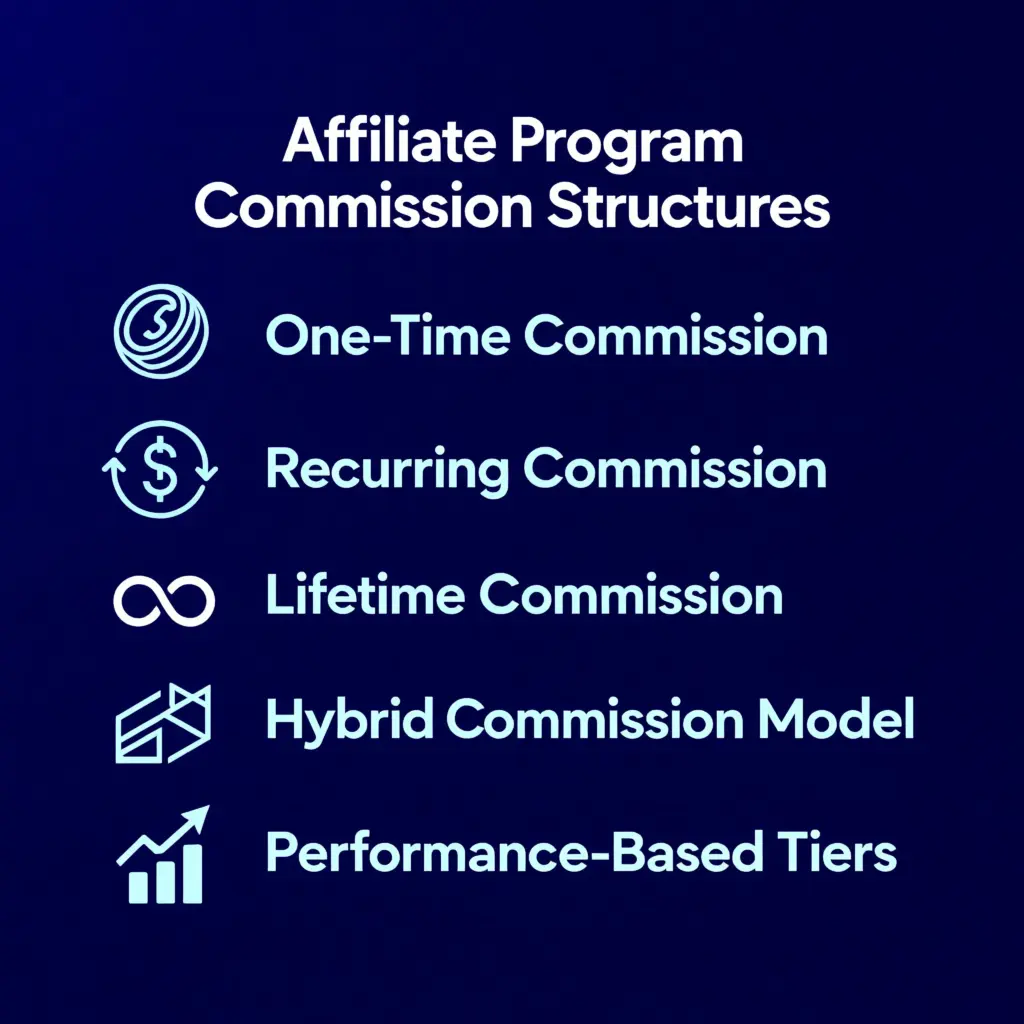
1. One-Time Commission
A one-time commission pays affiliates once when the referred customer makes a purchase.
For example, if your product costs $100 and the commission is 20 percent, the affiliate earns $20 for that sale. After that, no additional commission is paid from future purchases by the same customer.
This model is common for:
- eCommerce stores
- Online courses
- Digital downloads
- WordPress plugins with one-time licenses
It works well for products that are sold as a single purchase rather than a subscription.
2. Recurring Commission
A recurring commission pays affiliates every time the referred customer renews a subscription.
If a SaaS tool pays 30 percent recurring commission and a customer pays $50 per month, the affiliate earns $15 every month as long as the customer stays subscribed.
This structure is extremely attractive for affiliates because it creates predictable long-term income.
Recurring commissions are most common in:
- SaaS platforms
- Membership sites
- Subscription-based WordPress plugins
- Online communities or learning platforms
3. Lifetime Commission
A lifetime commission means the affiliate continues to earn from every future purchase made by the customer they referred.
Even if the customer buys additional products months later, the original affiliate still receives credit.
This model is sometimes used by:
- Course creators with multiple products
- Digital product ecosystems
- Tools with upsells and add-ons
Lifetime commissions can encourage affiliates to focus on higher-quality customers instead of quick promotions.
4. Hybrid Commission Model
A hybrid commission structure combines multiple models.
For example, a SaaS company might offer:
- A large one-time commission for the first sale
- Plus a smaller recurring commission for ongoing subscriptions
This approach gives affiliates immediate reward and long-term incentives, which can significantly increase promotion effort.
Hybrid structures are commonly used in:
- SaaS businesses
- Premium WordPress plugins
- Subscription tools with onboarding costs
5. Performance-Based Commission Tiers
Some affiliate programs reward affiliates who generate more sales by increasing their commission rate.
A typical tiered commission structure might look like:
- 20 percent commission for the first 10 sales
- 25 percent after 25 sales
- 30 percent after 50 sales
This system motivates affiliates to scale their promotion because the rewards increase with performance.
Tiered commissions are widely used in:
- WordPress plugin ecosystems
- SaaS products
- High margin digital products
Choosing the right commission structure depends heavily on your business model and customer lifecycle. A subscription-based SaaS product may benefit from recurring commissions, while an eCommerce store may prefer a one-time payout.
Understanding these structures helps businesses design affiliate programs that are both attractive for partners and profitable for the company.
Learn More: Affiliate Commission Structure- Choose the best model for your Business
How Businesses Recruit High Quality Affiliates
Launching an affiliate program is only the first step. The real growth comes from recruiting affiliates who already reach your target audience.
Businesses usually find quality affiliates through a few common channels:
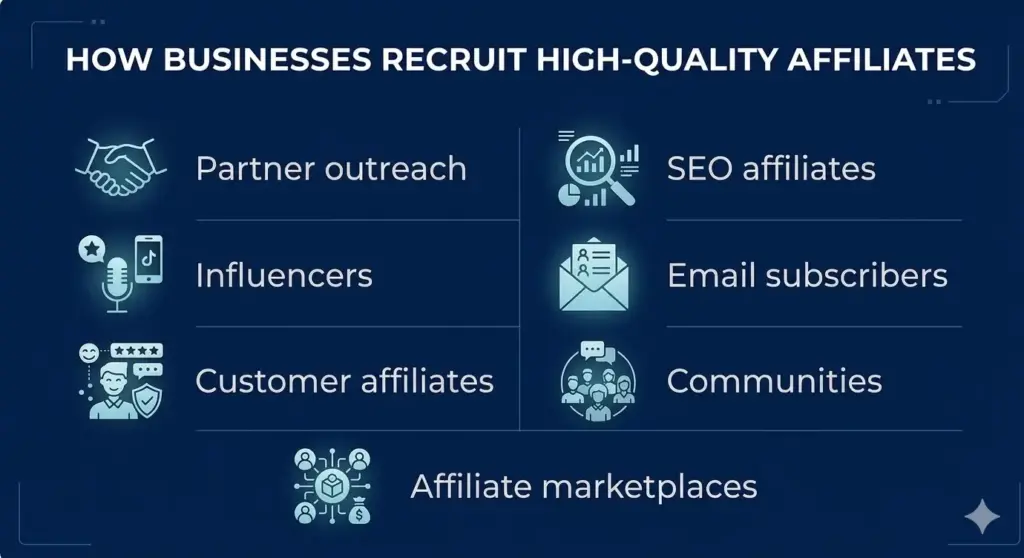
- Partner outreach: Contact bloggers, educators, or businesses in your niche.
- SEO affiliates: Websites that rank for reviews, comparisons, and “best tools” articles.
- Influencers: Content creators on YouTube, social media, or niche platforms.
- Email subscribers: Loyal followers who already trust your brand.
- Customer affiliates: Happy customers who recommend your product naturally.
- Communities: Forums, groups, and industry spaces where your audience gathers.
- Affiliate marketplaces: Platforms where affiliates actively look for products to promote.
Recruitment is an ongoing process. Strong programs continuously attract new partners while building relationships with their top affiliates.
Explore Step-by-step Guide: How to Recruit Affiliates for Your Business
How Affiliates Promote Products
Affiliates promote products using different marketing channels depending on their audience and expertise. The goal is simple: recommend a product and share a tracking link so they earn a commission when someone purchases through it.
Some of the most common promotion methods include:

- SEO blogs: Product reviews, tutorials, and “best tools” lists that rank on search engines
- YouTube reviews: Demonstrations, comparisons, and walkthrough videos
- Email marketing: Recommending products to subscribers through newsletters
- Paid ads: Running targeted ads that send traffic to affiliate content or landing pages
- Social media: Sharing recommendations on platforms like LinkedIn, X, or niche communities
- Comparison sites: Websites that compare multiple tools or products in the same category
Different affiliates use different strategies, but the most successful ones focus on educating their audience and recommending products that genuinely solve problems.
Affiliate Program Metrics to Track
Launching an affiliate program is only the beginning. To grow it effectively, businesses need to track the right performance metrics. These metrics help you understand which affiliates drive results and where the program can improve.
Here are some key metrics worth monitoring.
- Affiliate Conversion Rate
This measures the percentage of visitors referred by affiliates who complete a purchase. A higher conversion rate usually indicates strong affiliate traffic and effective landing pages.
- Average Order Value (AOV)
Average order value shows how much customers spend per purchase. Affiliates who bring higher AOV customers can generate more revenue even with fewer sales.
- Revenue per Affiliate
This metric helps you see how much revenue each affiliate generates. It quickly reveals your top-performing partners and highlights affiliates who may need more support.
- Top Affiliate Contribution
Many programs discover that a small number of affiliates drive most of the sales. Tracking this metric helps you identify and build stronger relationships with your most valuable partners.
- Customer Lifetime Value from Affiliates
For subscription products or repeat purchase businesses, it is important to track the lifetime value of customers acquired through affiliates. This shows the long-term revenue impact of affiliate-driven customers.
Monitoring these metrics helps businesses optimize their affiliate programs, reward top partners, and make smarter growth decisions over time.
Read More: Affiliate Marketing Metrics: What to Track at Every Stage of Your Program
Affiliate Program Software: What to Look For
Running an affiliate program manually becomes difficult very quickly. Once you have multiple affiliates, hundreds of clicks, and ongoing commissions, spreadsheets simply cannot keep up. That is why most businesses rely on affiliate program software to manage everything in one place.
The right system does more than track links. It helps you run the entire affiliate operation efficiently and fairly. Here are the key features worth paying attention to when choosing a platform.
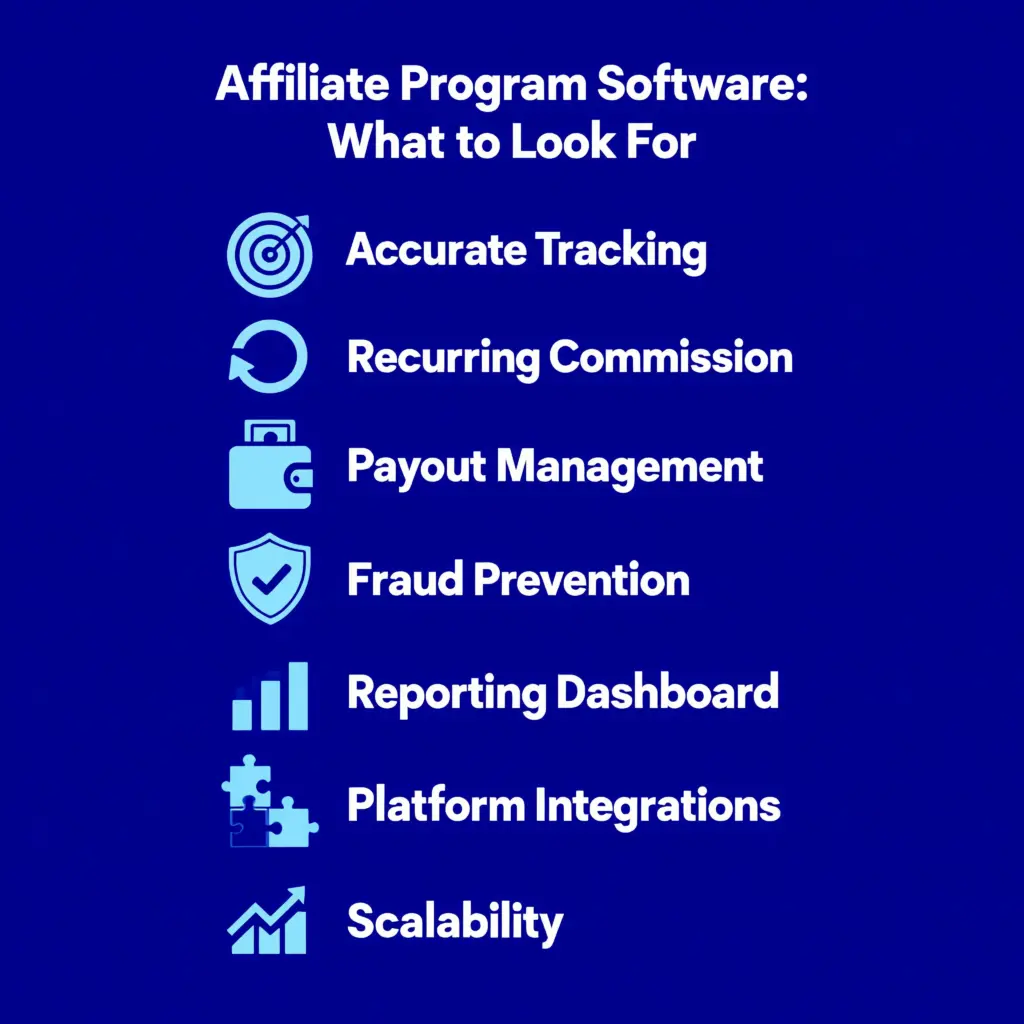
A. Accurate Tracking
Tracking is the foundation of any affiliate program. The software should reliably track clicks, referrals, and conversions so every affiliate gets credit for the sales they generate.
Look for systems that support:
- Unique affiliate tracking links
- Cookie-based referral tracking
- Attribution for multiple traffic sources
Accurate tracking builds trust with affiliates and ensures commissions are calculated correctly.
B. Recurring Commission Support
If your business runs on subscriptions, recurring commissions become essential.
Good affiliate software should automatically calculate and assign commissions every time a referred customer renews their subscription. This is especially important for SaaS products, membership platforms, and subscription-based tools.
Without built-in support, recurring commissions quickly become difficult to manage manually.
C. Payout Management
Managing affiliate payments can become complex as the program grows. A reliable system should help you approve commissions, manage payout thresholds, and process payments smoothly.
Key capabilities to look for include:
- Commission approval workflows
- Minimum payout limits
- Exportable payout reports
- Integration with payment tools such as PayPal or bank transfers
This reduces administrative work and keeps payouts consistent.
D. Fraud Prevention
Affiliate programs can sometimes attract fraudulent activity, such as fake referrals or self-purchases.
Good affiliate software includes tools that help detect and prevent suspicious behavior, such as:
- Duplicate or self-referral detection
- IP monitoring
- Commission review and approval controls
These safeguards help protect your program and maintain fairness for legitimate affiliates.
Find More: 7 Best Affiliate Fraud Detection Software for WordPress
E. Reporting Dashboard
To grow an affiliate program, you need visibility into performance.
A strong reporting dashboard should allow you to quickly see:
- Which affiliates generate the most sales
- Top performing links or campaigns
- Conversion rates from affiliate traffic
- Total commissions owed and paid
Clear reporting helps you identify top partners and optimize your program over time.
F. Integration With Your Sales Platform
Your affiliate system must work smoothly with the tools you already use.
For many online businesses, that means integrating with platforms such as:
- WooCommerce, FluentCart for eCommerce stores
- Learning management systems (LMS) for courses
- Membership plugins for subscription sites
Seamless integration ensures referrals are tracked automatically whenever a sale or signup happens.
G. Scalability
Finally, choose software that can grow with your business.
A program that works for 20 affiliates should still work when you have 200 or even 2,000 partners promoting your product.
Scalable systems support:
- Large numbers of affiliates
- automated onboarding and communication
- advanced reporting and automation features
When these elements come together, affiliate software becomes the backbone that keeps your entire program running smoothly while allowing you to focus on growing partnerships and revenue.
Explore: The Best Affiliate Plugin for WordPress
Affiliate Program Mistakes to Avoid
Launching an affiliate program is exciting. But many businesses rush into it and make mistakes that quietly kill the program’s growth. A poorly structured affiliate program can discourage good partners, reduce trust, and even damage your brand.
Here are some common mistakes businesses should avoid when building and managing an affiliate program.
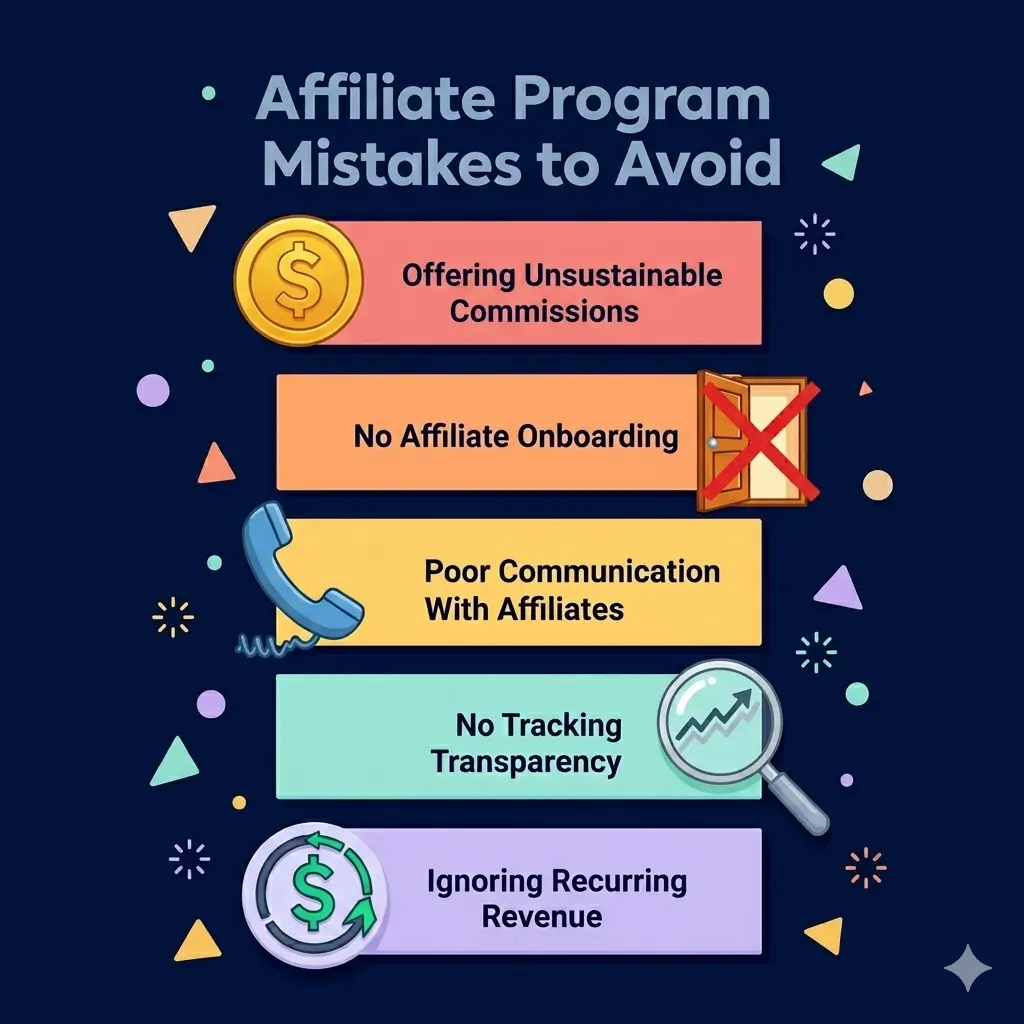
1. Offering Unsustainable Commissions
High commissions can attract affiliates quickly, but they must be financially sustainable.
Some businesses promise aggressive payouts just to recruit affiliates, only to realize later that the margins do not support those rates. This often leads to commission cuts, which can frustrate affiliates and damage long-term relationships.
Before setting commissions, calculate:
- Product margins
- Customer lifetime value
- Operational costs
- Refund rates
Your commission should motivate affiliates while still keeping the program profitable.2
2. No Affiliate Onboarding
Many programs approve affiliates but give them no clear guidance on how to promote the product.
Without onboarding, affiliates may not understand:
- Who the product is for
- What messaging works best
- Which features solve real problems
- How to use their tracking links
A simple onboarding email, promotion guide, or resource hub can dramatically improve affiliate success.
3. Poor Communication With Affiliates
Affiliates are partners, not just traffic sources. When businesses rarely communicate with them, engagement drops.
Strong affiliate programs regularly share:
- Product updates
- New features or offers
- Promotion ideas
- Seasonal campaigns or bonuses
Even occasional newsletters or updates can keep affiliates active and motivated.
4. No Tracking Transparency
Trust is critical in affiliate marketing. If affiliates cannot clearly see how their referrals and commissions are tracked, they may lose confidence in the program.
Good programs provide affiliates with clear dashboards and reporting, showing clicks, conversions, and earned commissions in real time.
Transparency builds credibility and encourages affiliates to promote more aggressively.
5. Ignoring Recurring Revenue Opportunities
Some businesses offer only one-time commissions, even when their products generate recurring revenue.
For subscription products, recurring commissions can be a powerful incentive. Affiliates are far more motivated to promote products that create long-term income streams.
When the business model allows it, recurring rewards often lead to stronger affiliate relationships and more consistent promotion.
Avoiding these mistakes helps build an affiliate program that affiliates actually want to promote. A well-structured program, clear communication, and transparent tracking create the kind of environment where partners feel confident recommending your product.
Read More: 10 Key Affiliate Program Challenges [How to Overcome]
Affiliate Program on WordPress
If your business runs on WordPress, setting up an affiliate program can be much more flexible than using external platforms. WordPress-based businesses often benefit from self-hosted affiliate software, which allows them to manage the entire program directly from their own website.
This approach gives businesses more control over how the affiliate program works and how it scales over time.
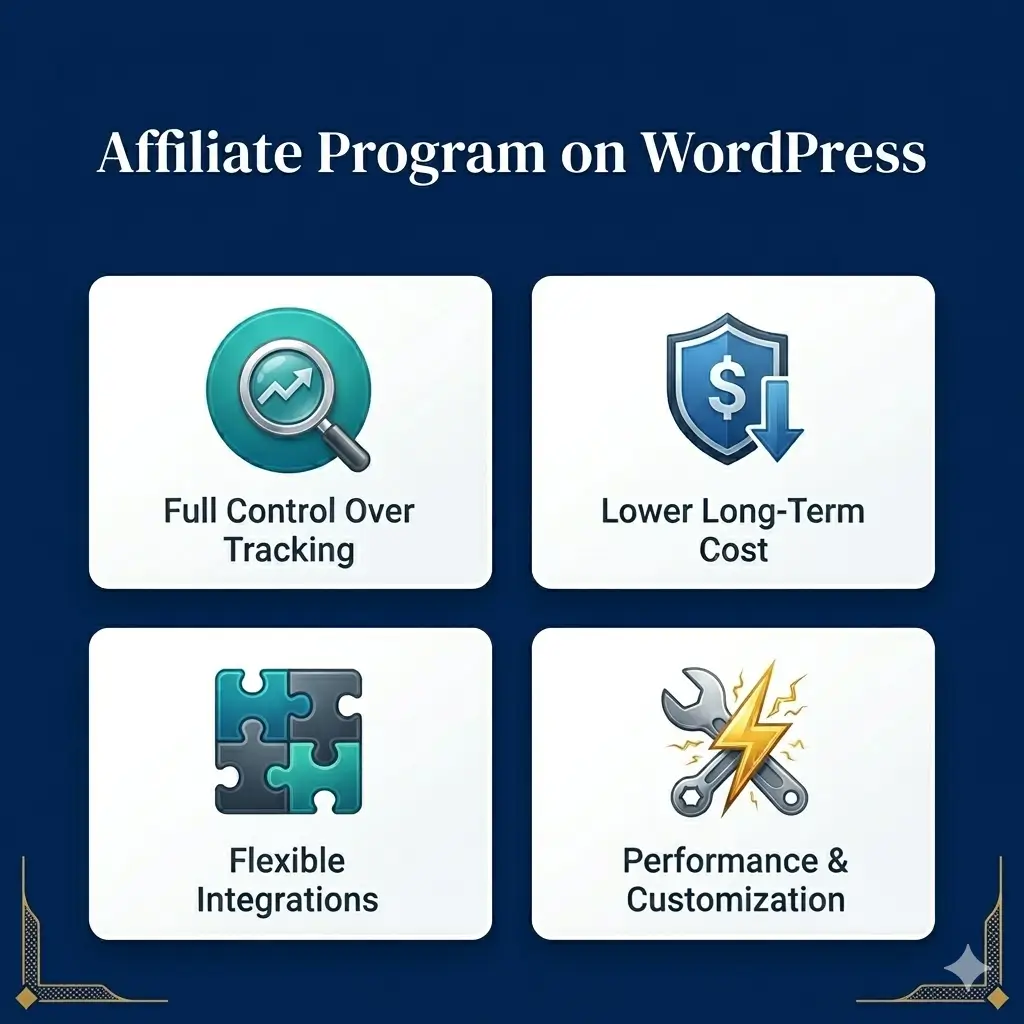
1. Full Control Over Tracking
When you run an affiliate program inside your own WordPress site, all tracking happens within your own system.
That means you control:
- Referral tracking data
- Affiliate records
- Commission calculations
- Customer attribution
Instead of relying on third-party platforms to store and process referral data, everything remains inside your own environment. This gives businesses more transparency and control over their affiliate ecosystem.
2. Lower Long-Term Cost
Many hosted affiliate platforms charge monthly fees that grow as your program scales.
For small programs, this may seem manageable, but costs can increase significantly as you add more affiliates or generate more referrals.
Self-hosted WordPress affiliate solutions typically involve one predictable software cost, which can be far more economical for long term growth.
3. Flexible Integrations With WordPress Tools
WordPress businesses often run their products using different plugins and systems.
For example:
- WooCommerce for eCommerce stores
- Learning management systems (LMS) for courses
- Membership plugins for subscription communities
- Digital download plugins for software or templates
A WordPress-based affiliate system can integrate directly with these tools so referrals are tracked automatically whenever a purchase or signup occurs.
This flexibility makes it easier to build an affiliate program that fits your existing sales workflow.
4. Better Performance and Customization
Because the affiliate program runs inside your own website, businesses can customize the experience to match their brand and workflow.
This may include:
- Custom affiliate dashboards
- Tailored commission structures
- Branded signup pages
- Integration with existing marketing tools
For WordPress product businesses, tools like FluentAffiliate provide a way to manage affiliates directly inside the WordPress admin dashboard while keeping full ownership of the program’s data and structure.
For many plugin creators, course platforms, and digital product businesses, this approach offers the control, flexibility, and scalability needed to grow a successful affiliate program within the WordPress ecosystem.
Explore: How to Set Up an Affiliate Program on WordPress (Step-by-Step Guide)
Is an Affiliate Program Right for Your Business?
Affiliate programs can become powerful growth channels. But they do not work equally well for every business at every stage. Before launching one, it is worth asking a few practical questions.
A successful affiliate program usually requires a solid product, healthy margins, and the ability to support partners who promote your brand.
Use this quick checklist to evaluate whether your business is ready.
A. Do You Have Product Market Fit?
Affiliates promote products that already deliver clear value.
If customers love your product, leave good reviews, and continue buying from you, affiliates will feel confident recommending it. But if the product still needs validation, affiliates may struggle to generate conversions.
A strong affiliate program usually starts with a product that already sells well on its own.
B. Is Your Margin Sufficient?
Affiliate commissions come directly from your revenue. That means your pricing and profit margins must support the payout.
For example, if your margin is very small, offering a competitive commission may become difficult. On the other hand, businesses with healthy margins or high lifetime value can often run much stronger affiliate programs.
Before launching, calculate how much commission you can offer while staying profitable.
C. Can You Support Affiliates?
Affiliates are partners, and successful programs require ongoing support.
You should be prepared to provide:
- Clear promotion guidelines
- Marketing materials such as banners or email swipes
- Product updates and campaign announcements
- Timely responses to affiliate questions
Even simple communication can significantly improve how actively affiliates promote your product.
D. Do You Have Recurring Revenue?
Recurring revenue is not mandatory, but it can make affiliate programs far more attractive.
Products such as SaaS tools, memberships, and subscription services can offer recurring commissions, giving affiliates an incentive to promote consistently.
Even without subscriptions, businesses with strong upsells or repeat purchases can still create profitable affiliate programs.
If your product has clear demand, healthy margins, and a structure that supports partners, an affiliate program can become a scalable and performance-driven growth channel for your business.
Also Read: Is Affiliate Marketing Legal & Ethical in 2026?
Final Thoughts
Affiliate programs can turn customers, creators, and partners into a powerful distribution channel for your business. When structured properly, they create performance-driven growth while rewarding partners who bring real value.
However, launching a program is only the first step. The real success comes from recruiting, managing, and motivating affiliates effectively.

Starting From Scratch? Kickstart
with Affiliate Marketing 101 Guide!
In the next guide, Affiliate Management 101, we will explore how to manage affiliates, build strong partner relationships, and grow your program into a sustainable revenue engine.