

Affiliate Marketing vs MLM: A Complete Clarity Guide

Affiliate marketing and MLM get mixed up all the time, and honestly, it’s easy to see why. Both involve promoting products and earning money.
But underneath the surface, they work very differently. One is a legitimate, skill-based income model. The other has a structure that leaves most people worse off.
This guide clears up every bit of confusion so you can make the right call.
Key Takeaways: Affiliate Marketing vs LLM
- Affiliate marketing pays you for driving sales through your unique link. MLM pays you for sales plus recruiting others into the business.
- Affiliate marketing requires zero recruitment. Your income depends entirely on your own marketing performance.
- Most affiliate programs are free to join. Most MLMs charge upfront fees, starter kits, or mandatory monthly product purchases.
- FTC data shows the majority of MLM participants earn less than $1,000 per year before expenses. Affiliate marketing income scales with your skills and content.
- MLM is legal when real products are sold to real customers outside the network. It crosses the line when recruitment becomes the primary revenue driver.
- Affiliate marketing builds long-term digital assets like blog posts and videos that keep earning passively. MLM income stops when recruitment slows.
- The biggest red flag in any opportunity is being asked to recruit or pay to participate. Legitimate affiliate programs never require either.
What Is Affiliate Marketing, Really?
Affiliate marketing is pretty simple once you understand it. You promote someone else’s product using a unique link. When someone clicks your link and buys, you earn a commission. That’s the whole model.
You do not need to recruit anyone. You do not need to buy inventory. You do not need to build a team. Your job is to drive traffic and convert that traffic into sales.
Here’s how a basic affiliate marketing flow looks:
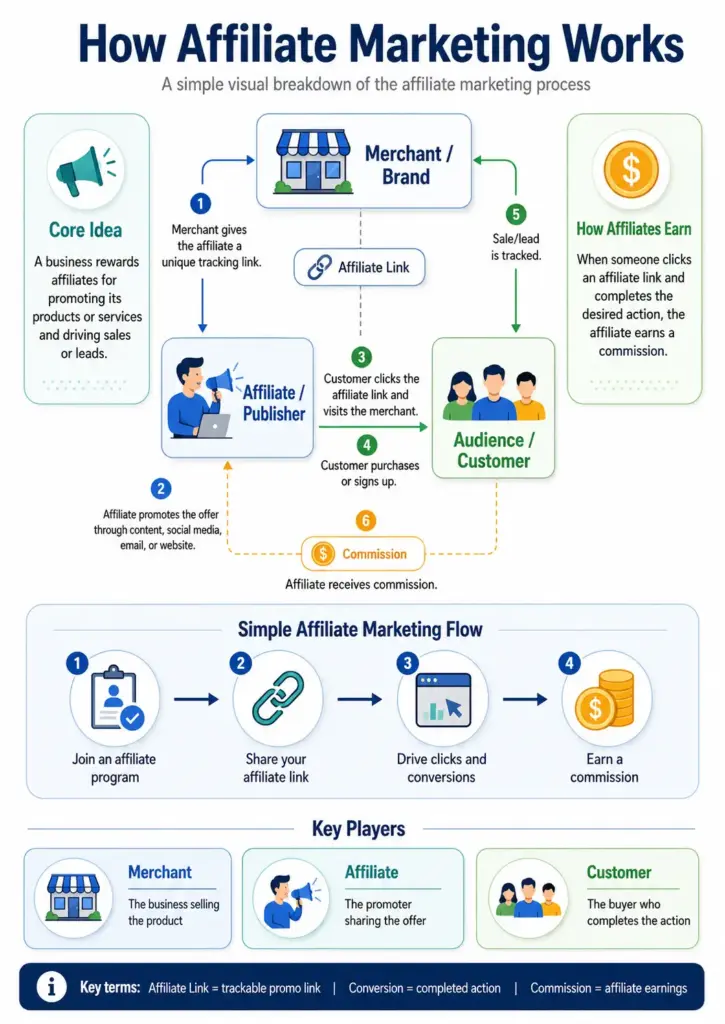
- A business (the merchant) creates a product or service
- They set up an affiliate program and offer a commission rate
- You (the affiliate) sign up and get your unique tracking link
- You promote that link through your blog, YouTube, social media, email list, or ads
- A customer clicks your link and buys the product
- You earn a commission, usually a percentage of the sale
The merchant handles customer service, refunds, and product delivery. Your only job is to send the right people to the right offer.
Affiliate programs like the ones you can run through FluentAffiliate track every click, every referral, and every payout from one clean dashboard. No spreadsheets, no guesswork.
What Is MLM, Really?
MLM stands for multi-level marketing. It is also called network marketing. In an MLM, you earn money in two ways: by selling products directly and by recruiting other people into the business.
Here’s the part that matters. In most MLMs, the majority of earnings come from recruitment, not retail sales. This means your success depends heavily on how many people you bring in beneath you, and how many people they bring in beneath them.
This creates a pyramid-shaped structure where people at the top earn the most, and people at the bottom (the majority) often earn little to nothing.
Let’s break down how an MLM typically works:
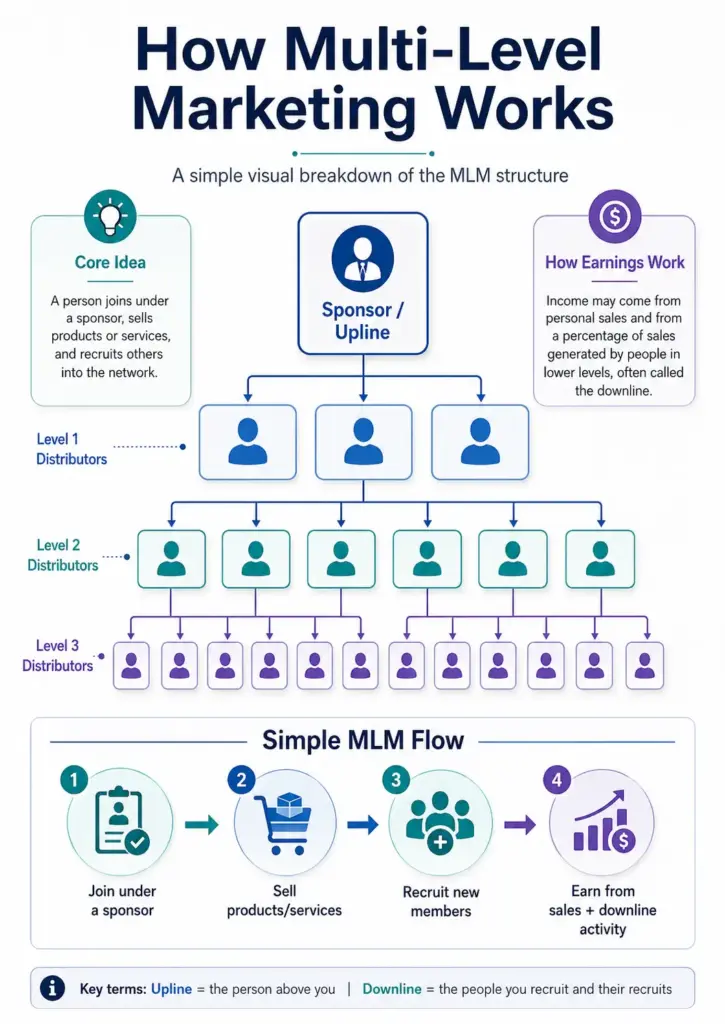
- You pay to join and often purchase a starter kit
- You are encouraged to recruit friends, family, and coworkers
- Each person you recruit becomes part of your “downline”
- You earn commissions on their sales and their recruits’ sales
- The company’s compensation plan rewards you for building a larger team
This is not illegal on its own. The line between a legitimate MLM and an illegal pyramid scheme often comes down to whether real products are actually being sold to real customers outside the network, or whether the main “product” is the recruitment itself.
Affiliate Marketing vs MLM: The Core Differences
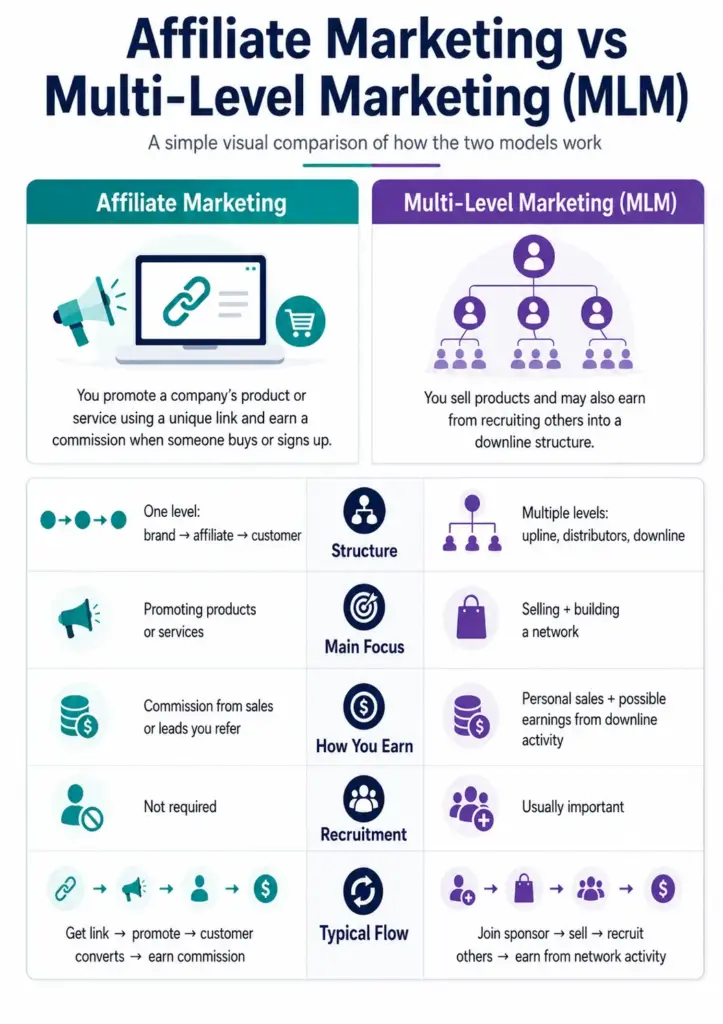
This is where things get really clear. Let’s go side by side.
Income Structure
In affiliate marketing, you earn based on your own performance. If you drive 100 sales this month, you get paid for those 100 sales. Simple.
In MLM, your income is tied to a multi-level structure. You earn from your sales, your recruits’ sales, their recruits’ sales, and so on. The deeper the structure, the more complex the commissions get.
Recruitment
Affiliate marketing does not require you to recruit anyone. Ever. Your earning potential is based entirely on your ability to market and drive conversions.
MLM almost always encourages or requires recruitment. In many MLMs, you will not hit higher commission tiers unless you have a certain number of active recruits beneath you.
Startup Costs
Most affiliate programs are free to join. You sign up, get your link, and start promoting. Your only real costs are optional, like running ads or building a website.
MLMs almost always have upfront costs. You may need to buy a starter kit, pay a monthly membership fee, or purchase a minimum amount of product each month to stay “active” and eligible for commissions.
Product Ownership
Affiliates never touch a product. You are a pure marketer. The merchant handles everything product-related.
In MLM, you often need to buy and hold inventory. You may be expected to use the products yourself. Some MLMs push auto-ship programs where product is shipped to you each month whether you want it or not.
Risk Level
Affiliate marketing has low financial risk because you are not investing in inventory or paying monthly fees. If a campaign does not work, you lose time, not thousands of dollars.
MLMs carry much higher financial risk. The Federal Trade Commission has studied MLMs and found that most participants earn little to nothing, or even lose money when factoring in required purchases and fees.
Scalability
Affiliate marketing scales through content, traffic, and strategy. You build assets like blog posts, videos, and email lists that keep working for you over time.
MLM growth depends on exponential recruitment. Mathematically, recruitment-based models eventually run out of viable recruits, especially in any defined geographic or social circle.
Why Do People Confuse the Two?
Honestly, the confusion is not accidental. Some MLMs use the word “affiliate” to sound more modern and legitimate. They will say things like “join our affiliate network” or “earn affiliate commissions” when the underlying structure is still multi-level recruitment-based.
Here are a few signs that something marketed as “affiliate” is actually an MLM:
- You need to pay to join or buy a starter package
- Your earnings depend on how many people you recruit
- There are multiple “tiers” of commission tied to recruits
- The biggest earners are the people who joined earliest
- You are required to buy a monthly minimum of product to stay active
Legitimate affiliate programs never require you to recruit. They never ask you to buy products. They simply pay you for driving sales.
Is MLM Legal?
Yes, MLM is legal in most countries as long as genuine products are being sold to real customers outside the network. The problem is that many MLMs operate in gray areas, and a large number of participants end up losing money.
The FTC has taken action against companies whose compensation plans are built more on recruitment than actual retail sales. If a business cannot survive without constant recruitment, it is essentially functioning as a pyramid scheme, which is illegal.
When evaluating any MLM, ask these questions:
- Can you earn money without recruiting anyone?
- Are real products being sold to people outside the company?
- What percentage of earnings come from retail sales versus recruiting?
- What is the average income of participants after expenses?
If the company cannot clearly answer these questions, walk away.
Is Affiliate Marketing Legitimate?
Absolutely. Affiliate marketing is one of the most straightforward ways to earn money online. Big brands like Amazon, Shopify, HubSpot, and thousands of others run affiliate programs because they work.
The model is transparent. The commission structure is clear. You know exactly how you earn and when you earn it.
Affiliate marketing also has a long track record. It has been a standard part of digital marketing since the late 1990s. Thousands of bloggers, YouTubers, content creators, and media companies earn significant income through affiliate partnerships.
Is MLM a Pyramid Scheme?
This is a fair question, and it deserves a straight answer.
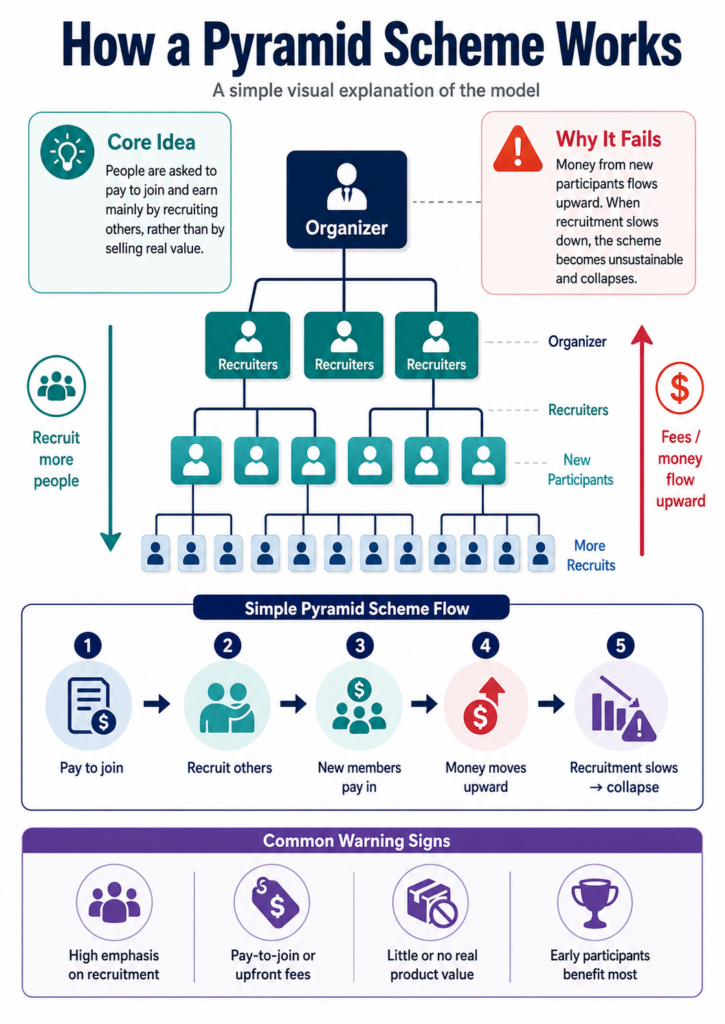
Not all MLMs are pyramid schemes. A pyramid scheme is illegal because it generates revenue primarily through recruitment rather than actual product sales. MLMs are technically legal because there is a real product involved.
But here is the uncomfortable truth: some MLMs function very similarly to pyramid schemes in practice. When recruitment is emphasized more than product quality, when most participants lose money, and when income is primarily flowing to those at the very top, the structure starts to resemble a pyramid whether the product is real or not.
The distinction matters legally, but from a practical standpoint, if the business model requires constant recruitment to be profitable for participants, that is a red flag regardless of what it is called.
Affiliate marketing has no such structure. There are no levels. There is no downline. You earn based on results, period.
Who Should Choose Affiliate Marketing?
Affiliate marketing is a strong fit if you:
- Have or want to build a content platform (blog, YouTube, newsletter, social media)
- Prefer a performance-based income without complex structures
- Want low financial risk and no inventory management
- Are interested in building digital assets that earn passively over time
- Want to work independently without building or managing a team
You do not need a massive audience to start. Even a small, targeted audience can generate meaningful affiliate income if the product-audience fit is strong.
Who Typically Gets Into MLM?
MLM attracts people who are looking for flexible income, community, and business ownership. The pitch is usually compelling: low barrier to entry, a supportive “team,” and unlimited earning potential.
The problem is the reality rarely matches the pitch. Income disclosure statements from MLM companies often show that the vast majority of participants earn less than minimum wage when accounting for hours worked and expenses.
People who do well in MLM are typically those who got in early, have large personal networks, or are highly skilled at sales and recruiting. For most people, it is not a viable path to financial independence.
The Earnings Reality: Affiliate Marketing vs MLM
Let’s talk numbers, because this is where the clearest difference shows up.
In affiliate marketing, earnings are directly tied to your output. A blogger who gets 50,000 monthly visitors to a niche review site can earn anywhere from a few hundred to several thousand dollars per month. A YouTuber with 20,000 subscribers in a specific niche can do the same. Income is tied to content quality and audience fit.
In MLM, income data tells a different story. Many MLMs are required by law to publish income disclosure statements. When you read them, you will often find:
- The majority of participants (sometimes over 90%) earn less than $1,000 annually before expenses
- The top 1% of participants earn the bulk of the income
- Average earnings often fall below minimum wage when expenses are factored in
This is not a knock on hardworking people in MLMs. It is a structural reality of how most multi-level models work.
Red Flags to Watch Out For
Whether you are evaluating an affiliate program or an MLM opportunity, here are the red flags that should make you stop and think.
For affiliate programs:
- Unclear or vague commission structures
- No tracking system or way to verify your referrals
- Long or arbitrary cookie windows that reset too easily
- No clear payout schedule or minimum payout threshold
For MLMs:
- Pressure to recruit immediately
- Required monthly product purchases to stay eligible
- Vague income claims without documented proof
- Emphasis on “the lifestyle” over actual product sales
- Upfront fees disguised as “starter kits” or “business packages.”
Building a Sustainable Online Income
The biggest difference between affiliate marketing and MLM comes down to sustainability.
Affiliate marketing builds assets. A blog post you write today can drive commissions for years. A YouTube video can bring in referrals for as long as people search for that topic. You are building something with long-term value.
MLM is relationship-dependent. Your income depends on maintaining a team, keeping recruits active, and constantly adding new people. If recruitment slows down, so does income. It is a treadmill, not an asset.
For most people who want a legitimate, low-risk, scalable way to earn online, affiliate marketing is the clearer choice. It rewards skill, consistency, and good content over time.
How FluentAffiliate Fits Into This Picture
If you are running a WordPress business and want to launch a real affiliate program, the affiliate marketing model is the way to go. You set fair commissions, bring in affiliates who genuinely promote your products, and track everything automatically.
FluentAffiliate is built for exactly this. You can:
- Set default commission rates or custom rates per product, category, or membership tier
- Let affiliates sign up through a registration page, no recruitment required
- Track every click, referral, and payout from a clean admin dashboard
- Automate email notifications so affiliates always know their status
- Manage everything from inside your WordPress dashboard
Your affiliates earn based purely on the sales they drive. No recruitment tiers. No inventory purchases. No hidden fees. Just a clean, honest performance-based model.
For businesses selling through WooCommerce, Easy Digital Downloads, MemberPress, FluentCart, or any of the other supported integrations, FluentAffiliate makes it simple to reward people who genuinely move the needle for your business.

Launch Your Sustainable Affiliate Program Today!
Practical Steps to Start with Affiliate Marketing
If you are ready to explore affiliate marketing seriously, here is a simple path forward:
- Choose a niche you know or are willing to learn about
- Build a platform, whether that is a blog, newsletter, YouTube channel, or social media presence
- Find affiliate programs that match your audience’s interests and needs
- Create content that genuinely helps your audience, and include your affiliate links naturally
- Track your performance and double down on what works
- Be transparent with your audience by disclosing affiliate relationships
If you are a business owner who wants to launch your own affiliate program, the path is even simpler. Set up a tool like FluentAffiliate, define your commission structure, create a registration page, and start bringing in affiliates who want to promote your work.
Final Thoughts
Affiliate marketing and MLM are two very different models wearing similar marketing clothes. Affiliate marketing is transparent, low-risk, and based on your own performance. MLM is complex, often costly, and dependent on building and sustaining a recruitment network.
If you want to earn online without the pressure of recruiting or the burden of inventory, affiliate marketing is the model worth your time and energy. It is a proven path that thousands of content creators and businesses use every day to build real, sustainable income.
And if you are on the business side, FluentAffiliate makes it straightforward to launch your own affiliate program inside WordPress, with clean tracking, automated payouts, and full control over your commission structure. No tricks, no tiers, no complexity. Just a fair system that rewards people who genuinely help your business grow.
Ready to start? Setting up your first affiliate program takes less than an hour.
Frequently Asked Questions
Can you do affiliate marketing and be in an MLM at the same time?
Technically yes, but the two models require very different approaches. Affiliate marketing focuses on content and traffic. MLM focuses on relationships and recruitment. Doing both can dilute your focus and make it harder to succeed at either.
Is affiliate marketing passive income?
It can become passive over time. Content you create today can earn commissions for years if it ranks well in search or keeps getting views. But getting to that point requires active work upfront.
Do affiliates need to disclose their links?
Yes. In most countries, including the United States, you are legally required to disclose affiliate relationships. The FTC has clear guidelines on this. Transparency is also better for trust with your audience.
What is the average affiliate commission rate?
It varies widely by industry. Digital products often pay 20% to 50%. Physical products through networks like Amazon Associates pay 1% to 10%. SaaS products often pay recurring commissions for the life of the customer.






Add your first comment to this post