

Affiliate Marketing for Startups: A Lean Playbook That Actually Works
You have a product, a small team, and a marketing budget that feels stretched on a good day. Paid ads burn cash fast. SEO takes months. Cold outreach is a grind.
So you keep hearing about affiliate marketing and wondering if it could actually move the needle for a startup like yours. It can, but only if you set it up the right way.
Here is the practical playbook.
Key Takeaways: Affiliate Marketing for Startups
- Affiliate marketing for startups works best when your product already converts and your team can spend a few hours a week managing the program.
- Self-hosted affiliate tools like FluentAffiliate are usually a better fit for startups than affiliate networks because there are no setup fees, no commission cuts, and full data ownership.
- Commission rates for startup affiliate programs typically range from 10 to 30 percent for first sales, with 10 to 15 percent on renewals being a common range for subscription products.
- Your first 10 affiliates should be recruited manually through personal outreach, not by waiting for sign-ups. Happy customers and niche creators convert best.
- The real cost of an affiliate program includes software, commission payouts, and roughly 3 to 5 hours per week of management time in the first three months.
- Affiliates only promote what is easy. Providing ready-made banners, email templates, QR codes, and swipe copy can double active affiliate participation.
- A typical 90-day launch plan covers two weeks of setup, four weeks of manual recruiting, four weeks of optimization, and one full payout cycle before opening the program more broadly.
Why affiliate marketing makes sense for startups (and when it doesn’t)
Affiliate marketing is performance-based. You only pay when someone sends a paying customer your way. For a startup, that is rare and beautiful. Most marketing channels charge you upfront and hope something works. Affiliates flip that around.
But here is the part most blog posts skip. Affiliate marketing works best when a few things are already true for your startup:
- You have a product people actually want and a checkout that converts
- You can afford to share 10 to 30 percent of revenue with a partner
- You have someone on the team who can spend a few hours a week managing it
- Your average order value or customer lifetime value is high enough to make commissions worth it
If your conversion rate is broken, no affiliate will save you. They will send traffic, nothing will sell, they will quit, and you will think the channel does not work. The channel works. The funnel was leaky.
So before you do anything else, look at your last 100 sign-ups or sales. Are people happy? Are they sticking? If yes, you are ready. If not, fix that first.

Starting From Scratch? Kickstart
with Affiliate Marketing 101 Guide!
The real cost of running an affiliate program (it’s not free)
People love saying affiliate marketing is “free” because you only pay on conversion. That is partly true and partly a trap.
The real costs of running a startup affiliate program look more like this:
- Software cost (anywhere from $0 to $200 a month)
- Commission payouts to affiliates
- Time to recruit, onboard, and answer affiliate questions
- Time to create assets like banners, copy, and QR codes
- Time to handle disputes, refunds, and weird edge cases
Most startups underestimate the time cost. Plan for at least 3 to 5 hours a week in the first three months. After that, things get smoother as your top affiliates know what works.
Network vs self-hosted: which one fits a startup budget
This is the first big decision, and it shapes everything else.
When an affiliate network makes sense
Networks like ShareASale, CJ, or Impact give you a ready-made pool of affiliates. They handle payments, tracking, and compliance. Sounds great, right?
The problem for startups is the cost. Most networks charge a setup fee in the thousands, take a percentage on top of every commission, and lock you into minimum spends. For a bootstrapped startup, that math rarely works.
You also lose control. You do not own the affiliate relationships. If you leave the network, you might lose access to those partners.
When self-hosted wins
A self-hosted affiliate program lives on your own website. You own the data, the relationships, and the rules. You pay once for the software and then only on commissions you actually earn back.
For WordPress-based startups, this is a no-brainer. A plugin like FluentAffiliate lets you launch an affiliate program right inside your WordPress dashboard. You set the rules, track every click and sale, and pay affiliates manually through PayPal or bank transfer.
If you are already using WooCommerce, Easy Digital Downloads, MemberPress, or FluentCart, the integrations handle the tracking for you automatically. No custom code. No external dependencies. No middleman taking a cut.
For most early-stage startups, self-hosted is the smarter call. Lower cost, more control, easier to experiment.
Explore In-depth: Self-Hosted Affiliate Tracker for Your Business
How to set up a startup affiliate program in 7 steps
Here is the actual sequence, in the order I would do it.
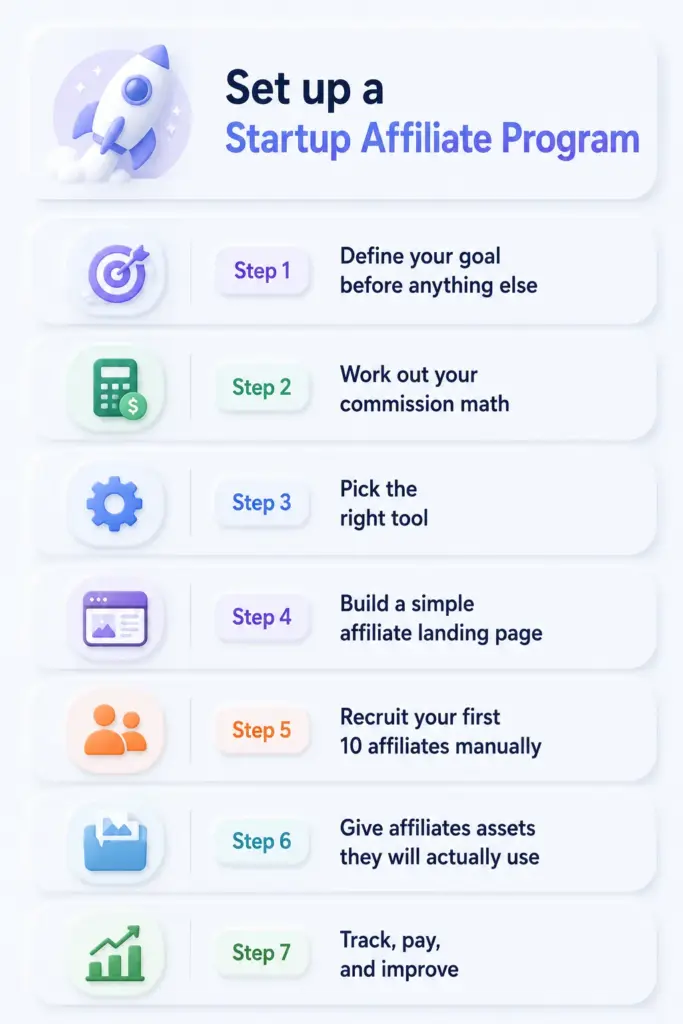
Step 1: Define your goal before anything else
What does “winning” look like for the first six months? Be specific. Vague goals lead to vague programs.
Try one of these as a starting point:
- 20 percent of new monthly revenue from affiliates
- 50 active affiliates by month six
- 100 paying customers from affiliate referrals in the first quarter
Pick one. Write it down. Every decision you make after this should serve that goal.
Step 2: Work out your commission math
This is where startups either set themselves up to win or quietly cap their growth. The math is simple but most people skip it.
Take your customer acquisition cost (CAC) on paid ads. Whatever you spend to get one customer through Google or Meta is your benchmark. If you spend $80 to get a customer through ads, paying a $40 commission on a $200 sale (20 percent) is half the cost. That is the deal.
Now factor in:
- Average order value
- Profit margin per sale
- Whether the product is one-time or recurring
For a SaaS startup with a $30/month subscription and a 12-month average lifetime, a customer is worth $360 lifetime. Paying a 30 percent first-year commission (about $108) still leaves you with $252 in revenue. That works.
For a physical product with a 40 percent margin on a $50 sale, a 20 percent commission ($10) eats half your profit. That might still be worth it for new customer acquisition, but only if those customers come back.
Run the numbers honestly. Affiliates will not promote a 5 percent commission. Be generous enough that good partners actually care.
Explore More: Affiliate Commission Structure: Choose the best model for your Business
Step 3: Pick the right tool
For a WordPress startup, you have a few options. The big questions are: how much control do you want, and how easy do you want the setup to be?
If you want a self-hosted, owned solution that works with your existing stack, FluentAffiliate is built for exactly this. The free version handles affiliate registration, link generation, click tracking, and basic referral management. The Pro version adds integrations with platforms like WooCommerce, MemberPress, LifterLMS, and recurring commissions for subscriptions.
To install it, follow the installation and activation guide. The whole setup takes about 15 minutes. After that, the onboarding wizard walks you through connecting your store, setting your default commission rate, and creating your affiliate portal.
Explore More: The All-in-One WordPress Affiliate Software for Startups
Step 4: Build a simple affiliate landing page
Most startups skip this and wonder why no one signs up. Your affiliate page is a sales page. It needs to answer three questions in under 30 seconds:
- What do affiliates earn?
- Who is this program for?
- How do they get started?
Be specific. “Earn 30% recurring commission for every paying customer you refer” beats “Generous commissions available.”
Use the [fluent_affiliate_portal] shortcode on a dedicated page to display the affiliate dashboard and registration form. Add a few testimonials if you have them. Add an FAQ. Make the application form short.
If you want to give a top creator a fully branded experience, you can also use custom affiliate landing pages so they get a clean URL like yoursite.com/partner/their-name instead of a generic referral link.
Step 5: Recruit your first 10 affiliates manually
This is the step that separates programs that grow from programs that gather dust.
Do not wait for affiliates to find you. They will not. Especially when no one knows your brand yet.
Make a list of 30 people who already know your product or your space:
- Current happy customers
- Small bloggers in your niche
- YouTubers with 1K to 50K subscribers who cover related topics
- Newsletter writers in adjacent spaces
- Coaches, consultants, or course creators who serve your target customer
Then email them personally. Not a mass blast. A real email. Mention something specific about their work. Tell them what they will earn. Offer to set everything up for them.
Your first ten affiliates will be relationships you build by hand. Accept it. After that, the word starts spreading on its own.
Learn More: How to Recruit Affiliates for Your Business
Step 6: Give affiliates assets they will actually use
Here is something most startups get wrong. They invite affiliates, then leave them to figure everything out alone. Good affiliates are busy people. If promoting you takes effort, they will promote someone else.
Inside FluentAffiliate, the Affiliate Creatives feature lets you upload ready-to-use banners, text snippets, and QR codes. Every creative automatically includes the affiliate’s tracking link. They just copy and paste.
At a minimum, give your affiliates:
- Three banner sizes (square, leaderboard, sidebar)
- Two or three pre-written email templates
- A short product description they can drop into a blog
- A QR code they can use on printed materials or in videos
- A swipe file of social media captions
This one move can double your active affiliate rate.
Explore More: 15 Affiliate Creatives that Benefit Both Your Partners and Your Brand
Step 7: Track, pay, and improve
Once referrals start coming in, you need a clean way to manage them. From the admin dashboard, you can see total visits, conversion rate, top affiliates, and recent referrals at a glance.
For paying affiliates, FluentAffiliate generates payout records and CSV exports, but the actual payment happens manually through PayPal or bank transfer. For a startup, that is actually good. You stay in control of cash flow and can batch payments monthly.
Set a fixed payout day each month. Affiliates love predictability. Pay on the 15th or the last Friday. Whatever you pick, stick to it.
Commission structures that actually work for early startups
There is no single right commission rate. But there are patterns that work for startups in different stages.
For a brand new startup with no traction:
- Offer a higher commission (25 to 40 percent) on the first sale only
- This attracts affiliates willing to take a chance on you
For a startup with some traction and a recurring revenue model:
- Pay 20 to 30 percent on the first payment
- Then 10 to 15 percent on renewals for the first year
- This rewards affiliates who bring sticky customers
For ecommerce startups:
- Pay 10 to 20 percent per sale
- Offer bonus tiers (extra 5 percent if affiliate brings in over 10 sales a month)
You can set all of this up using affiliate groups. Create tiers like “Standard,” “Pro,” and “VIP” with different commission rates, then move affiliates up as they perform.
One tip from experience: avoid making your commission structure too clever in the first six months. Simple wins. Get one structure working, then layer in complexity.
Read In-depth: Affiliate Commission Structure: Choose the best model for your Business
Where to find good affiliates when no one knows your brand
This is the question no one really answers, so let me be specific.
Look in places where your ideal customer already hangs out. Then find the people who already serve that audience.
Real examples:
- If you sell a WordPress plugin, look at WordPress YouTubers with 5K to 30K subs. They review tools constantly. They are always looking for new programs.
- If you sell an online course, look at smaller course creators in adjacent topics. A productivity coach might love promoting a notetaking app to their list.
- If you sell ecommerce products, look at niche Instagram and TikTok creators in your category. Micro-influencers often outperform big ones.
- If you sell B2B SaaS, look at consultants who already recommend tools in your space. They get paid to give advice. Affiliate income is a natural fit.
Use Reddit, niche Facebook groups, and X to find people talking about problems your product solves. Reach out with value first. Mention their work specifically. Make it easy to say yes.
And do not forget your customers. The single highest-converting affiliate channel for many startups is happy users. Email your top 100 customers and invite them to join the program. Some of them write blogs. Some run communities. Almost all of them will tell at least one friend.
Explore More: How to Promote Your Affiliate Program and Attract Quality Affiliates
Mistakes that quietly kill startup affiliate programs
I have seen these patterns over and over. Avoid them.
- Setting the commission too low to be exciting
- Not paying on time, ever
- Ignoring your affiliates after they sign up
- Making the affiliate dashboard confusing or hard to find
- Not tracking which campaigns are converting
- Letting fraud or self-referrals go unchecked
- Promising features the program does not actually have
- Treating affiliates like a sales team instead of partners
The single biggest mistake is treating affiliate marketing as set-and-forget. It is not. It is a relationship channel. The startups that win at this treat their top 10 affiliates like co-founders of their growth.
Also Read: 10 Key Affiliate Program Challenges [How to Overcome]
A 90-day affiliate launch plan for startups
Here is a realistic timeline if you are starting from zero.
Days 1 to 14:
- Install your affiliate tool and run the onboarding setup
- Decide your commission rate, cookie duration, and approval process in referral settings
- Build your affiliate landing page with shortcode
- Create your first set of creatives (banners, email templates, QR codes)
- Write your affiliate program terms
Days 15 to 45:
- Manually recruit your first 10 to 15 affiliates
- Onboard each one personally with a short welcome email
- Send them their links and creatives
- Test the full flow yourself, end to end (sign up as a fake affiliate, share your link, complete a fake order)
Days 46 to 75:
- Send your first monthly newsletter to affiliates with tips and updates
- Run your first payout
- Identify the top 3 performers and check in with them personally
- Ask top affiliates what assets or features would help them sell more
Days 76 to 90:
- Review what worked and what did not
- Adjust commission rates if needed
- Open the program to a wider audience
- Start your second wave of outreach to a bigger list
By day 90, you should know whether the channel works for your startup. If it does, double down. If it does not, look at conversion rate, commission structure, and affiliate quality before quitting.

Launching Affiliate Program? Explore Complete 101 Guide!
Wrapping Up
Affiliate marketing for startups is not a magic button. It is a slow, compounding channel that rewards startups willing to put in real effort upfront. The math works. The model is proven. The tools are cheap or free.
What you actually need is patience, a fair commission, and a willingness to treat your affiliates like the partners they are. Get that right, and you can build a referral engine that brings in customers for years without any ad spend at all.
If you want to launch your own program inside WordPress without paying network fees, FluentAffiliate is built for exactly this kind of lean startup setup. Install the free version, run the onboarding, and you can have your first affiliate signed up by the end of the day. Start small, recruit by hand, treat your partners well, and let the channel compound.



Add your first comment to this post