
How To Increase Affiliate Conversion For Niche Ecommerce Brands
You signed up twenty affiliates last quarter. They are sending clicks. Your dashboard shows visits climbing. But the sales line barely moved. For a niche ecommerce brand, that quiet gap between clicks and purchases is where money leaks out.
Here is the part most people miss: affiliate conversion is mostly fixable, and almost every lever sits on your side of the link, not the affiliate’s.
Key Takeaways: Affiliate Conversion Rate for Niche Brands
- Affiliate conversion is the share of affiliate-referred clicks that turn into actual purchases, not just traffic volume.
- Referral and affiliate traffic converts at around 4 to 5.4 percent, the highest of any ecommerce channel, because it arrives pre-qualified.
- For niche brands, low conversion is usually a fit problem, so recruit affiliates whose audience already matches your niche.
- Most levers that move conversion sit after the click: landing pages, page speed, trust signals, and checkout.
- Branded coupon codes lower buyer hesitation and give your affiliates something concrete to promote.
- Commission rates should be set against your real product margins, not copied from a competitor.
- Correct cookie duration, clean tracking, and steady affiliate nurturing keep credit accurate and partners active.
What Affiliate Conversion Means For A Niche Ecommerce Brand
Affiliate conversion is the percentage of people who click an affiliate’s link to your store and then complete a purchase. If 500 people click an affiliate link and 15 of them buy, your affiliate conversion rate is 3 percent.
That single number tells you more than your visit count ever will. Visits show that affiliates are working. Conversion shows that the traffic is the right traffic and that your store closes the deal once it arrives.
For a niche brand, where every visitor is harder to earn, the conversion rate is the real health check on your program.
Why Niche Brands Convert Differently Than Big Stores
A big-box store can afford sloppy targeting because volume covers the waste. A niche brand cannot. When you sell handmade leather goods, single-origin coffee, or gear for left-handed guitarists, your buyer pool is small and specific. That changes the whole game.
Here is the upside. Affiliate and referral traffic already converts better than almost anything else. Recent ecommerce data puts referral and affiliate traffic at 4 to 5.4 percent conversion, the highest of any channel, because those visitors arrive pre-qualified. Someone else they trust already vouched for you before they clicked.
For a niche brand, that trust transfer is worth more than a thousand cold ad impressions.
Now the catch. More clicks no longer guarantee more sales. A 2025 benchmark across 2,368 retail brands found clicks rose 2 percent year over year while transactions fell 5 percent and conversion dropped 6 percent. Shoppers are clicking to compare, then buying later and more carefully. So if your answer to weak sales is “get more affiliates,” you may just be buying more comparison clicks.
The fix for a niche brand is not volume. It is fit.
7 Ways to Increase Affiliate Conversion For Niche Ecommerce Brands
You win by sending the right visitor to a store that is ready to close, then making sure the right affiliate gets credit. The rest of this guide walks through each lever that does that.
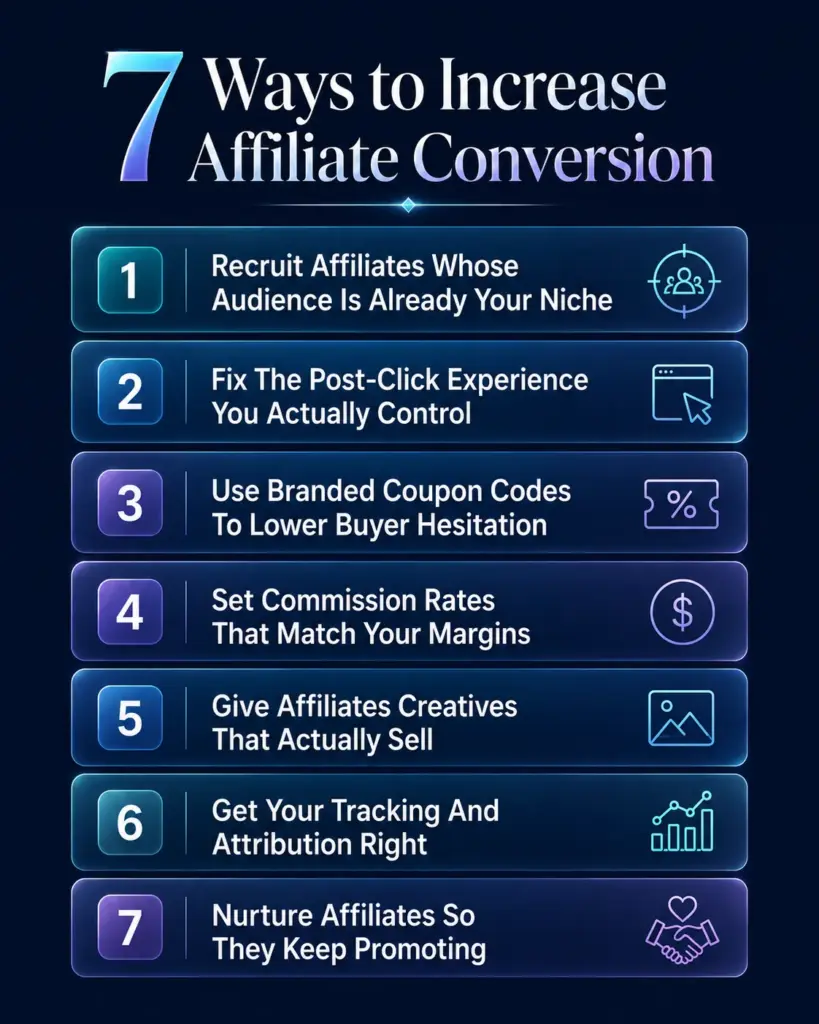
1. Recruit Affiliates Whose Audience Is Already Your Niche
This is the lever almost nobody talks about, and it matters more than any landing page tweak. The cleanest way to lift affiliate conversion is to recruit affiliates whose existing audience is already your exact buyer.
Think about it honestly. A general deals affiliate with a huge coupon site will send you a flood of bargain hunters who bounce the second they see full price. A small newsletter writer who covers your niche with 4,000 engaged readers will send fewer clicks, but those people already want what you sell. Fewer clicks, higher conversion, better customers. That trade is almost always worth it for a niche brand.
So how do you find them? Start with your own customers.
Your happiest buyers already understand the product and already talk to people like themselves. Invite them in with manual approval turned on so you can screen for genuine fit instead of letting anyone in. Look for micro-creators, niche bloggers, community moderators, and podcast hosts who serve your corner of the market. One relevant voice beats ten generic ones.
When you do bring on a high-fit partner, treat them differently. You can sort affiliates into Affiliate Groups and assign your best-fit partners a group with a higher commission rate.
In FluentAffiliate, you create the group, set its rate, then assign affiliates to it from their profile. It is a manual assignment, which is actually a feature here, because it forces you to decide who has earned the better terms rather than handing them out automatically.
The point is simple. Stop measuring recruitment by how many affiliates joined. Measure it by how well their audience overlaps with your buyer. That overlap is your conversion rate in disguise.
Read More: How to Recruit Affiliates for Your Business
2. Fix The Post-Click Experience You Actually Control
Here is a reframe that changes everything. You cannot control how an affiliate writes their email or films their video. But the moment someone clicks, the visitor lands on your turf, and now every conversion lever is yours.
Start with the page they land on. If your affiliate link drops shoppers onto a generic homepage, you are making them hunt. Send them to the specific product or a tailored landing page instead. FluentAffiliate lets you build custom landing pages with a shortcode like [fluent_aff_custom_landing ref=”X”], so you, the admin, can spin up a clean, branded page for a key partner.
Imagine a page that says “Recommended by” your partner’s name, with a short note and the exact product they promote. That continuity from their content to your page reduces the “wait, am I in the right place” hesitation that kills conversions.
Next, speed and friction. Roughly 70 percent of shoppers abandon their carts, and a slow or clunky checkout makes that worse. Compress your images, cut unnecessary form fields, offer guest checkout, and turn on the one-tap payment options your platform supports. None of this is fancy. It just removes the small frustrations that send a warm visitor away.
Then trust. A niche shopper buying from a brand they just discovered needs reassurance. About 96 percent of consumers check reviews before buying, so put real reviews, clear shipping and return terms, and a visible guarantee on the pages affiliate traffic actually hits.
You are not redesigning your whole store. You are tuning the handful of pages where affiliate visitors land. That focus is what makes it doable for a small team.
3. Use Branded Coupon Codes To Lower Buyer Hesitation
Coupons do two jobs at once for a niche brand, and both lift conversion.
First, they give hesitant first-time buyers a reason to act now. Around 88 percent of consumers say a discount makes them more likely to become a first-time customer. For a brand people are meeting for the first time through an affiliate, a small, honest discount is often the nudge that closes the sale.
Second, they fix a tracking weakness. Some buyers strip links, switch devices, or click an affiliate’s content but type your URL in later. A code travels with the person, not the browser.
FluentAffiliate supports branded coupon codes assigned to a specific affiliate through integrations like WooCommerce, Easy Digital Downloads, FluentCart, and SureCart. You create a normal discount in your store, then attach an approved affiliate to it. When a customer uses that code, the affiliate is credited automatically.
This is perfect for a partner with real influence in your niche, say a creator whose audience trusts them deeply. “Use code SARAH15 for 15 percent off” is easier to say in a video and easier to remember than a long tracking link. The affiliate gets a clean way to promote, the buyer gets a deal, and you get a tracked, converted sale. Just keep the discount sized to your margin so the win does not eat the profit.
Learn More: Coupon Code Tracking: The Smarter Way to Track Affiliates
4. Set Commission Rates That Match Your Margins
A lot of niche brands quietly hurt their own program by copying someone else’s commission rate. Ecommerce affiliate commissions typically run 3 to 10 percent, but the right number for you depends on your margin, not the industry average.
Here is the founder math. If your product carries a thin margin after the cost of goods, shipping, and fees, a flat 20 percent commission can turn a sale into a loss. If your margin is healthy, an attractive rate motivates affiliates to actually push you instead of a competitor. So work backward from what you keep per sale, decide the commission you can pay and still profit, then set it with eyes open.
FluentAffiliate gives you room to be precise instead of blunt. You can set a global default rate in Referral Settings, then override it with custom rates per product or category through your store integration. That means you can pay a higher rate on a high-margin signature product to drive promotion there, and a leaner rate on tight-margin items. You can also use Affiliate Groups to give your proven, high-fit partners better terms than brand-new sign-ups.
One more note. Higher commission does not directly raise the buyer’s conversion rate, but it raises affiliate effort and the quality of partner you can attract. Better partners send better-fit traffic, and better-fit traffic converts. That is the chain you are paying for.
For subscription products, FluentAffiliate can also reward affiliates on subscription renewals when you use WooCommerce & FluentCart, which keeps strong partners invested in keeping customers, not just acquiring them.
Learn More: Affiliate Commission Structure: Choose the best model for your Business
5. Give Affiliates Creatives That Actually Sell
If you make your affiliates create their own promo material from scratch, most will not bother, and the ones who do will do it inconsistently. Hand them ready-to-use assets instead.
FluentAffiliate has an Affiliate Creatives module where you store banners, text links, and QR codes that already carry each affiliate’s tracking link. Your partner just copies and pastes. No setup, no broken links, no missing attribution.
For a niche brand, this matters because consistency builds recognition. When every affiliate uses the same clean banner and the same accurate product description, your brand looks bigger and more trustworthy than it is, which helps conversion.
A few practical moves.
- Make creatives that match real buying moments, like a seasonal banner or a bestseller image, not just a generic logo.
- Use the public and private settings to give your top-tier partners exclusive assets, such as a special offer only their audience sees.
- And use scheduling so a holiday creative switches on and off on its own, which keeps your affiliates from promoting an expired deal.
Small touches, but they keep the post-click promise consistent with what the affiliate showed, and consistency is quietly one of the strongest conversion levers you have.
Read More: 15 Affiliate Creatives that Benefit Both Your Partners and Your Brand
6. Get Your Tracking And Attribution Right
You cannot improve a conversion rate if you are measuring it wrong. Plenty of niche brands think their affiliates underperform when the truth is that sales are happening but not being credited. Fix attribution first, then judge performance.
Start with cookie duration. This is the window after a click during which a purchase still counts for the affiliate. Niche products often have a longer consideration cycle, because the buyer researches, compares, and sleeps on it. If your cookie duration is set short, you are punishing your affiliates for your customers’ careful buying. Match the window to how long your buyers actually take to decide.
Next, decide who gets credit when more than one affiliate is involved. FluentAffiliate lets you credit the first or the last affiliate. There is no universal right answer. If your niche relies on discovery content, the first-touch affiliate did the hard work. If it relies on a final nudge like a review or a code, the last touch makes sense. Pick the model that matches your real buyer journey, then keep it consistent so your data stays comparable.
Then clean up the leaks. Turn on the disable self-referral option so affiliates cannot game commissions on their own purchases. Watch your visits log, which shows the landing URL, the referrer, and UTM source, medium, and campaign for every click. That data tells you which affiliates and which content actually convert, so you can double down on the partners who work and gently coach the ones who do not.
Affiliate spend fraud is estimated at 5 to 15 percent of total affiliate spend across the industry, so manual approval and self-referral blocking are simple, sensible defenses for a lean program.
Read More: 8 Affiliate Tracking Methods & How They Actually Work on WordPress
7. Nurture Affiliates So They Keep Promoting
Most affiliate programs are not killed by bad partners. They fade because brands sign affiliates up and then go silent. An affiliate who forgets you exist sends zero clicks, and zero clicks convert at zero percent.
The fix is steady, low-effort communication, and you can automate it. FluentAffiliate connects to FluentCRM with triggers for New Affiliate Created, New Referral Created, and New Payout Created. That lets you build a real onboarding and nurture flow without manual work.
A new affiliate joins and immediately gets a welcome sequence with their link, your best creatives, and a quick “here is what sells best” note. When they earn their first referral, a congrats email keeps the momentum going.
Why does this lift conversion and not just activity?
Because a well-informed affiliate promotes the right products to the right people in the right way. When you tell them which item converts best in your niche, share a proven angle, or flag a seasonal push, they send more qualified traffic to better-prepared pages. You are not just keeping them active. You are steering them toward the promotions that actually close.
For a niche brand with a small team, this automation is the difference between a program that needs constant babysitting and one that quietly compounds. Add affiliates to a dedicated FluentCRM contact list, set up the welcome and milestone emails once, and let it run. Returning, engaged partners behave a lot like returning customers, who are 2.5 to 3 times more likely to convert than first-timers. Familiarity sells.
Read More: What is the Value of Creating Relationships with Affiliate Marketers
A Simple 30-Day Plan To Lift Affiliate Conversion
You do not need to do everything at once. Here is a focused month that targets the biggest levers first.
Week 1: Audit attribution. Check your cookie duration against how long your buyers actually take, confirm your first or last credit choice, and turn on disable self referral. Fix tracking before you judge anyone.
Week 1: Pull your visits and referrals data. Identify your three best-converting affiliates and your three highest-traffic, low-conversion ones.
Week 2: Fix the landing pages affiliate traffic hits most. Tighten copy, add reviews, speed up load, and cut checkout friction.
Week 2: Build one custom landing page and one branded coupon for your top-fit partner.
Week 3: Recruit two to three new affiliates whose audience clearly matches your niche, with manual approval on.
Week 3: Load three ready-to-use creatives into the Affiliate Creatives module so partners can promote without effort.
Week 4: Set up a FluentCRM welcome sequence for new affiliates and a milestone email for first referrals.
Week 4: Review your conversion rate in the dashboard against where you started, and keep what moved the number.

Get the Best Affiliate Plugin for Your eCommerce Business
Final Thoughts
Increasing affiliate conversion for a niche ecommerce brand is not about chasing more clicks. It is about fit and follow-through. Recruit affiliates whose audience already wants what you sell, fix the pages and checkout you actually control, set commissions that respect your margins, track honestly, and keep your partners engaged. Do those things in order, and the same affiliate traffic starts converting noticeably better.
The good news is you can run all of it from inside WordPress, without handing a network a cut of every sale. FluentAffiliate gives you branded coupons, custom landing pages, flexible commission groups, a full visits log, and FluentCRM nurturing in one self-hosted toolkit. Want to see how it fits your store? Explore what FluentAffiliate can do and start tuning your program toward sales, not just clicks.
Frequently Asked Questions
What is a good affiliate conversion rate for a niche ecommerce brand?
A good affiliate conversion rate usually falls between 1 and 3 percent, with strong programs reaching 5 percent or higher. Niche brands often sit at the higher end because affiliate traffic arrives pre-qualified, so anything above 2 percent is a healthy starting point to build on.
Why are my affiliates sending clicks but no sales?
Clicks without sales usually point to one of three things: the traffic is not your real buyer, the landing page or checkout has friction, or the sales are happening but not being tracked. Check attribution and cookie duration first, then audit the pages affiliate traffic lands on.
How do I recruit better affiliates for a small niche store?
Start with your happiest customers and look for micro-creators, niche bloggers, and community voices who already serve your exact audience. Use manual approval to screen for genuine fit rather than accepting everyone. A few high-fit partners convert far better than many generic ones.
Do branded coupon codes really improve affiliate conversion?
Yes. Coupon codes give first-time buyers a reason to act, and roughly 88 percent of consumers say a discount makes them more likely to buy from a new brand. Codes also travel with the customer across devices, so they capture sales that link tracking can miss.
How should I set affiliate commission rates without losing money?
Work backward from your real margin per sale, not from a competitor’s rate. Decide what you can pay and still profit, then set a global default and use product-level or group-level overrides to pay more on high-margin items and less on tight-margin ones.
What cookie duration should a niche ecommerce brand use?
Match the cookie window to how long your buyers actually take to decide. Niche products often have a longer consideration cycle, so a short window can cut your affiliates out of sales they earned. Review your buyer timeline and set the duration to comfortably cover it.
Can I run an affiliate program on WordPress without a third-party network?
Yes. A self-hosted plugin like FluentAffiliate runs your entire program inside WordPress, including tracking, branded coupons, custom landing pages, commission rules, and payouts. You keep your data and avoid a network taking a percentage of every affiliate sale.


Add your first comment to this post