

Affiliate Marketing vs Performance Marketing: Which One Fits Your Business
You keep seeing both terms. A blog post says performance marketing, a YouTube video says affiliate marketing, and they sound like the same thing, wearing two different shirts. Are they? Sort of.
They are related, but they do not do the same job.
And if you run a WordPress site, picking the right one early saves you a pile of wasted time and money. Let’s sort it out.
Key Takeaways: Affiliate vs Performance Marketing
- Performance marketing is the umbrella term; affiliate marketing is one channel that sits under it.
- Both share one rule: you pay for results, not for guesses.
- Performance marketing usually means paid ads where you pay per click or per action upfront.
- Affiliate marketing means partners promote you and earn a commission only after a sale happens.
- For a WordPress owner with a small budget, affiliate marketing is the one model you can fully run in-house.
- Performance marketing scales with money; affiliate marketing scales with relationships and rules.
- Most growing businesses end up using both, but affiliate is usually the safer place to start.
What Is Performance Marketing
Performance marketing is a type of digital marketing where you pay only when a specific, measurable action happens, such as a click, lead, or sale, instead of paying for exposure.
Performance marketing is a big bucket. It covers any marketing where you pay based on a measurable action instead of paying for exposure and hoping.
That action could be a click, a lead, an app install, a signup, or a sale. The point is simple. You are not paying for a billboard that maybe gets seen. You are paying when something actually happens.
So when a business runs Google Ads, Facebook ads, retargeting campaigns, or influencer deals tied to a result, that is all performance marketing. The common thread is accountability. Every dollar is supposed to connect to an outcome you can see in a report.
Here is the catch though. In most performance marketing, you still pay before you know if it worked. You pay per click on a Google ad whether or not that click ever buys. You set a budget, the platform spends it, and you find out later if the math was good. The “performance” part is that you can measure it, not that you only pay after a sale.
That distinction matters, and it is exactly where affiliate marketing THRIVES.
What Affiliate Marketing Actually Is
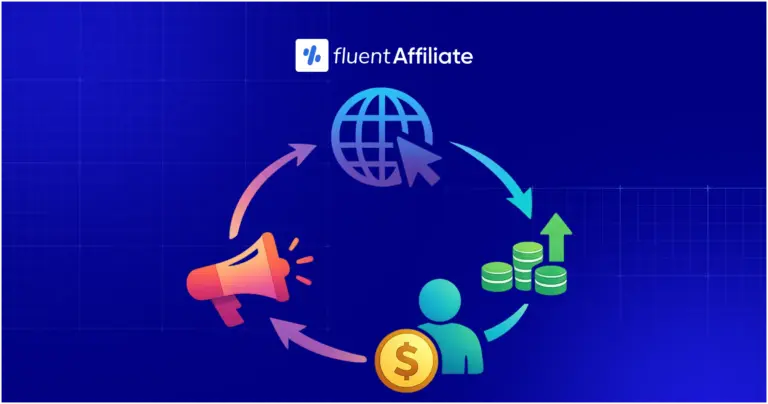
Affiliate marketing is a type of performance marketing where other people promote your product using a special link and earn a commission only after they bring you a real sale or lead.
Here is how that plays out.
Affiliate marketing is one specific type of performance marketing. The difference is who does the promoting and when you pay.
Instead of you buying ads, other people promote your product to their audience. These are your affiliates. They could be bloggers, YouTubers, newsletter writers, niche site owners, or even happy customers. They share a special link, and when someone clicks it and buys, that affiliate earns a commission.
The big thing is the timing. You pay nothing until a real sale or lead happens. No sale, no cost. Think of it like hiring a salesperson who only gets paid when they close a deal. That is why so many small businesses lean on it.
If you run WordPress, this is the model you can actually own. With a plugin like FluentAffiliate, your whole affiliate program lives right inside your own site. You set the rules, your supporters sign up, they get their links, and you track everything from your dashboard. No ad network, no monthly ad spend, no media-buying skills required.
We will come back to that, because it is the heart of why this comparison matters for WordPress site owners.

Starting From Scratch? Kickstart
with Affiliate Marketing 101 Guide!
The Simplest Way To See The Difference
Picture a coffee shop.
Performance marketing is paying for a flyer campaign where you get charged every time someone glances at the flyer and walks toward your door. You can count the walk-ins, so it is measurable. But you pay whether or not they buy a coffee.
Affiliate marketing is telling your regular customers, “Bring a friend, and if they buy a coffee, I’ll give you a free pastry.” You pay only after the friend actually buys. The reward is tied to the real result, not the attempt.
Both are smarter than a plain billboard. But one charges you for the effort, and the other charges you for the outcome. That is the cleanest line between them.
How They Overlap And Why People Mix Them Up
The reason these two terms get tangled is that affiliate marketing genuinely is performance marketing. It is not a rival. It is a family member.
So when a marketer says “we run performance marketing,” they might mean paid ads, they might mean an affiliate program, or they might mean both. When someone says “affiliate marketing,” they are always talking about that specific partner-and-commission setup.
Here is the relationship in one line. All affiliate marketing is performance marketing. Not all performance marketing is affiliate marketing.
The confusion usually comes from people in different roles. An ad buyer calls everything performance marketing because they judge it all on cost per action. A partnerships person calls affiliate work performance-led because affiliates only earn on results. Both are partly right. They are just standing in different corners of the same room.
Affiliate vs Performance Marketing: A Side-by-Side Comparison
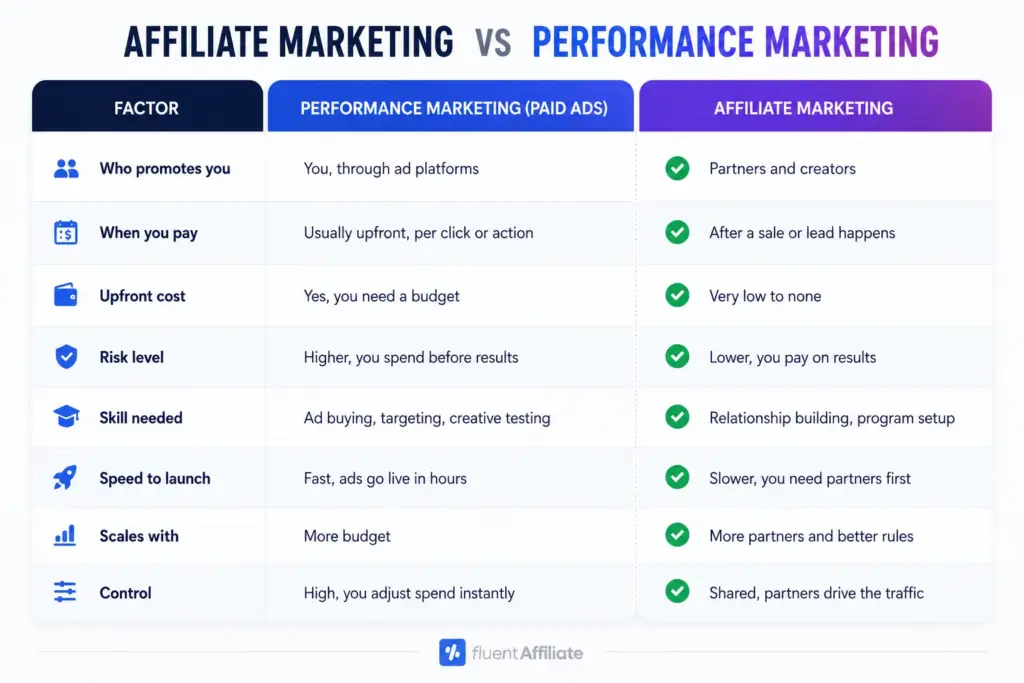
Sometimes, a plain table clears it up faster than paragraphs. So take a quick look:
| Factor | Performance Marketing (paid ads) | Affiliate Marketing |
| Who promotes you | You, through ad platforms | Partners and creators |
| When you pay | Usually upfront, per click or action | After a sale or lead happens |
| Upfront cost | Yes, you need a budget | Very low to none |
| Risk level | Higher, you spend before results | Lower, you pay on results |
| Skill needed | Ad buying, targeting, creative testing | Relationship building, program setup |
| Speed to launch | Fast, ads go live in hours | Slower, you need partners first |
| Scales with | More budget | More partners and better rules |
| Control | High, you adjust spend instantly | Shared, partners drive the traffic |
Neither column is the winner. They just fit different situations, which is the whole point.
Why This Matters More Than Ever
This is not a small side debate. The money involved is real and growing.
In the United States, affiliate marketing spend reached $13.62 billion in 2024, up nearly 50 percent from $9.1 billion in 2021, according to the Performance Marketing Association. That same study found affiliate activity drove around $113 billion in ecommerce sales and made up about 9.4 percent of all U.S. ecommerce sales.
On the wider performance side, U.S. digital ad revenue hit $294.6 billion in 2025, up almost 14 percent year over year, per the IAB. Search and social alone made up a huge slice of that.
And the return on affiliate spend tends to be strong. Industry reporting from Influencer Marketing Hub has businesses earning an average of around $15 for every $1 spent on affiliate marketing, though the exact figure shifts by industry.
The takeaway is not “affiliate beats ads.” It is that both channels are now serious, trackable places to put your money. The crowded, expensive part is paid ads. The lower-risk, partner-driven part is affiliate. Knowing which one suits you keeps you from burning a budget you cannot afford to lose.
Which One Should You Start With
For most WordPress owners, the answer leans toward affiliate marketing first. Here is the thinking behind that.
When affiliate marketing fits better
Affiliate marketing is the smarter starting point when:
- You have a small or unpredictable budget and cannot risk upfront ad spend.
- Already have some happy customers, an audience, or contacts in your niche.
- Sell something with healthy margins, so you can afford a commission.
- Want a setup you can run yourself without learning ad platforms.
- Care about trust, since recommendations from real people convert well.
A course creator, a plugin shop, a membership site, a small WooCommerce store. These are textbook fits. You reward people for sending real buyers, and you never pay for empty clicks.
When performance marketing (ads) fits better
Paid performance marketing earns its place when:
- You need traffic fast and have money ready to spend on it.
- Want tight control to test offers, audiences, and creative quickly.
- Have a short campaign window, like a launch or a seasonal push.
- Already know your numbers and can afford to lose some spend while testing.
- Have someone who actually knows how to run ad campaigns.
Speed and control are the upside. The downside is you are paying before you know what works, and a bad week can get expensive.
The practical middle ground
Most businesses that grow end up using both. They run an affiliate program for steady, low-risk, trust-driven sales, and they layer in paid ads when they want a burst of fast traffic.
Affiliate becomes the reliable base. Ads become the accelerator. But you rarely need both on day one, and starting with affiliate keeps your risk low while you learn.
How To Run Affiliate Marketing On WordPress
Since affiliate is the model you can own yourself, let’s get practical. Here is what setting it up looks like when everything lives inside your own site.
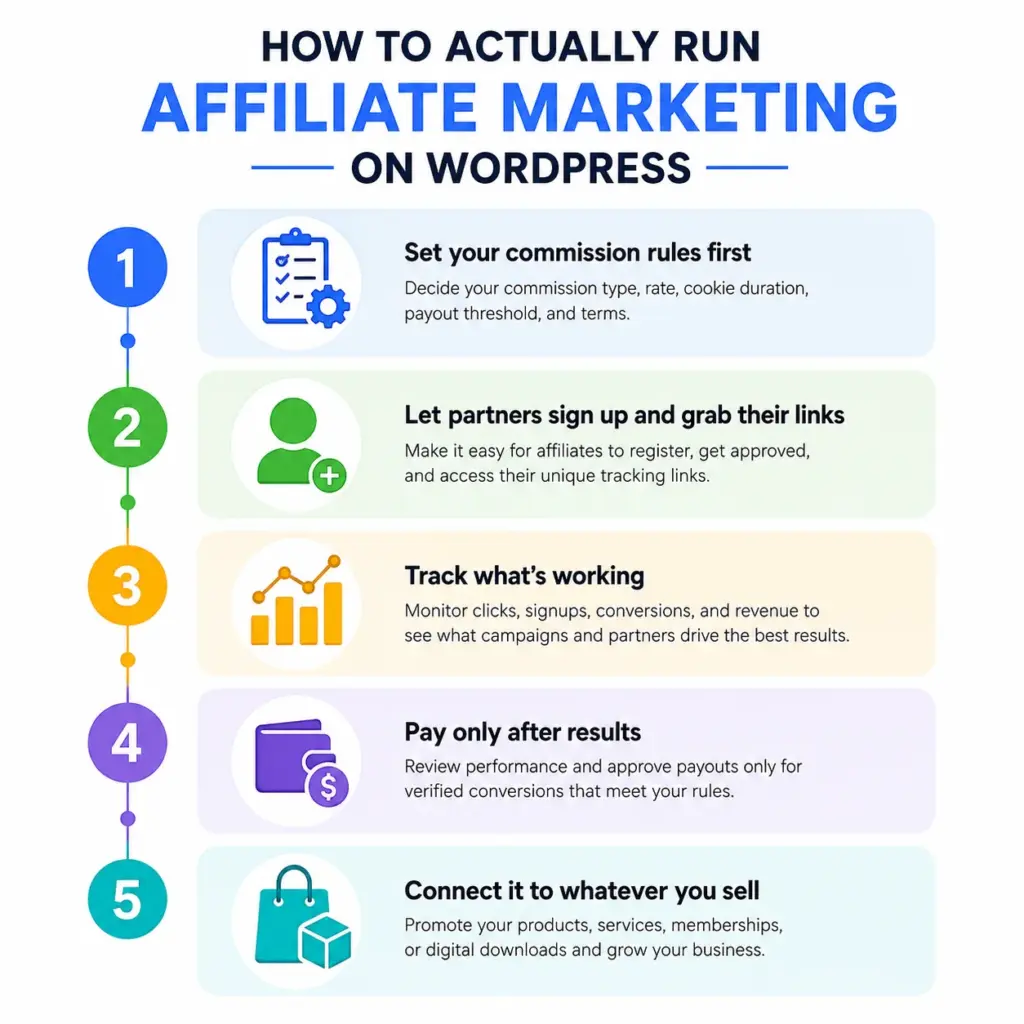
Set your commission rules first
Before anyone signs up, decide what you will pay. A flat amount per sale, or a percentage of each order. In FluentAffiliate, you handle this in the referral settings, where you set your default rate, your currency, and how long the tracking cookie lasts. This is your foundation, so it is worth getting right before you invite partners.
If you are just installing the plugin, the onboarding setup walks you through the core choices in a few steps, so you are not staring at a blank dashboard.
Let partners sign up and grab their links
Once your rules are set, affiliates can register and get to work. Each one generates their own unique referral link from their dashboard, which they then share on their blog, channel, or email list. The generating affiliate links process is simple enough that partners can do it without help from you, which saves you a lot of back and forth.
You can also give them ready-made promo material. Banners, text links, and QR codes all live in affiliate creatives, so your partners are not starting from scratch every time they want to promote you.
Track what’s working
This is where the “performance” in performance marketing shows up. You can see every click in managing visits, and every sale that came through in managing referrals. That means you know which partners actually drive buyers, not just clicks. If an affiliate sends a thousand visits and zero sales, the data tells you. If one quiet partner sends ten sales a month, you know to take care of them.
Pay only after results
When it is time to reward your affiliates, payout management records each payment and generates a report you can export. One thing to know up front: FluentAffiliate records and tracks payouts, but the actual money transfer is done manually, usually through PayPal or bank transfer. So it keeps your books clean, but you send the payment yourself.
Connect it to whatever you sell
Affiliate tracking only matters if it plugs into your store or membership tool. FluentAffiliate connects with the platforms most WordPress owners already use, through its integrations. That includes WooCommerce, Easy Digital Downloads, MemberPress, LifterLMS, SureCart, and more. So a sale in your store automatically becomes a tracked referral, with no copy-pasting order numbers.
Final Thoughts
So, affiliate marketing vs performance marketing is not really a fight. Performance marketing is the big family, and affiliate marketing is the one member you can raise yourself without a big budget or ad-buying skills.
If you run a WordPress site and you are weighing where to put your limited time and money, starting with an affiliate program is usually the lower-risk, higher-trust move. You only pay when sales happen, and you keep full control inside your own site.
Ready to turn your customers and fans into a sales team that only earns when you do? FluentAffiliate lets you launch and run the whole program right from your WordPress dashboard.
Frequently Asked Questions
Is affiliate marketing the same as performance marketing?
No. Affiliate marketing is one type of performance marketing. Performance marketing is the broad category covering any marketing where you pay based on a measurable action, like clicks or sales. Affiliate marketing is the specific version where outside partners promote you and earn a commission only after a real conversion.
Which is cheaper, affiliate marketing or paid performance marketing?
Affiliate marketing is usually cheaper to start because you pay only after a sale happens, with little to no upfront cost. Paid performance marketing, like Google or Facebook ads, requires a budget you spend before you know the results, which makes it higher risk for small businesses.
Can I run affiliate marketing without an ad budget?
Yes. Affiliate marketing does not require ad spend. Your partners promote your product to their own audiences, and you only pay commissions on actual sales. With a WordPress plugin like FluentAffiliate, you can run the entire program from your own site without buying any ads.
Do I need a separate platform to run an affiliate program?
Not on WordPress. You can manage your whole affiliate program inside your own site using a plugin. It handles affiliate signups, link generation, click and sale tracking, and payout records, so you do not need a third-party affiliate network to get started.
Is affiliate marketing better than running ads?
Neither is better overall. Affiliate marketing is lower risk and trust-driven, which suits small budgets and steady growth. Paid ads are faster and give tighter control, which suits launches and quick testing. Many businesses use affiliate as a reliable base and add ads for speed when needed.
How do I track whether my affiliates are actually driving sales?
You track it through clicks and referrals. A good affiliate tool logs every visit from an affiliate link and every sale that results. This lets you see which partners bring real buyers versus just clicks, so you can reward your top performers and spot underperformers.
Does affiliate marketing work for small WordPress businesses?
Yes. Affiliate marketing fits course creators, membership sites, small ecommerce stores, and plugin or digital product sellers especially well. The low upfront cost and pay-on-results model make it a safe way for small WordPress businesses to grow




Add your first comment to this post