

How Do Affiliate Marketers Promote Products [12 Proven Ways That Actually Work]
![How Do Affiliate Marketers Promote Products [12 Proven Ways That Actually Work]](https://fluentaffiliate.com/wp-content/uploads/2026/05/Frame-2147238371-scaled.webp)
Affiliate marketing looks simple from the outside. Share a link, earn money. But honestly, the real work happens in how affiliates promote those products. The smartest affiliates use a mix of content, trust, and the right channels to turn clicks into commissions.
In this guide, you will learn 12 proven ways affiliate marketers actually promote products, with real examples and practical tips you can use right away.
Key Takeaways: How Affiliate Promote Products
- Affiliate marketers promote products by combining helpful content, real trust, and the right tools, not by just dropping links.
- The 12 most proven methods are blog reviews, YouTube videos, email marketing, SEO content, social media, paid ads, short-form video, podcasts, QR codes, branded coupons, custom landing pages, and webinars.
- Trust is the real currency of affiliate marketing, and it always comes before the click.
- You do not need to use every method, just pick two or three that match your strengths and go deep.
- SEO and email marketing usually give the most reliable long-term results, while short-form video grows the fastest in 2026.
- Program owners can boost affiliate performance by offering creatives, branded coupons, QR codes, and custom landing pages.
- Tools like FluentAffiliate help WordPress businesses run their own affiliate programs with full tracking, creatives, and integrations built in.
What Affiliate Marketers Actually Do to Promote Products
In simple terms, affiliate marketers share unique tracking links to products they recommend. When someone clicks the link and buys, the affiliate earns a commission.
But here is the thing. Just dropping a link somewhere does not work anymore. People are smarter, platforms are stricter, and trust is harder to win.
So affiliates today focus on building content that genuinely helps people. They review products, compare options, answer questions, and show real use cases. The link is just the last step. The trust comes first.
Think of it like recommending a restaurant to a friend. You would not just text them an address. You would tell them what to order, why you love it, and what to avoid. Affiliate marketing works the same way, just at a larger scale.
12 Proven Ways Affiliate Marketers Promote Products
Let us get into the methods that actually work. Some of these are evergreen. Others are newer and growing fast in 2026. The best affiliates usually mix several of them.
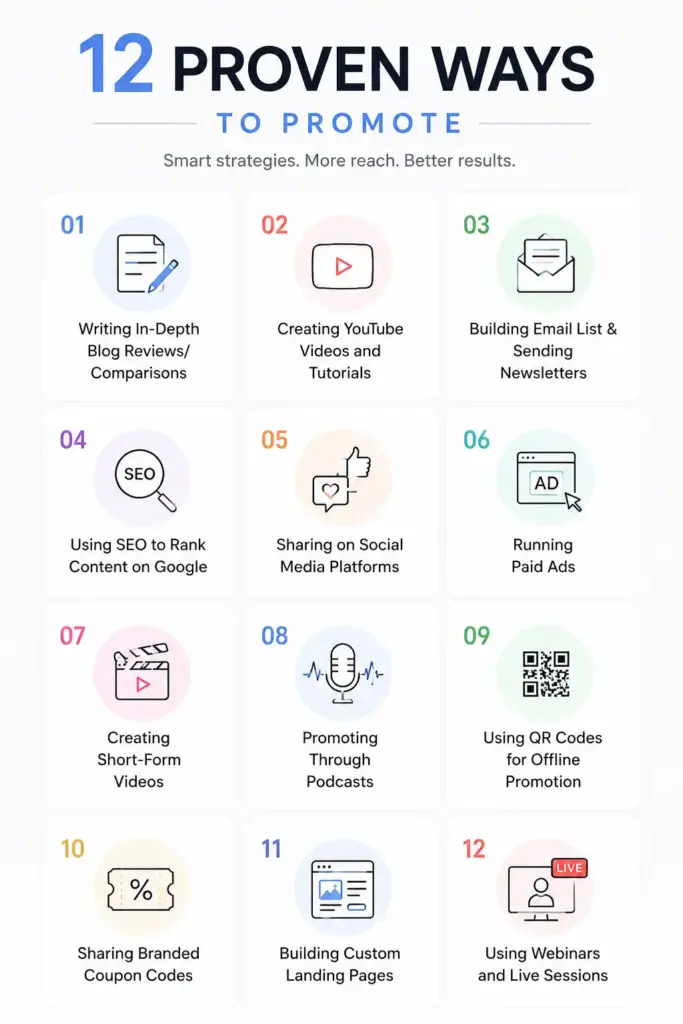
1. Writing In-Depth Blog Reviews and Comparisons
Blog reviews are still one of the most reliable ways affiliates earn commissions. People searching for “best email marketing tool” or “X vs Y” usually have their wallet half open already.
A good review answers real questions. It covers the pros, the cons, the pricing, who it is for, and who should skip it. Honest reviews build trust, and trust drives clicks.
Comparison posts work even better because they catch people at the decision stage. Someone comparing two tools is much closer to buying than someone reading a general “what is affiliate marketing” post.
Quick tip: add screenshots, real test results, and personal opinions. Generic AI-style reviews rarely rank well in 2026.
2. Creating YouTube Videos and Tutorials
YouTube is a goldmine for affiliate marketers. Why? Because video builds trust faster than text. You can see the person, hear their tone, and watch them actually use the product.
Tutorial videos, unboxings, and walkthroughs perform really well. So do “set up X in 10 minutes” or “how I use Y for my business” style videos.
The best part is that YouTube videos keep earning for years. A good tutorial can bring in clicks long after it is published. Add your affiliate link in the description, mention it in the video, and pin a comment with the link.
3. Building an Email List and Sending Newsletters
If you ask any experienced affiliate where their best commissions come from, most will say email. The reason is simple. Email subscribers chose to hear from you. They trust you more than a random reader on Google.
Affiliates use newsletters to share product recommendations, deals, case studies, and behind-the-scenes lessons. A well-written email with one solid recommendation often beats a month of social media posts.
The trick is to give value first. Share tips, free resources, or insights. Then, when you recommend a product, people actually listen.
4. Using SEO to Rank Affiliate Content on Google
SEO is the long game, but it pays off. When your content ranks on Google, you get free traffic every single day without spending on ads.
Affiliates target search-intent keywords like “best CRM for small business” or “how to start a podcast.” These phrases show that someone is researching or ready to buy.
Good SEO content covers the topic deeply, answers related questions, includes real screenshots, and earns backlinks naturally. With AI Overviews now showing up in search results, well-structured content with clear answers performs even better.
5. Sharing on Social Media Platforms
Social media is where conversations happen, and affiliates use that to their advantage. Platforms like Facebook, X (formerly Twitter), LinkedIn, and Instagram all work, depending on your audience.
On LinkedIn, affiliates share business-focused recommendations. On Instagram, they use stories, carousels, and posts. On X, short tips with affiliate links work well for tech and SaaS niches.
The key is not to spam. Share useful content most of the time, then mention products naturally when they fit. Think of it as 80 percent value, 20 percent promotion.
6. Running Paid Ads
Paid ads are faster but riskier. Affiliates use Google Ads, Facebook Ads, and TikTok Ads to drive traffic to their content or directly to landing pages.
This method needs careful tracking. You are paying for clicks, so the math has to work out. Most successful affiliates send ad traffic to a landing page or blog post first, not directly to the affiliate link. That way, they warm up the visitor before sending them to the product.
Honestly, paid ads are not for beginners. But once you know which products convert well, they can scale your income fast.
7. Creating Short-Form Videos on TikTok, Reels, and Shorts
Short-form video has exploded, and affiliate marketers are riding the wave. A 30-second TikTok showing how a product solves a problem can reach millions of people for free.
What works here is hooks. The first three seconds decide if someone keeps watching. Affiliates show the result first, then explain how the product helped. Something like “I tripled my email signups using this one tool” gets attention fast.
You usually cannot add clickable links inside the video, so most affiliates send viewers to their bio link, where they have a list of affiliate links or a landing page.
8. Promoting Through Podcasts
Podcasts build deep trust. When listeners hear someone for hours, they start to feel like they know them. That trust translates well into product recommendations.
Affiliates either run their own podcasts or get featured as guests on other shows. They mention products naturally during interviews, often with a unique discount code or link that listeners can use.
Even small podcasts with loyal audiences can generate solid commissions. The audience is usually highly targeted, which means higher conversions.
9. Using QR Codes for Offline Promotion
QR codes are making a strong comeback. Affiliates print them on business cards, flyers, posters, event handouts, and even t-shirts. Anyone with a phone camera can scan and land on the affiliate link instantly.
This works really well for local promotion, events, conferences, and physical product launches. A speaker at a marketing event can flash a QR code on their slide, and dozens of people scan it within seconds.
Tools like FluentAffiliate let affiliates generate custom QR codes for their referral links right from their dashboard. So they can download a branded QR code and start using it offline immediately.
10. Sharing Branded Coupon Codes
Coupon codes are powerful because they give the customer something in return. Instead of just sharing a link, affiliates share a code like “JOHN20” that gives 20 percent off.
People love discounts, and codes are easy to remember. Influencers and content creators especially benefit from this method. They can mention their code in a video, on a podcast, or in a blog post, and the tracking still works perfectly.
For program owners using FluentAffiliate with WooCommerce, Easy Digital Downloads, or FluentCart, you can assign branded coupon codes directly to affiliates. When someone uses the code, the affiliate gets credit automatically. It is one of the cleanest ways to track offline and influencer-driven sales.
11. Building Custom Landing Pages
A custom landing page makes affiliate promotion feel more professional. Instead of sharing a long URL with tracking parameters, affiliates can use a clean, branded link like yoursite.com/partner/alex.
These pages usually include the affiliate’s photo, a personal message, a testimonial, or even a special offer. They build trust and convert better than raw affiliate links.
If you are running a program with FluentAffiliate, you can create custom landing pages for your top affiliates using a simple shortcode. This gives them a professional URL to share with their audience while still tracking every sale properly.
12. Using Webinars and Live Sessions
Webinars work well for higher-priced products. They give the affiliate time to explain the product, show its value, answer questions, and address objections in real time.
Affiliates often host free webinars on a topic their audience cares about, then recommend a tool or course at the end. Live sessions on Instagram, YouTube, or LinkedIn work the same way.
The conversion rate from a good webinar is much higher than from a blog post or social media post. People who stay for an hour are usually serious about solving their problem.
How Program Owners Can Help Affiliates Promote Better
Now, if you are running an affiliate program yourself, here is something most program owners miss. Your affiliates need the right tools to promote properly. Giving them just a link is not enough.
The best affiliate programs in 2026 give their affiliates a full toolkit. That usually includes:
- Ready-made banners, images, and ad creatives
- Branded QR codes for offline use
- Custom coupon codes they can share
- Personalized landing pages
- Email swipe copy and social media templates
- Clear performance tracking dashboards
This is exactly where a tool like FluentAffiliate helps. It is a WordPress affiliate management plugin built for businesses that want to run their own affiliate program without relying on third-party platforms.
With FluentAffiliate, you can:
- Give affiliates ready-to-use creatives like banners, text links, and QR codes through the Affiliate Creatives feature
- Assign branded coupon codes to specific affiliates through integrations with WooCommerce, FluentCart, and Easy Digital Downloads
- Create custom landing pages for top affiliates using a simple shortcode
- Let affiliates generate their own referral links and QR codes from their dashboard
- Track every visit, referral, and payout in one place
- Connect multiple websites for cross-domain tracking using Multi-Domain Management
When affiliates have the right tools, they promote more, more often, and with better results. That is a win for both sides.
Common Mistakes Affiliate Marketers Should Avoid
Even smart affiliates trip up sometimes. Here are the most common mistakes to watch out for.
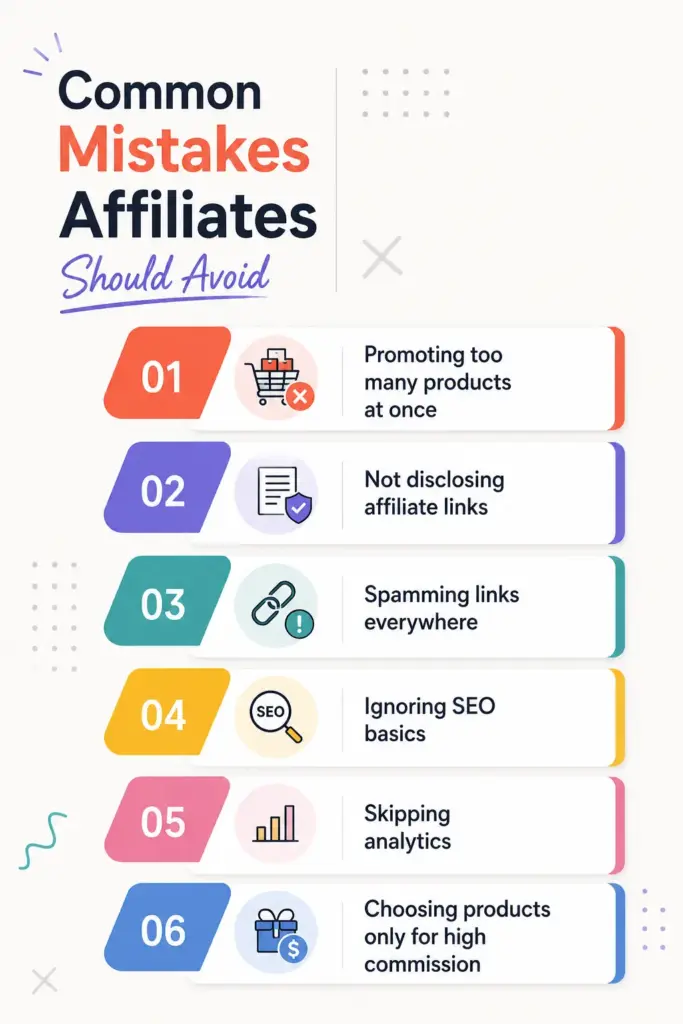
Promoting too many products at once. Picking 20 products to promote spreads you thin. Focus on a few you truly believe in.
Not disclosing affiliate links. This is both an ethical and legal issue in most countries. A simple line like “this post contains affiliate links” builds trust.
Spamming links everywhere. Dropping links in random Facebook groups or Reddit threads usually gets you banned, not paid.
Ignoring SEO basics. Writing without keyword research means your content sits invisible on Google. A little SEO research goes a long way.
Skipping analytics. If you do not track what works, you will keep doing what does not. Even basic tracking helps you double down on winning content.
Choosing products only for high commission. A 50 percent commission means nothing if no one buys. Always pick products that genuinely fit your audience.
How to Choose the Right Promotion Method for You
You do not need to use all 12 methods. In fact, trying everything at once usually leads to burnout. The smarter move is to pick two or three methods that match your strengths.
Ask yourself a few questions.
Do you enjoy writing? Start with blog reviews and SEO content.
Are you comfortable on camera? YouTube and short-form video will work well for you.
Do you have a strong network? Email and webinars will give you faster results.
Do you already have an audience on social media? Build on what is working there.
Once you pick your main channels, get really good at them before adding more. Most successful affiliates earn most of their income from just one or two methods, not all of them.
Conclusion
So, how do affiliate marketers promote products? The honest answer is that the best ones combine helpful content, real trust, and the right tools. They focus on solving problems, not just sharing links.
Whether you are an affiliate looking to grow your income or a business owner running your own affiliate program, the methods in this guide give you a solid starting point. Pick a few that match your strengths and stay consistent.
If you are thinking about launching your own affiliate program on WordPress, FluentAffiliate gives you everything you need to support your affiliates with creatives, branded coupons, QR codes, custom landing pages, and complete tracking. The easier you make it for affiliates to promote, the faster your program will grow.
Frequently Asked Questions (FAQs)
What is the most effective way to promote affiliate products?
There is no single best method. For most affiliates, a mix of SEO blog content and email marketing gives the most reliable long-term results. YouTube and short-form video are also growing fast in 2026.
Can you do affiliate marketing without a website?
Yes, you can. Many affiliates promote products through YouTube, TikTok, Instagram, podcasts, and email lists without owning a website. However, having a website gives you more control and better long-term results.
How long does it take to make money with affiliate marketing?
It depends on the method. Paid ads can bring results in days, while SEO content usually takes three to six months to start earning consistently. Most affiliates see steady income after six to twelve months of consistent work.
Do affiliate marketers need to disclose their links?
Yes. In most countries, including the US and UK, affiliate marketers must disclose that their links earn them a commission. A short line at the top of a post or video is usually enough.
What is the best platform for affiliate marketing in 2026?
It depends on your audience. YouTube, blogs, email, and short-form video platforms like TikTok and Instagram Reels are all performing strongly in 2026.
How do affiliate marketers get traffic to their links?
They use SEO, social media, email lists, paid ads, YouTube, podcasts, and offline methods like QR codes. Most successful affiliates combine two or three of these channels.
Is affiliate marketing still profitable in 2026?
Yes, very much. Affiliate marketing continues to grow each year. The methods have changed, with more focus on video, AI search, and trust-based content, but the opportunity is still wide open.



Add your first comment to this post