
What is the Value of Creating Relationships with Affiliate Marketers
Most affiliate programs grow slowly. Not because the product is weak or the commission is low, but because the brand treats affiliates like one-time promoters instead of real partners.
Honestly, that mindset costs more sales than people realize. Strong affiliate relationships are where the real growth lives.
In this guide, you’ll see why these relationships matter and how to build them the right way.
Key Takeaways: Affiliate Relationship
- Affiliate relationships are more valuable than commission rates. Strong relationships create steady traffic, loyal advocates, and long-term sales. A small group of engaged affiliates almost always outperforms a large group of cold ones who signed up and disappeared.
- Treating affiliates like partners drives real business growth. When you treat affiliates as part of your team, you get higher conversion rates, better content, stable monthly revenue, and word-of-mouth growth you cannot buy with ads.
- Communication is the foundation of every strong affiliate relationship. Affiliates need more than payout emails. Regular updates, product news, and friendly check-ins keep them informed, engaged, and motivated to promote your brand consistently.
- Recognition and rewards reduce affiliate churn. Top performers stay loyal when they feel seen. Simple actions like thank-you messages, public shoutouts, or higher commission tiers can dramatically lower churn and increase long-term performance.
- The right tool turns relationship-building into a system. FluentAffiliate brings affiliate tracking, creatives, custom landing pages, automated communication through FluentCRM, and a transparent dashboard into one place. So you can focus on relationships instead of admin work.
What Are Affiliate Relationships, Really?
Affiliate relationships are the ongoing connections between your brand and the people who promote it. They go beyond commission rates, tracking links, and monthly payouts. In simple terms, it is the way you treat your affiliates and the way they feel about your brand.
Think of it like this. A vendor at a busy market can sell to anyone walking by. But the regular customers, the ones who come back every week, are the ones who trust the vendor and bring friends along. Affiliate marketing works the same way. Random promoters bring random sales. Real partners bring steady, growing sales.
A good affiliate relationship has three parts:
- Clear and open communication
- Mutual respect and fair value exchange
- A sense that both sides are working toward the same goal
When these three parts come together, affiliates stop feeling like outsiders. They start feeling like part of your team.
Why Most Affiliate Programs Stay Small
A lot of affiliate programs stay flat for years. The owner adds new affiliates, sets up tracking, and waits. But the sales never really grow. Well, the reason is usually not the product. It is the lack of relationship building.
Here are some common mistakes that quietly hurt affiliate programs:
- Treating affiliates as numbers on a dashboard
- Only contacting them when there is a payout or a problem
- Offering no support, no creatives, and no guidance
- Ignoring top performers instead of rewarding them
- Giving the same commission to everyone, no matter their effort
- Making the affiliate dashboard confusing or hard to use
The cost of ignoring these things is higher than most people think. Affiliates quietly drop off. They stop promoting. They move to a competitor who actually talks to them. And the brand never knows what went wrong.
The Real Value of Building Strong Affiliate Relationships
This is the part that most brands underestimate. Strong affiliate relationships are not just nice to have. They directly affect your revenue, your brand image, and your long-term stability. Let’s break it down.
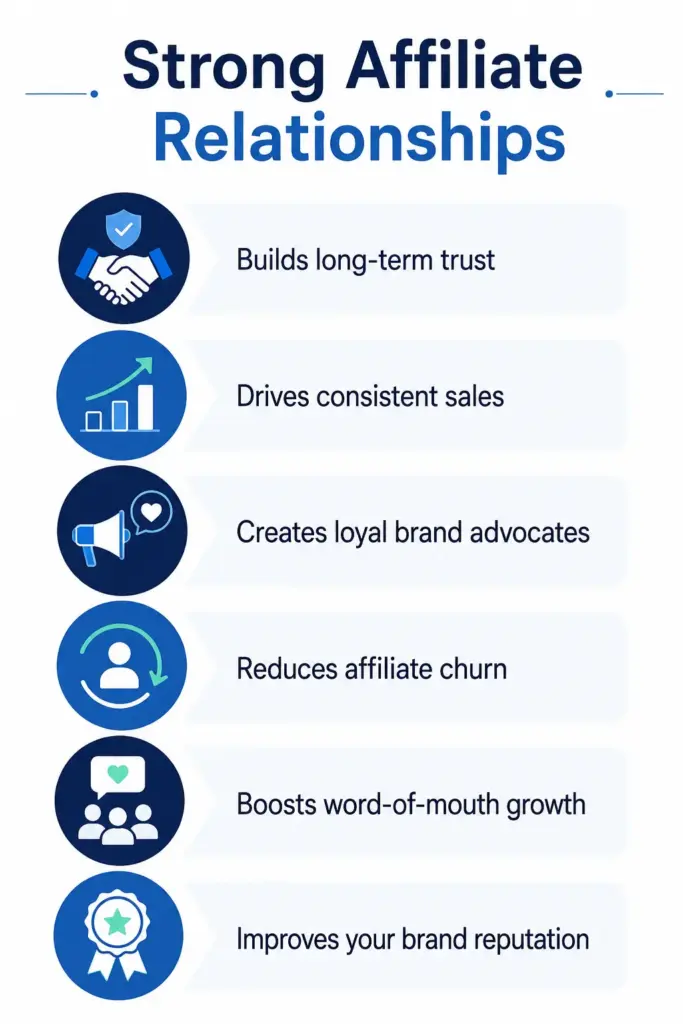
Builds long-term trust
Trust is the foundation of every good business relationship. When affiliates trust your brand, they promote it with confidence. They speak about your product like they actually believe in it, because they do. That kind of promotion sounds real, and readers can feel the difference.
Trust also works the other way. When you trust your affiliates, you give them more freedom, better tools, and bigger opportunities. That trust loop is where serious growth begins.
Drives consistent and higher-quality sales
A random promoter might send a few clicks once in a while. A loyal affiliate partner sends steady traffic every single month. They write better content, create better videos, and recommend your product in the right context.
That is why one engaged affiliate often outperforms ten cold ones. The traffic is warmer, the conversion rate is higher, and the customers tend to stick around longer.
Creates loyal brand advocates
Strong affiliate relationships turn promoters into advocates. Advocates do more than just share a link. They defend your brand in comments, recommend you in private conversations, and bring in new affiliates through word of mouth.
This is the kind of growth you cannot buy with ads. It only comes from people who genuinely care about your brand.
Reduces affiliate churn
Affiliate churn is a silent killer. Affiliates sign up, promote once or twice, then disappear. When you build real relationships, churn drops. Affiliates stay because they feel valued, supported, and connected to your brand.
Lower churn means more stable revenue and less time spent recruiting new affiliates every month.
Boosts word-of-mouth growth
Happy affiliates talk. They mention your program in their communities, on social media, and in private groups. That kind of organic recommendation brings in higher-quality affiliates than any paid campaign.
In simple terms, your best affiliates become your best recruiters.
Improves your brand reputation
Every affiliate is a small extension of your brand. The way they speak about you shapes how people see your business. When your affiliates feel respected, that respect shows up in their content. When they feel ignored, that shows up too.
Strong relationships create strong brand stories. And strong brand stories are what people remember.
How Strong Affiliate Relationships Affect Business Growth
Let’s connect the dots between relationships and real business outcomes. This is where the value becomes hard to ignore.
When affiliate relationships are strong, you usually see:
- More repeat referrals from the same affiliates
- Higher conversion rates because the audience is pre-warmed
- Better content quality from affiliates who understand your product
- More stable monthly revenue instead of unpredictable spikes
- Faster product feedback because affiliates talk to real customers
- Lower marketing costs because affiliates handle a lot of the awareness work
Think about it. If ten affiliates trust you and promote you every month, that is ten consistent traffic sources working for your business. Compare that to a hundred cold affiliates who sign up and never promote. The smaller, stronger group almost always wins.
This is also why brands that invest in affiliate relationships often beat bigger competitors. They might have a smaller program, but the engagement is deeper and the results are more consistent.
Signs You Are Not Building Real Relationships With Your Affiliates
Sometimes it helps to look at this from the other side. If any of these sound familiar, your affiliate relationships probably need work.
- You do not know the names of your top five affiliates.
- You only email affiliates when there is a payout or a policy update.
- Your affiliates have no clear way to ask questions or get help.
- You have not updated your affiliate creatives in months.
- Top performers and beginners get the same commission rate.
- You have no idea why affiliates leave your program.
- Your affiliate dashboard is confusing or feels outdated.
- You do not celebrate wins, milestones, or top affiliates publicly.
If you nodded at three or more of these, that is okay. It just means there is room to grow. The good news is that fixing these things is not complicated. It just takes intention.
How to Build Strong Relationships With Your Affiliates
Now let’s get into the practical part. Building affiliate relationships is not about big budgets or fancy tools. It is about being thoughtful, consistent, and human. Here are the strategies that actually work.
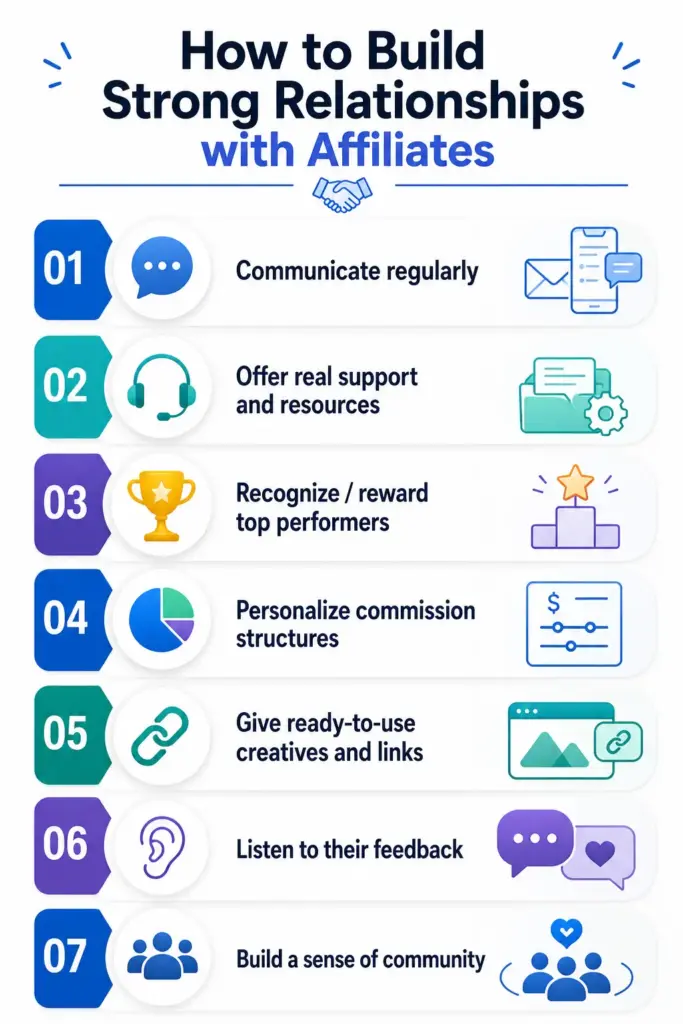
Communicate regularly, not just at payout time
Send monthly updates. Share new product launches, upcoming promotions, and small wins. Ask for feedback. A short, friendly email goes a long way. The goal is to make affiliates feel informed and included.
You can set up automated communication flows so affiliates stay in the loop even when you are busy. For example, FluentAffiliate connects with FluentCRM, which lets you run automated campaigns based on affiliate actions like signing up, making their first referral, or receiving a payout.
Offer real support and resources
Affiliates do better when you give them tools, not just links. Share things like:
- Brand guidelines
- Pre-written email templates
- Social media captions
- Banner images
- Product screenshots
- Talking points and FAQs
When affiliates have ready-to-use assets, they promote more often and more effectively. FluentAffiliate includes a built-in Affiliate Creatives module where you can store banners, text links, and QR codes for your affiliates to grab anytime.
Recognize and reward top performers
Recognition is one of the most underrated motivators in affiliate marketing. A simple thank-you message, a feature in your newsletter, or a small bonus can change how an affiliate feels about your brand.
You can also offer higher commission rates to top performers. With FluentAffiliate, you can create different affiliate groups with separate commission rates. So your top affiliates can earn more, and others have something to aim for.
Personalize commission structures
Not every affiliate should earn the same rate. Some bring more value, some focus on premium products, and some run high-effort campaigns. Personalizing commissions shows that you actually pay attention.
You can set custom rates for specific products, categories, or affiliates inside FluentAffiliate. This kind of flexibility makes affiliates feel seen, not just sorted.
Give them ready-to-use creatives and links
Make promotion as easy as possible. The harder it is to share your product, the less your affiliates will promote it. Provide banners, QR codes, and clean shareable links.
For your top partners, you can even create personalized landing pages. FluentAffiliate supports custom affiliate landing pages using a simple shortcode. So instead of a generic link, an affiliate can promote something like yoursite.com/partner/john, which looks more professional and builds more trust with their audience.
Listen to their feedback
Affiliates talk to your customers every day. They hear objections, questions, and praise that you might never see. Ask them what is working, what is not, and what they wish you offered. Then actually act on it.
This single habit can improve your product, your marketing, and your affiliate experience all at once.
Build a sense of community
Affiliates love being part of something bigger than a dashboard. You can create a private community space, a monthly call, or even a simple group chat. The goal is to make them feel connected to your brand and to each other.
Community turns affiliates into long-term partners. And long-term partners build long-term revenue.
How FluentAffiliate Helps You Manage and Nurture These Relationships
Building strong affiliate relationships gets a lot easier when you have the right tools. FluentAffiliate is built to support both program management and partner care, so you can focus on the relationship side instead of the technical side.
Here are the features that help most:
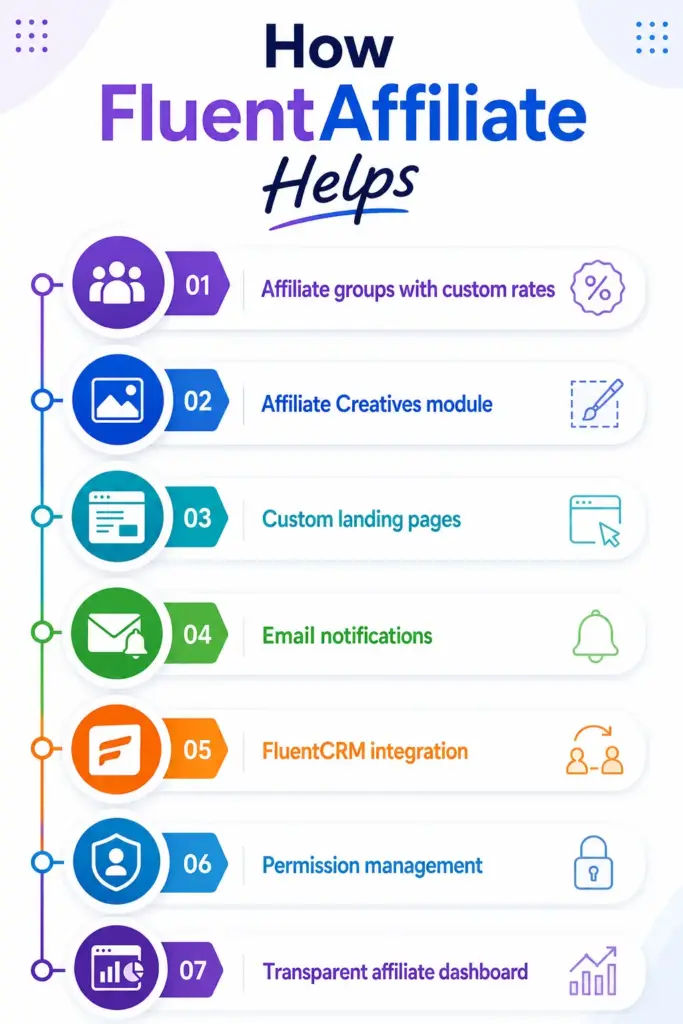
- Affiliate groups with custom rates. Reward your top performers with higher commissions using affiliate group settings. This makes it easy to build tiers and recognize loyalty.
- Affiliate Creatives module. Store banners, text links, and QR codes in one place so affiliates always have ready-to-use assets.
- Custom landing pages. Give your top affiliates branded, professional URLs with the custom landing page shortcode.
- Email notifications. Keep affiliates informed about new referrals, payouts, and approvals. You can fully customize these in the notification settings.
- FluentCRM integration. Automate affiliate communication based on real events like signups, referrals, and payouts.
- Permission management for your team. Let team members support affiliates without giving them full admin access.
- Transparent affiliate dashboard. Affiliates can track their visits, referrals, payouts, and earnings in one clean place, which builds trust through clarity. You can see how this looks in the affiliate dashboard overview.
The point is not to use every feature at once. The point is that the platform should support your relationship-building, not slow it down.
Common Mistakes to Avoid When Managing Affiliate Relationships
Even brands with good intentions slip up sometimes. Here are the mistakes to watch out for so your relationships stay strong.
- Promising bonuses or rewards you cannot deliver
- Changing commission rates without warning
- Delaying payouts without clear communication
- Ignoring small affiliates who could grow into big ones
- Sending only sales-focused emails with no real value
- Using complicated rules that confuse new affiliates
- Treating affiliate management as a one-time setup instead of an ongoing job
Avoiding these mistakes is often more important than chasing new strategies. Trust is hard to build and easy to break.
Final Thoughts and Where to Start
Affiliate marketing is not just a numbers game. It is a relationship game. The brands that grow steadily are the ones that treat their affiliates like real partners, not just promoters. They communicate, support, reward, and listen. And in return, they get loyal advocates who keep bringing in sales month after month.
If you are just starting out or trying to fix a slow affiliate program, the first step is simple. Pick one thing from this guide and act on it this week. Maybe it is sending a thank-you email to your top affiliate. Maybe it is updating your creatives. Maybe it is setting up a new affiliate group.
If you want a platform that makes all of this easier inside WordPress, FluentAffiliate is built exactly for that. It gives you the tools to manage, communicate, and grow your affiliate relationships from one clean dashboard.
Frequently Asked Questions
Why are affiliate relationships important for business growth?
Affiliate relationships are important because they create steady traffic, higher-quality referrals, and long-term brand advocates. Strong relationships reduce churn, improve conversion rates, and build trust that random promoters cannot offer.
How do you build trust with affiliate marketers?
You build trust by communicating regularly, paying on time, offering real support, recognizing top performers, and being transparent about commission rates and program changes. Trust grows when affiliates feel respected and valued.
What is the difference between an affiliate and an affiliate partner?
An affiliate is anyone who signs up to promote your product for a commission. An affiliate partner is someone who actively engages with your brand, promotes consistently, and works with you long-term. Partners are built through strong relationships.
How often should you communicate with your affiliates?
A good rule is at least once a month. Share updates, new launches, performance tips, and small wins. You can also set up automated emails for events like signups, referrals, and payouts so affiliates always feel informed.
How can small businesses build strong affiliate relationships?
Small businesses have an advantage because they can be more personal. Send personal thank-you messages, offer small bonuses, share early product news, and listen closely to feedback. Personal attention often beats big budgets.
What tools help manage affiliate relationships effectively?
Tools like FluentAffiliate help by combining affiliate tracking, commission management, creatives, automated communication, and a transparent dashboard in one place. The right tool reduces admin work and gives you more time to focus on relationships.




Add your first comment to this post