
Self-Hosted Affiliate Tracker for Your Business
Ever felt uncomfortable knowing your entire affiliate data lives on someone else’s server?
Be honest. You build your affiliate program. You recruit partners. Sales start coming in. Things feel good. Then one day, your SaaS tracking platform raises its pricing. Or locks a feature behind a higher plan. Or limits your data access.
Suddenly, you realize something scary.
You don’t actually own your affiliate system.
For growing businesses, that can feel like building your house on rented land.
In this guide, you’ll learn:
- What a self-hosted affiliate tracker really is
- Why it matters if you are serious about growth
- When it makes sense to switch
- How to choose the right solution for your business
Let’s break it down.
What Is a Self-Hosted Affiliate Tracker?
A self-hosted affiliate tracker is a system that lets you track affiliate clicks, referrals, and commissions directly on your own website.
In simple words, it lives on your server. Not someone else’s.
That means:
- You own the data
- You control how tracking works
- You decide how commissions are calculated
- You are not dependent on a third-party platform
Think of it like this.
Using a SaaS affiliate platform is like renting an apartment. It works. It is convenient. But the rules are not yours. The pricing is not yours. The data is not fully yours.
A self-hosted affiliate tracker is like owning your own house. You maintain it. You control it. You build it the way you want.
And for many growing businesses, that control matters more than convenience.
How It Actually Works
Let’s keep it simple.
When you use a self-hosted affiliate tracking system:
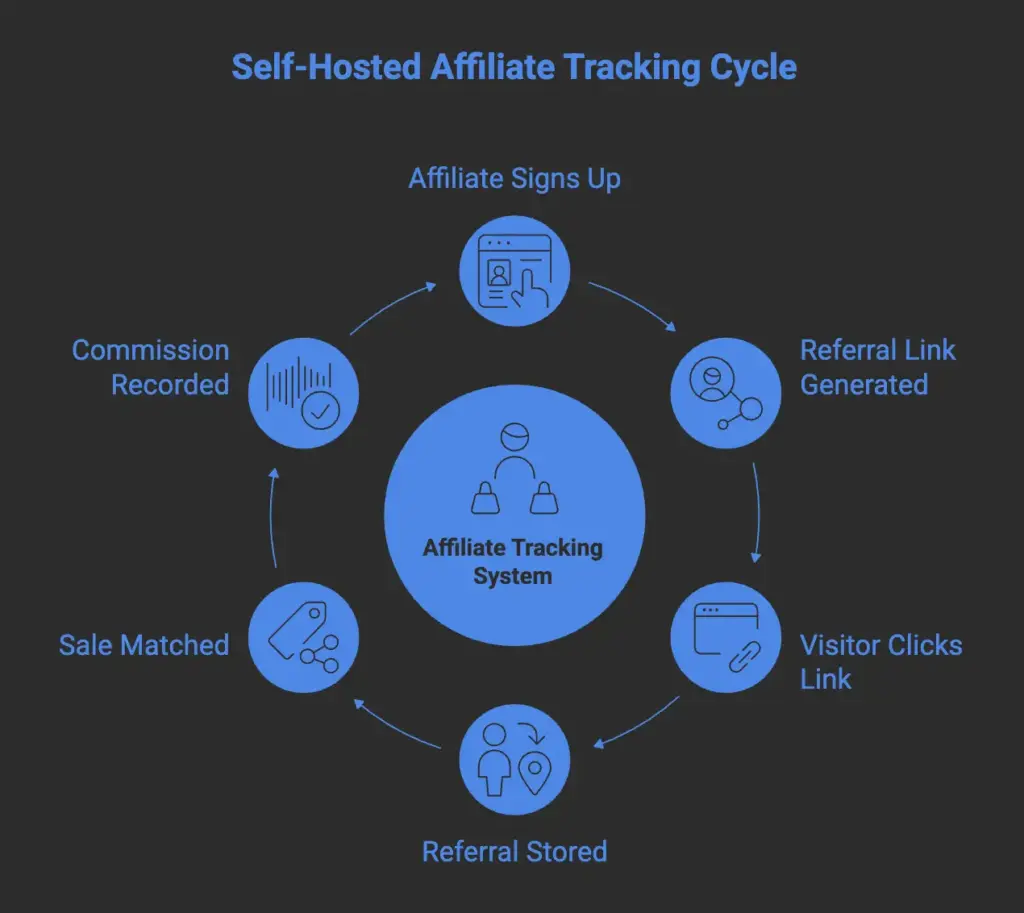
- An affiliate signs up on your website.
- They get a unique referral link.
- A visitor clicks that link.
- A tracking cookie or server record stores the referral.
- When the visitor buys, the system matches the sale to the affiliate.
- The commission is recorded inside your own dashboard.
Everything happens inside your own ecosystem.
No outside platform processing your transactions. No third party storing your customer-level data. No surprise limits when your program grows.
SaaS vs Self-Hosted Affiliate Tracking: A Deep Comparison
Let’s not sugarcoat this. Let’s compare side by side.
| Factor | SaaS Affiliate Tracking | Self Hosted Affiliate Tracking |
|---|---|---|
| Data Ownership | Data stored on provider’s servers | Data stored on your own server |
| Cost Structure | Monthly or yearly subscription, often usage based | Usually one time license or predictable pricing |
| Scalability | Costs increase as affiliates or revenue grow | You scale based on your own hosting capacity |
| Customization | Limited to platform features | Full flexibility within your ecosystem |
| Privacy Compliance | Dependent on provider policies | Full control over data handling and consent |
| Performance Control | Shared infrastructure | Self-Hosted Affiliate Tracking |
Now let’s break these down properly.
1. Data Ownership
With SaaS platforms, your referral data, affiliate records, and performance logs live on someone else’s servers.
Yes, you can export reports. But the infrastructure is not yours.
With a self-hosted system, the data lives in your WordPress database. You can back it up. Audit it. Control retention policies. Integrate it with other tools.
For businesses serious about long-term growth, owning your marketing data is a big deal.
2. Cost Structure
SaaS affiliate platforms often start cheaply. That is how they attract users.
Then growth happens.
- More affiliates
- More clicks
- More transactions
- Higher monthly bill
Many platforms charge based on revenue volume or number of affiliates. That means your success increases your expenses.
A self-hosted solution usually involves:
- A plugin license
- Your existing hosting cost
No sudden jumps because you hit a new revenue tier.
Over three to five years, that difference can easily add up to thousands of dollars.
3. Scalability
SaaS platforms scale automatically. That is convenient. But scaling often comes with tiered pricing.
Self-hosted systems scale based on your hosting setup.
If you are already running WooCommerce, handling traffic, and processing orders, adding affiliate tracking inside the same system often makes technical sense.
You grow. Your server grows with you.
Not your subscription bill.
4. Customization
SaaS tools must work for everyone. So they limit flexibility.
Custom commission rules? Maybe.
Deep integration with your LMS? Sometimes.
Custom workflows? Rare.
Self-hosted systems, especially inside WordPress, allow:
- Custom commission logic
- Deep integration with WooCommerce
- Membership plugins
- Learning management systems
- CRM connections
You are building within your own ecosystem.
That is powerful.
5. Privacy Compliance
Privacy is not optional anymore.
With GDPR and stricter cookie policies, businesses must clearly manage:
- Data storage
- Consent
- Tracking transparency
Browsers like Safari and Chrome are reducing third-party cookie reliability. First-party tracking is becoming the safer route.
A self-hosted affiliate tracker runs as first-party tracking on your own domain. That gives you more control over compliance and implementation.
You define retention policies. You manage consent banners. You control how tracking works.
6. Performance Control
With SaaS, performance depends on the provider’s infrastructure.
If their servers slow down, your dashboard slows down.
If their API has delays, reporting lags.
With self-hosted tracking, performance depends on your hosting environment.
If your e-commerce store already handles traffic smoothly, affiliate tracking runs inside that same optimized setup.
Everything stays within your stack.
So, Which One Is Better?
If you want convenience and zero technical responsibility, SaaS may feel easier.
If you want ownership, long-term cost efficiency, deeper integration, and more control, self-hosted affiliate tracking becomes very attractive.
Key Features to Look for in a Self-Hosted Affiliate Tracker
Not all self-hosted affiliate trackers are built the same.
Some look good on the surface but fall apart when traffic increases. Others track clicks but lack serious reporting. And some simply cannot grow with your business.
If you are choosing a self-hosted affiliate tracking system, use this checklist.
No fluff. Just what actually matters.
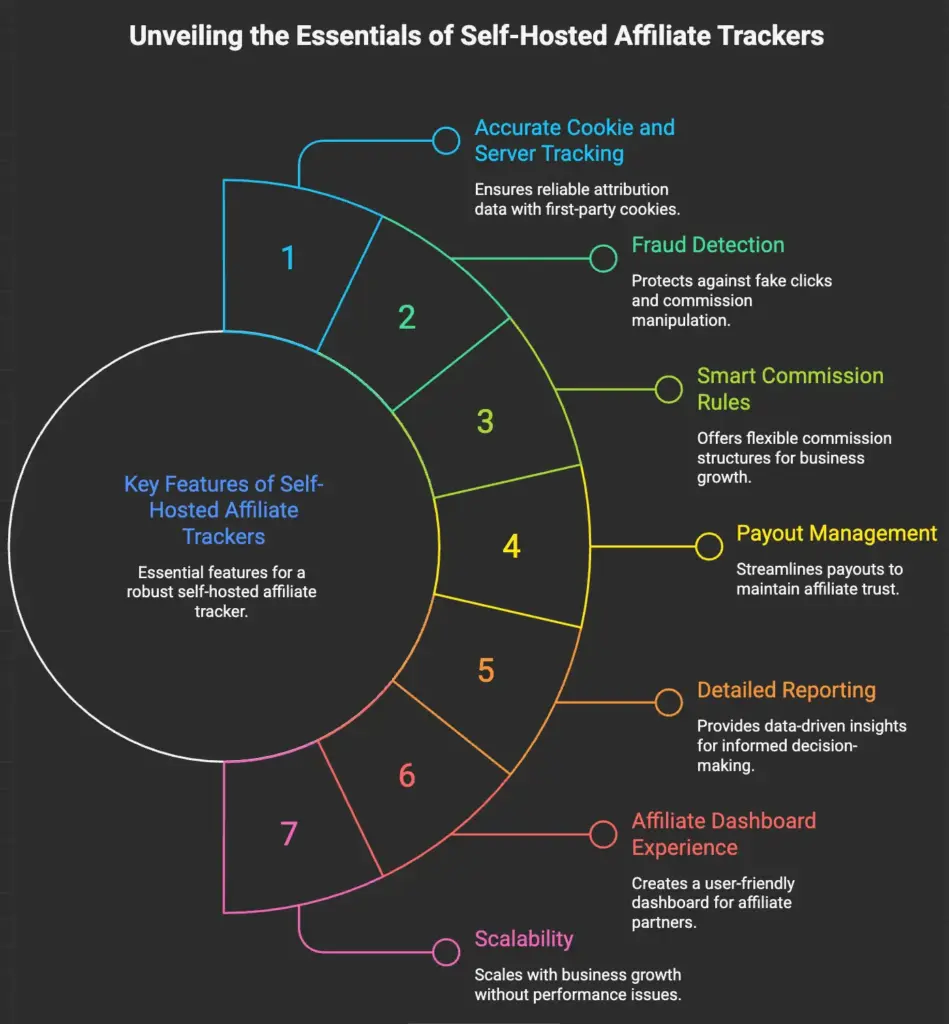
1. Accurate Cookie and Server Tracking
Tracking accuracy is everything. Your system should support:
- First-party cookie tracking
- Reliable referral attribution
- Server-side tracking options
- Protection against cookie deletion issues
Why does this matter?
Browsers are tightening cookie policies. Third-party cookies are fading. If your tracking relies only on outdated methods, you will lose attribution data.
A strong self-hosted system should track referrals cleanly and consistently inside your own domain.
If affiliates do not trust your tracking accuracy, they stop promoting.
It is that simple.
2. Fraud Detection
Affiliate fraud is real. Fake clicks. Self-referrals. Coupon abuse. Commission manipulation.
Your tracking system should help you:
- Detect suspicious activity
- Block self-referrals
- Monitor abnormal click spikes
- Manually review commissions
Even basic fraud prevention features can protect thousands of dollars in the long run.
A good self-hosted affiliate tracker gives you visibility, not just automation.
3. Smart Commission Rules
As your business grows, simple flat rate commissions may not be enough.
Look for systems that allow:
- Percentage-based commissions
- Fixed amount commissions
- Product-specific commission rates
- Recurring commissions for subscriptions
- Tiered rewards
- Performance bonuses
For example, if you sell courses, memberships, or SaaS subscriptions, recurring commissions become very important.
WordPress native solutions like FluentAffiliate allow flexible commission structures directly inside your e-commerce setup, which makes complex rules much easier to manage.
You do not want to outgrow your system in year two.
4. Payout Management
Tracking commissions is one thing. Paying affiliates smoothly is another.
Your system should support:
- Clear unpaid and paid commission status
- Exportable payout reports
- Bulk payout processing
- Integration with payment tools
When payouts are messy, affiliates lose trust.
A clean payout workflow keeps relationships healthy.
5. Detailed Reporting
You need more than total revenue numbers.
Look for:
- Click reports
- Conversion rates
- Top performing affiliates
- Product-level affiliate performance
- Date-based filters
- Exportable analytics
As your affiliate program grows, you will want to answer questions like:
- Which affiliate brings the highest lifetime value customers?
- Which product converts best through partners?
- Which campaigns are underperforming?
A serious business needs data-driven answers.
6. Affiliate Dashboard Experience
Your affiliates are your partners. Their experience matters. The dashboard should be:
- Clean and simple
- Easy to generate referral links
- Transparent about commissions
- Mobile friendly
- Easy to understand even for beginners
If affiliates feel confused or overwhelmed, they will not promote actively.
A good dashboard reduces support tickets and builds trust.
7. Scalability
This is where many systems fail.
Ask yourself:
- Can it handle 10 affiliates?
- Can it handle 100?
- What about 1,000?
Will performance slow down as data grows?
A strong self-hosted solution built for WordPress should scale alongside WooCommerce or your membership site.
Since it operates inside your existing ecosystem, growth becomes more predictable and manageable.
Bringing It All Together
If you are already running your business on WordPress, choosing a self-hosted affiliate tracker that integrates directly into your stack makes the transition smoother.
Solutions like FluentAffiliate are built specifically for WordPress ecommerce environments. That means:
- Native integration
- Unified data storage
- Flexible commission logic
- Ownership of your affiliate infrastructure
Not because it is flashy.
But because it aligns with how serious WordPress businesses operate.
The goal is not just to track clicks.
The goal is to build a reliable, scalable affiliate growth engine inside your own business.
Why WordPress Based Businesses Have an Advantage
If you are running your business on WordPress, you already have a hidden advantage.
Seriously.
Most businesses using SaaS affiliate platforms are building on rented infrastructure. WordPress businesses, on the other hand, already control their foundation.
Let’s break down why that matters.
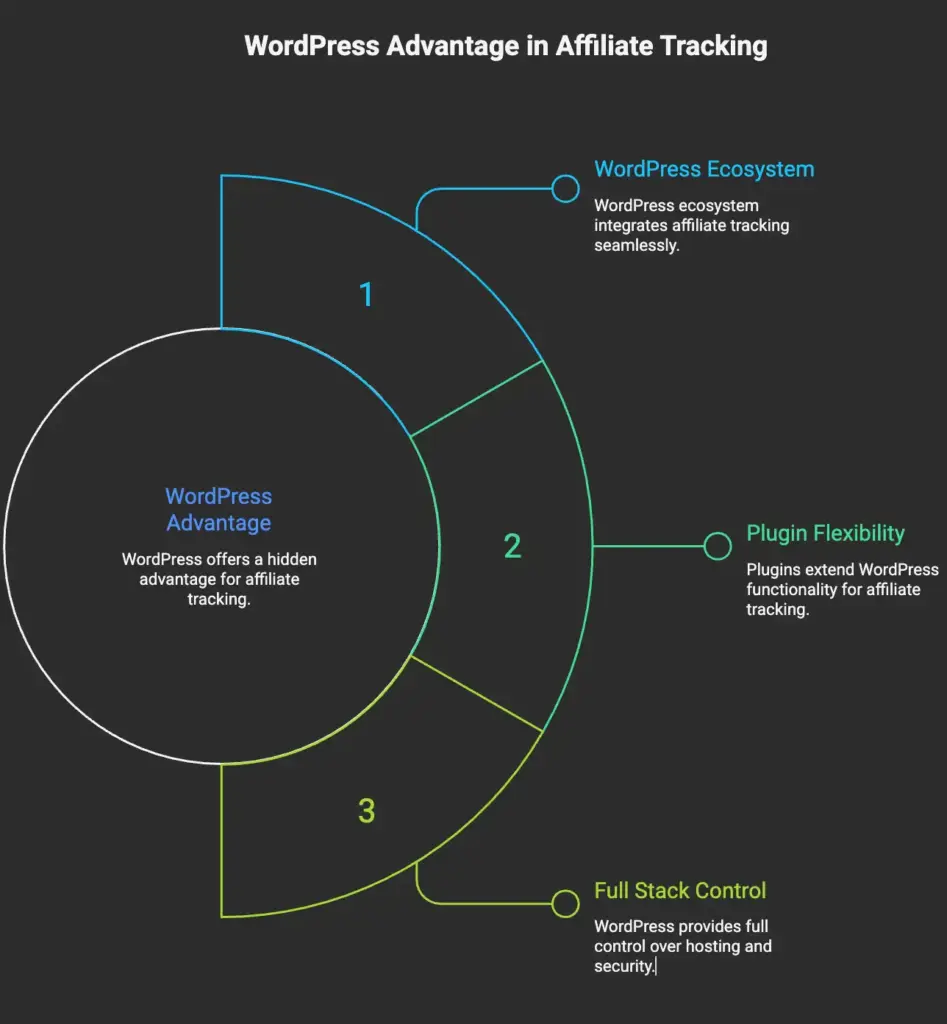
The WordPress Ecosystem
WordPress powers over 40 percent of websites on the internet. That is not a small number.
It is not just a website builder. It is a full ecosystem.
Inside WordPress, you can run:
- WooCommerce stores
- Online courses
- Membership platforms
- Subscription businesses
- Digital product marketplaces
- Service-based websites
Everything lives under one roof.
That means your affiliate tracking does not need to sit outside your system. It can live inside the same environment as your products, payments, and customer data.
When your affiliate tracker is part of your ecosystem, integration becomes natural.
Not forced.
Plugin Flexibility
One of WordPress’s biggest strengths is plugins.
Plugins let you extend your site without rebuilding everything from scratch.
Need subscriptions? Add a plugin.
Need memberships? Add a plugin.
Need CRM integration? Add a plugin.
The same logic applies to affiliate tracking.
Instead of connecting to an external SaaS tool with APIs and webhooks, you can install a native plugin that integrates directly with:
- WooCommerce orders
- Membership renewals
- LMS enrollments
- Custom checkout flows
No complicated syncing. No waiting for third-party updates.
Everything works within the same system.
That flexibility is hard to match with closed SaaS platforms.
Full Stack Control
This is where things get serious.
With WordPress, you control:
- Hosting
- Database
- Security layers
- Caching systems
- Data backups
- Tracking logic
You are not dependent on a provider’s infrastructure decisions.
If you want better performance, you upgrade hosting.
If you want tighter security, you adjust your setup.
If you want custom commission logic, you implement it.
Affiliate tracking becomes part of your stack, not an external dependency.
For growing businesses, that control reduces risk.
Where FluentAffiliate Fits In: Meet the best Self-Hosted Affiliate Tracker
Now here is where things connect naturally.
If you are already running WooCommerce or another WordPress-based e-commerce setup, moving to a self-hosted affiliate system does not require rebuilding your process.
Solutions like FluentAffiliate are built specifically for WordPress businesses.
That means:
- Native integration with your store
- Affiliate data stored inside your WordPress database
- Commission rules that align with WooCommerce products
- No external platform dependency
It is not about adding complexity.
It is about keeping everything inside the environment you already control.
If you are already on WordPress, FluentAffiliate makes this transition simple.
And that is the real advantage. You are not starting from scratch. You are strengthening the system you already own.
The Real World Scenario
Let’s make this practical.
Imagine this.
You run a growing WooCommerce store selling digital courses and premium templates. Your affiliate program is working well. You have around 120 active affiliates.
You are using a SaaS affiliate tracking platform that costs $149 per month.
At first, it felt fine.
But then you did the math.
- $149 per month
- $1,788 per year
- Over $5,000 in three years
And that does not include possible price increases or feature upgrades.
A. The Turning Point
As your affiliate revenue grows, you start noticing two things:
- Tracking delays during high traffic campaigns
- Rising monthly software costs
You also realize something uncomfortable.
All your affiliate and referral data lives outside your WordPress ecosystem.
Your store runs on WooCommerce or any shopping cart platform.
Your customers live inside WordPress.
But your affiliate data lives somewhere else.
That disconnect starts to feel inefficient.
B. The Switch to Self-Hosted
So you decide to move to a self-hosted affiliate tracking system built for WordPress.
Instead of paying $149 every month, you install a WordPress native solution like FluentAffiliate.
Now:
- Affiliate data is stored inside your WordPress database
- Commission logic connects directly with WooCommerce orders
- No third-party API syncing
- No usage-based pricing increases
The transition takes planning, but once done, the system runs inside your existing infrastructure.
C. The Financial Impact
Here is what changes financially:
Instead of $1,788 per year in SaaS fees, you now operate with a predictable license cost and your existing hosting.
Even conservatively, you save over $1,500 per year.
Over three years, that is enough to:
- Fund paid ads
- Increase affiliate bonuses
- Invest in better hosting
- Or simply increase profit
That is real money.
D. The Operational Impact
But the real benefit is not just savings.
It is control.
Tracking accuracy improves because:
- Everything runs on your own domain
- First-party tracking is stronger
- No external API dependency
Affiliates see accurate dashboards. You see real-time reports. Your marketing team pulls clean data.
And most importantly, you are no longer worried about pricing tier jumps as your revenue grows.

Starting From Scratch? Kickstart
with Affiliate Marketing 101 Guide!
Conclusion: Is It Time to Own Your Affiliate Tracking?
Affiliate marketing is no longer a side experiment for most businesses. It is a real growth channel.
So here is the honest question.
Are you building it on infrastructure you own, or on infrastructure you rent?
Take a few minutes today and evaluate your current system:
- How much are you paying yearly in SaaS fees?
- What will that cost look like in three to five years?
- Who truly owns your affiliate and customer data?
- How dependent are you on a third-party platform?
When you run your business on WordPress, you already control your foundation. Moving your affiliate tracking into your own ecosystem might simply be the logical next step.
Think long term. Think ownership. Think scalability.
Your future growth will thank you for it.




Add your first comment to this post