Affiliate Marketing 101: A Complete Beginner-to-Strategic Guide
Affiliate marketing is one of the most effective ways businesses grow online, yet many people still misunderstand how it actually works.
It’s not just about sharing links or earning commissions; it’s a performance-based partnership where businesses pay for real results, affiliates earn by creating value, and customers discover solutions through trusted recommendations.
This Affiliate Marketing 101 guide is designed to give you a clear, practical foundation. Whether you want to become an affiliate or launch your own affiliate program, you’ll learn how affiliate marketing works, the models behind it, the tools involved, and how different businesses use it to scale sustainably.
By the end, you’ll have a complete understanding of affiliate marketing and be ready to take the next step
What is Affiliate Marketing?
Affiliate marketing is a performance-based marketing model where a business rewards third parties (affiliates) for driving sales or actions through their unique referral links. In simple terms: you only pay when results happen.
A real-world example
Imagine you run a WordPress plugin business.
You create an affiliate program and invite bloggers, YouTubers, and educators who talk about WordPress to promote your plugin. One blogger writes a tutorial like “How to build an affiliate program on WordPress” and includes a special referral link.
A reader clicks that link, buys your plugin, and the blogger earns a commission for that sale.
No upfront ad cost. No guessing. Just a clear reward for real revenue.
That’s affiliate marketing in action.
Who is involved in affiliate marketing?
Affiliate marketing always works through a small ecosystem. Each role has a clear responsibility.
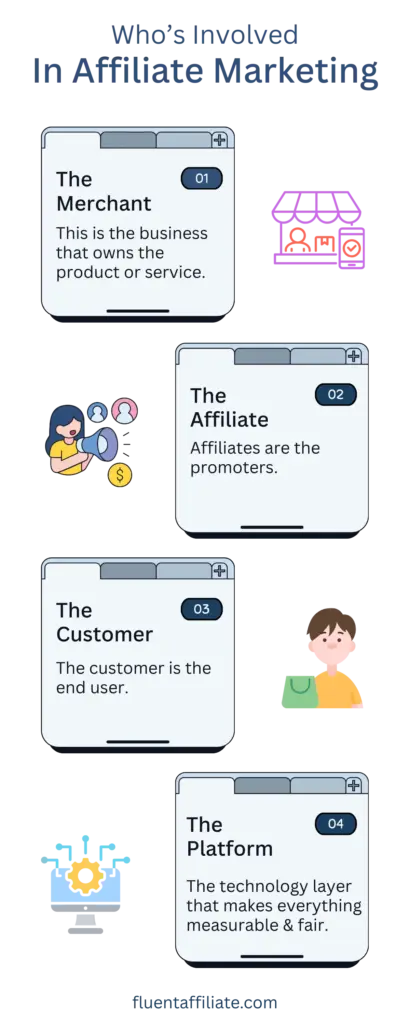
1. The Merchant (or Advertiser)
This is the business that owns the product or service.
- Can be a software company, eCommerce store, course creator, or SaaS brand
- Creates the affiliate program
- Decides commission rates, payout rules, and terms
Example: A WordPress plugin company selling a premium plugin.
2. The Affiliate (or Publisher)
Affiliates are the promoters.
- Bloggers, YouTubers, influencers, educators, agencies, or niche site owners
- They create content, tutorials, reviews, comparisons, or recommendations
- They promote using unique tracking links
Their goal is to send qualified, trust-based traffic, not random clicks.
3. The Customer
The customer is the end user.
- They discover the product through an affiliate’s content
- They make the purchase decision
- They don’t pay extra because of affiliate marketing
From the customer’s perspective, it often feels like a helpful recommendation—not an ad.
4. The Platform (Tracking & Management System)
This is the technology layer that makes everything measurable and fair.
- Tracks clicks, conversions, and commissions
- Attributes sales to the correct affiliate
- Handles reports, approvals, and payouts
In the WordPress ecosystem, this is typically handled by an affiliate management plugin that lives inside your site.
Why this foundation matters
Affiliate marketing isn’t about links or commissions; it’s about aligned incentives.
- Merchants grow through trusted distribution
- Affiliates earn by providing real value
- Customers discover relevant solutions
- Platforms ensure transparency and accuracy
Once you understand this foundation, everything else, affiliate programs, commissions, tracking models, and tools, starts to make sense. If you’re ready, the next step is understanding how affiliate marketing actually works step by step and why it scales so well for online businesses.
How Affiliate Marketing Works (Step-by-Step)
Affiliate marketing looks simple on the surface, but under the hood, it follows a very clear, repeatable flow. Once you understand this flow, you’ll understand why affiliate marketing scales so well, and why tracking accuracy matters so much.
Here’s the full mental model, step by step.
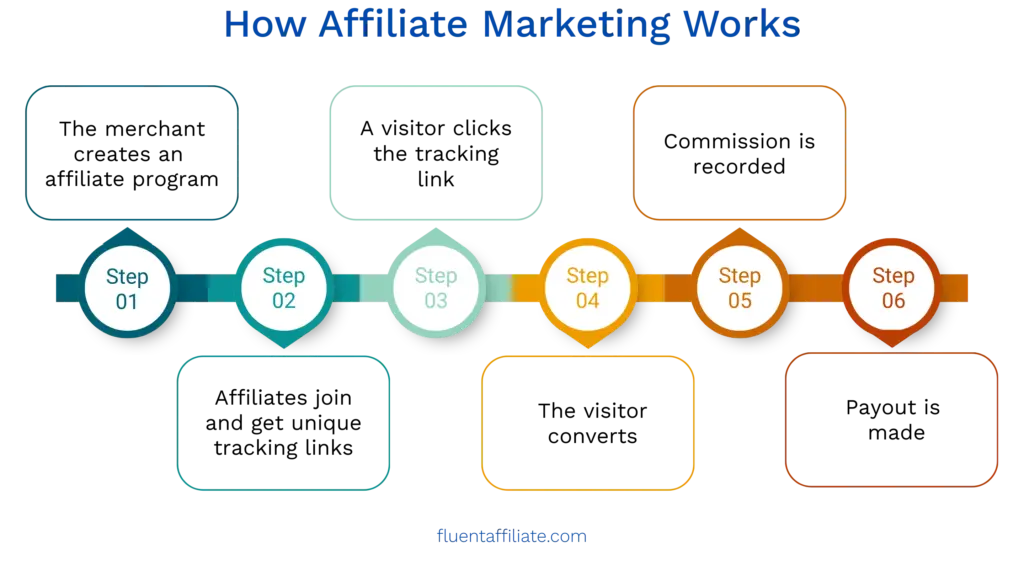
Step 1: The merchant creates an affiliate program
Everything starts with the business.
The merchant:
- Decides which products or plans are commissionable
- Sets commission rules (percentage, fixed amount, recurring, etc.)
- Defines cookie duration, payout schedule, and terms
- Uses an affiliate tracking system to manage everything
At this stage, no promotion has happened yet. The system is simply ready to track and reward performance.
Step 2: Affiliates join and get unique tracking links
Affiliates sign up for the program and receive special referral links.
These links:
- Are unique to each affiliate
- Contain tracking identifiers (not visible or annoying to users)
- Allow the system to know who referred whom
Affiliates then place these links inside:
- Blog posts
- YouTube video descriptions
- Email newsletters
- Tutorials, reviews, or comparison pages
Step 3: A visitor clicks the tracking link
A potential customer clicks the affiliate’s link.
At this moment:
- The tracking system records the click
- A cookie or session is stored in the visitor’s browser
- The affiliate is now associated with that visitor
Nothing is sold yet, but attribution has started.
Step 4: The visitor converts
The visitor completes a desired action, usually:
- Making a purchase
- Signing up for a paid plan
- Subscribing to a service
If the conversion happens within the allowed tracking window:
- The system connects the sale to the original affiliate
- The order data is captured (amount, product, plan, etc.)
This is where affiliate marketing becomes performance-based, no conversion, no commission.
Step 5: Commission is recorded
Once the conversion is confirmed:
- A commission is calculated based on predefined rules
- The referral is logged inside the system
- The commission may be marked as pending (for refunds or fraud checks)
Affiliates can usually see this in their dashboard:
- Clicks
- Conversions
- Earnings
Transparency builds trust on both sides.
Step 6: Payout is made
After the holding period:
- Approved commissions become payable
- The merchant pays affiliates via the chosen payout method
- The transaction is marked as completed
At this point, the cycle is complete, and ready to repeat.
How tracking actually works behind the scenes
This entire flow depends on how and where tracking happens. There are two common approaches.
SaaS-based affiliate platforms
These are third-party hosted systems.
- Tracking happens on external servers
- Data lives outside your website
- Often charge monthly fees or take a cut
- Limited control over data and customization
They can work, but they introduce dependency.
Self-hosted affiliate tracking (WordPress-based)
This approach runs directly on your own website.
- Tracking happens inside your WordPress environment
- You own your data
- Full control over logic, integrations, and workflows
- Naturally connects with your checkout, users, and plugins
For WordPress businesses, this creates a tighter, more reliable system, without sending critical sales data elsewhere.
Why this model works so well
Affiliate marketing succeeds because incentives are perfectly aligned:
- Merchants only pay for results
- Affiliates focus on quality traffic and trust
- Customers get relevant recommendations
- Tracking systems keep everything measurable and fair
Once this step-by-step flow is clear, the next big concept to understand is the types.
Types of Affiliate Marketing
Not all affiliate marketing looks the same.
Some affiliates promote aggressively without ever using the product. Others build entire businesses around deep product experience and trust. Understanding these types of affiliate marketing helps you see why some programs attract high-quality partners, and others struggle with low-value traffic.
Let’s break it down from the core classifications to the common real-world variations.
Core Types of Affiliate Marketing
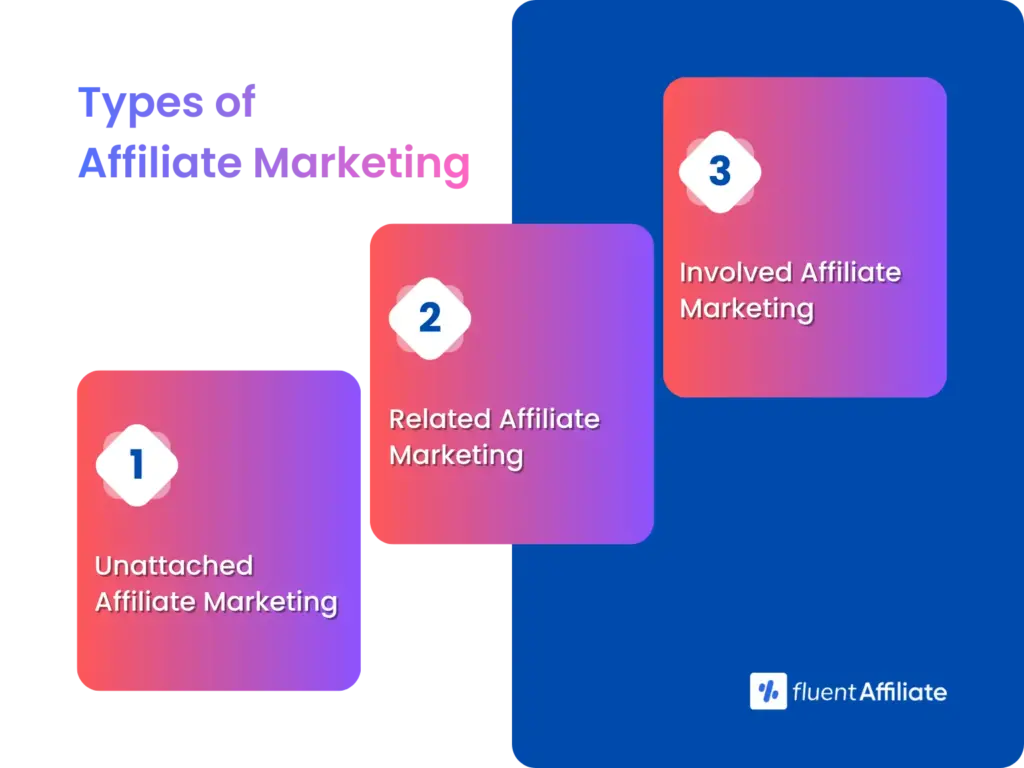
There are mainly 3 types of affiliate marketing. Explore below:
1. Unattached Affiliate Marketing
This is the most hands-off form of affiliate marketing.
What it looks like:
- The affiliate has no real connection to the product
- No personal usage, authority, or audience relationship
- Promotions often rely on paid ads or generic landing pages
Example:
Someone runs ads targeting “best WordPress plugins” and redirects traffic through affiliate links without ever using or reviewing the product.
Pros:
- Easy to start
- No content or brand required
Cons:
- Low trust
- Lower conversion rates
- Higher risk of low-quality traffic
This model is volume-driven, not trust-driven.
2. Related Affiliate Marketing
This is where relevance starts to matter.
What it looks like:
- The affiliate operates in a related niche
- Has an audience that could benefit from the product
- May not actively use the product, but understands the space
Example:
A WordPress blogger who writes about plugins and tools promotes an affiliate plugin as part of a resource list or comparison article.
Pros:
- Better audience alignment
- More natural promotion
- Higher conversions than unattached affiliates
Cons:
- Still limited personal proof
- Trust depends on the affiliate’s credibility
This is common in blogs, newsletters, and educational websites.
3. Involved Affiliate Marketing
This is the highest-trust and highest-value model.
What it looks like:
- The affiliate actively uses the product
- Promotion is based on real experience
- Content is often tutorial-driven or problem-solution-based
Example:
A WordPress educator creates a full tutorial showing how they run an affiliate program using a specific plugin, and recommends it because they actually rely on it.
Pros:
- Strong trust and authority
- Higher conversion rates
- Long-term customer value
Cons:
- Takes time and effort
- Requires real product knowledge
This is the model most sustainable affiliate programs aim to attract.
Common Affiliate Categories (Real-World Expansion)
Beyond the core types, affiliates are often grouped by how they promote, not just their relationship with the product.
1. Influencer Affiliates
Influencers promote products to their followers.
Channels include:
- YouTube
- Twitter / X
- Podcasts
Trust is built through personal brand, not written content. This works especially well for software demos and walkthroughs.
2. Content Affiliates
These affiliates focus on long-form, evergreen content.
Examples:
- Blogs and niche websites
- SEO-driven tutorials
- Comparison and “best tools” articles
They generate consistent traffic and often deliver high-intent buyers over time.
3. Coupon & Deal Sites
These affiliates focus on price-sensitive buyers.
How they work:
- Promote discount codes and limited-time offers
- Capture users right before checkout
Pros:
- Can boost short-term sales
- Useful during launches or promotions
Cons:
- Lower margins
- Can attract deal-only customers
Best used strategically, not as the core of your program.
4. Partner / Referral Affiliates
These are closer to business partnerships than typical affiliates.
Examples:
- Agencies
- Consultants
- Tool integrations
- Service providers
They refer clients as part of a broader relationship, often with higher lifetime value and stronger retention.
Why this classification matters
Understanding affiliate types helps you:
- Design smarter commission structures
- Set realistic expectations
- Attract the right affiliates, not just more affiliates
- Protect your brand from low-quality promotion
Affiliate marketing isn’t one strategy; it’s a spectrum. The most successful programs are built to reward trust, relevance, and real value, not just traffic. Next, it makes sense to look at why businesses choose affiliate marketing at all, and what makes it such a powerful growth channel.
Affiliate Marketing Models & Commission Structures
Affiliate marketing isn’t just about who promotes your product; it’s about how and when they get paid. The commission model you choose directly affects affiliate motivation, promotion quality, and long-term business growth.
Let’s break this down from a business perspective.
Core Affiliate Marketing Models
Here are the core models of affiliate marketing described below:
1. Pay Per Sale (PPS)
This is the most common and safest affiliate model.
How it works:
- Affiliates earn a commission only when a sale happens
- Commission is based on a completed purchase
Example:
A $100 product with a 30% commission earns the affiliate $30 per sale.
Why businesses use it:
- Low risk
- Directly tied to revenue
- Easy to track and manage
Best for:
- eCommerce
- Digital products
- WordPress plugins and themes
2. Pay Per Lead (PPL)
Here, affiliates are paid for generating qualified leads, not direct sales.
How it works:
- A “lead” could be a sign-up, demo request, or trial registration
- Payment happens once the action is completed
Example:
An affiliate earns $5 for every user who signs up for a free trial.
Why businesses use it:
- Useful when sales happen offline or later
- Encourages top-of-funnel growth
Best for:
- SaaS with sales teams
- Services and consultations
- High-ticket products
3. Pay Per Click (PPC)
This model rewards traffic rather than conversions.
How it works:
- Affiliates earn money for every click they generate
- No purchase or sign-up required
Why it’s risky:
- High fraud potential
- Weak alignment with revenue
- Can attract low-intent traffic
Best used:
- Rarely
- With strict controls and caps
Most modern affiliate programs avoid PPC unless there’s a strong reason.
Recurring Commissions (Critical for SaaS)
Recurring commissions are a game-changer for subscription-based businesses.
How it works:
- Affiliates earn commission every time the customer renews
- Commission continues monthly or yearly
- Often capped by time or customer lifetime
Example:
An affiliate earns 30% every month for as long as the customer stays subscribed.
Why SaaS businesses love it:
- Aligns affiliate incentives with retention
- Encourages higher-quality referrals
- Builds long-term affiliate loyalty
For SaaS and WordPress subscription products, recurring commissions often outperform one-time payouts.
Commission Calculation Types
There are mainly 2 types of commission calculation commonly practiced in the industry.
A. Flat (Fixed) Commission
Affiliates earn a fixed amount per conversion.
Example:
$50 per sale, regardless of order value.
Pros:
- Simple and predictable
- Easy for affiliates to understand
Cons:
- Doesn’t scale with higher-value purchases
4. Percentage-Based Commission
Affiliates earn a percentage of the sale value.
Example:
30% of every sale.
Pros:
- Scales naturally with pricing
- Encourages promotion of higher-value plans
Cons:
- Earnings can fluctuate
This model is especially popular for software and digital products.
Choosing the right structure
There’s no single “best” model.
The right commission structure depends on:
- Your business model
- Customer lifetime value
- Sales cycle length
- Desired affiliate behavior
Strong affiliate programs don’t just pay commissions; they engineer incentives. When affiliates earn in a way that matches how your business grows, affiliate marketing becomes a predictable, scalable channel rather than an experiment.
Next, it’s important to understand why affiliate marketing works so well for businesses, and where it fits in a broader growth strategy.
Benefits of Affiliate Marketing (For Businesses)
Affiliate marketing isn’t just another acquisition channel; it’s a business model shift. Instead of paying upfront and hoping for results, you reward partners only when they deliver real outcomes.
If you sell software, digital products, or run an online business, this model speaks directly to your bottom line.
Core Benefits of Affiliate Marketing
There are numerous benefits associated with affiliate marketing. Here are the major ones explained:
1. Performance-based marketing
You only pay when results happen.
- No impressions without outcomes
- No clicks without conversions
- Every commission is tied to revenue or a qualified action
This makes affiliate marketing one of the most ROI-friendly channels available.
2. Low upfront risk
Unlike ads or sponsorships, affiliate marketing doesn’t require heavy upfront spending.
- No ad budget to burn
- No fixed influencer fees
- No guesswork on performance
Your cost exists after value is created, not before.
3. Scalable growth without linear costs
Affiliate marketing scales horizontally.
- More affiliates = more reach
- More content = more entry points
- Growth isn’t limited by daily ad spend
A single high-performing affiliate can drive consistent revenue for years, without increasing your internal workload.
4. Trust-driven sales
Affiliate traffic converts differently than ads.
- Recommendations come from trusted creators
- Buyers are often pre-educated
- Purchase decisions feel informed, not pressured
This leads to:
- Higher conversion rates
- Lower refund rates
- Better long-term customers
Trust compounds in ways ads cannot.
5. Global reach, automatically
Affiliates don’t care about borders.
- You tap into audiences across regions and languages
- Local creators promote in their own voice
- Expansion happens without setting up local teams
Affiliate marketing becomes a distributed growth engine.
How Affiliate Marketing Compares to Other Channels
Here are the quick comparisons of how other channels differ from affiliate marketing:
Affiliate Marketing vs Paid Ads
| Aspect | Affiliate Marketing | Paid Ads |
|---|---|---|
| Cost model | Pay after conversion | Pay upfront |
| Risk | Low | High |
| Trust factor | High | Low |
| Scalability | Organic | Budget-limited |
| Long-term value | Compounds | Stops when spend stops |
Paid ads stop the moment you stop paying.
Affiliate marketing keeps working through content, trust, and relationships.
Affiliate Marketing vs Influencer Marketing
| Aspect | Affiliate Marketing | Influencer Marketing |
|---|---|---|
| Payment | Performance-based | Fixed or sponsored |
| Accountability | Clear ROI | Often unclear |
| Longevity | Long-term | Short-lived |
| Control | Measurable | Hard to track |
| Risk | Low | Medium to high |
Influencer marketing can create awareness.
Affiliate marketing creates measurable, repeatable revenue.
Why businesses choose affiliate marketing
Affiliate marketing aligns incentives perfectly:
- Businesses grow profitably
- Affiliates earn by delivering value
- Customers discover solutions they actually need
For many modern online businesses, especially SaaS and WordPress-based products, affiliate marketing isn’t optional anymore. It’s one of the smartest, safest, and most scalable growth channels available.
Next, it’s important to look at the other side of the equation: what affiliates gain, and why they choose to promote certain products over others.
Challenges & Common Misconceptions
Affiliate marketing is powerful, but it’s not magic.
The businesses that succeed long-term are the ones that understand the real challenges, avoid common myths, and build systems that protect both revenue and relationships. Being honest about this is what separates hype from authority.
Common Misconceptions About Affiliate Marketing
“Affiliate marketing is passive income”
This is the biggest myth.
Affiliate marketing is not passive, it’s leveraged.
For businesses:
- You still need onboarding, communication, and rules
- You must review affiliates and monitor performance
- Programs need optimization over time
For affiliates:
- Content creation takes work
- Trust must be built and maintained
- Results compound, but only after effort
Affiliate marketing becomes semi-passive only after systems, content, and relationships are in place.
Real Challenges Businesses Face
Here are the real-life struggles businesses often face:
1. Fraud and spam risks
Not all traffic is good traffic.
Common issues include:
- Fake leads and self-referrals
- Cookie stuffing
- Coupon abuse
- Low-quality paid traffic
Without proper controls, affiliate programs can quietly bleed money.
2. Tracking accuracy
Affiliate marketing lives and dies by attribution.
Problems often appear when:
- Cookies fail or get overwritten
- Checkout flows break tracking
- Subscription renewals aren’t attributed correctly
- Multiple tools don’t sync properly
If tracking isn’t accurate, you risk:
- Overpaying commissions
- Underpaying honest affiliates
- Losing trust on both sides
3. Affiliate management overhead
Running an affiliate program is not “set and forget.”
You need to:
- Approve and communicate with affiliates
- Answer questions and resolve disputes
- Review suspicious activity
- Manage payouts and compliance
As your program grows, manual processes don’t scale.
Why these challenges exist
Most problems don’t come from the idea of affiliate marketing—they come from poor infrastructure.
- Weak tracking leads to disputes
- Limited controls invite abuse
- Disconnected systems create confusion
- Lack of transparency kills trust
Affiliate marketing only works when everyone trusts the numbers.
Why good affiliate software matters
This is where many programs succeed or fail.
Good affiliate software helps you:
- Track accurately across clicks, sales, and subscriptions
- Detect and prevent fraud early
- Automate approvals, commissions, and payouts
- Give affiliates clear dashboards and confidence
For WordPress-based businesses, this matters even more. Your checkout, users, subscriptions, and content already live on your site. If affiliate tracking is disconnected from that ecosystem, complexity and risk increase fast. The strongest affiliate programs aren’t built on hype, they’re built on reliable systems, clean data, and fair incentives.
Affiliate Marketing for Different Business Types
Affiliate marketing isn’t one-size-fits-all.
How you design and run your program should depend on what kind of business you run, how customers buy, and how long they stay.
Here’s how affiliate marketing fits across different business models.
A. SaaS & Software Companies
Affiliate marketing is especially powerful for SaaS.
Why it works well:
- High customer lifetime value
- Subscription-based pricing
- Ongoing updates and retention
Typical setup:
- Recurring or hybrid commissions
- Longer cookie durations
- Content-focused and educator affiliates
Affiliates are motivated to bring quality users, not just sign-ups, because retention affects their earnings.
B. eCommerce Stores
For eCommerce, affiliate marketing acts as an extended sales force.
Why it works well:
- Clear purchase events
- Easy attribution
- Large pool of content and deal affiliates
Typical setup:
- Pay-per-sale commissions
- Percentage-based payouts
- Product-level or category-based commissions
Affiliate marketing works particularly well for niche stores where trust and product education matter.
C. Online Courses & Memberships
Education-based businesses thrive on trust.
Why it works well:
- High-ticket products
- Authority-driven decisions
- Long-form content converts better than ads
Typical setup:
- One-time or limited recurring commissions
- Longer cookie windows
- Involved affiliates who teach or demonstrate outcomes
Here, affiliates act more like advocates than promoters.
D. WordPress Product Businesses
WordPress businesses sit in a unique position.
Why it works well:
- Built-in content ecosystem
- Strong blogger and educator community
- Native integration with users, checkout, and licensing
Typical setup:
- Percentage-based commissions
- Recurring commissions for subscriptions
- Deep integration with WordPress plugins and tools
Because everything lives on WordPress, tracking and management can be tightly controlled and highly transparent.
E. Service-Based Businesses
Affiliate marketing also works beyond products.
Why it works:
- Referrals are already common
- Trust matters more than volume
- High-value conversions
Typical setup:
- Pay-per-lead or pay-per-sale
- Manual approval and qualification
- Partner-style affiliate relationships
This model often looks closer to referral partnerships than mass affiliate programs.
Why segmentation matters
Each business type has different:
- Sales cycles
- Customer lifetimes
- Risk tolerance
- Affiliate expectations
The most successful affiliate programs are designed around the business model, not copied from others.
Affiliate Marketing vs Referral Marketing
Affiliate marketing and referral marketing are often used interchangeably, but they are not the same. Understanding the difference clears up confusion for both businesses and users, and helps you choose the right strategy for growth.
Let’s break it down clearly.
What is Affiliate Marketing?
Affiliate marketing is a structured, performance-based marketing model.
- Promoted by marketers, creators, publishers, or partners
- Designed for scale
- Uses tracking links, dashboards, and commission rules
- Focuses on reaching new audiences
Affiliates usually promote publicly through content, media, or campaigns.
What is Referral Marketing?
Referral marketing is relationship-driven.
- Promoted by existing customers or users
- Based on personal recommendations
- Often private (email, messaging, direct sharing)
- Focuses on trust within a close network
Referrals typically happen because someone likes a product, not because they’re a professional promoter.
When to Use Affiliate Marketing
Affiliate marketing is best when you want to:
- Reach new markets and audiences
- Scale content-driven acquisition
- Build long-term partner relationships
- Drive predictable, trackable growth
It works especially well for SaaS, WordPress products, and online businesses aiming for expansion.
When to Use Referral Marketing
Referral marketing works best when you want to:
- Activate your existing user base
- Increase word-of-mouth growth
- Reward loyal customers
- Improve trust and retention
It’s ideal for early-stage products or communities with strong user satisfaction.
Can Affiliate & Referral Marketing Work Together?
Yes, and the best businesses use both.
A common structure looks like this:
- Referral program for customers (simple rewards, easy sharing)
- Affiliate program for marketers and partners (advanced tracking, higher commissions)
Both programs:
- Reward advocacy
- Encourage organic growth
- Reinforce trust
They serve different roles, but move the business in the same direction.
Why this distinction matters
Confusing affiliate marketing with referral marketing often leads to:
- Poor program design
- Wrong incentives
- Misaligned expectations
When each model is used intentionally, they complement each other beautifully.
Is Affiliate Marketing Legal & Ethical?
Yes, affiliate marketing is legal.
But it’s only sustainable when it’s done ethically, transparently, and compliantly.
Laws don’t exist to stop affiliate marketing; they exist to protect users. Businesses that understand this build more trust, avoid risk, and create programs that last.
1. FTC Disclosure Basics (Non-Negotiable)
If money is involved, disclosure is required.
What the FTC expects:
- Affiliates must clearly disclose affiliate relationships
- Disclosures must be visible and understandable
- Hidden or vague disclosures are not acceptable
Good disclosure example:
“This post contains affiliate links. If you purchase through them, I may earn a commission at no extra cost to you.”
Key rule:
If a recommendation could financially benefit someone, users have the right to know.
This applies to:
- Blog posts
- Videos
- Social media
- Emails
2. GDPR Considerations (Data Protection)
Affiliate marketing often involves user data.
Under GDPR:
- Users must know what data is being collected
- Personal data must be handled lawfully
- Tracking should have a clear legal basis
This matters especially when:
- Cookies are used for tracking
- User accounts are involved
- Data is stored or processed in the EU
Even if your business is outside the EU, GDPR can still apply if EU users are involved.
3. Cookie Consent & Tracking
Most affiliate tracking relies on cookies or similar technologies.
Best practices include:
- Informing users about tracking cookies
- Using cookie consent banners where required
- Respecting opt-out or decline choices
Consent isn’t just a legal checkbox; it’s part of respecting user privacy.
4. Transparency Best Practices (Beyond the Law)
Legal compliance is the minimum. Ethical affiliate marketing goes further.
Strong programs follow these principles:
- Clear affiliate terms and conditions
- Honest promotion guidelines
- No misleading claims or fake urgency
- Fair commission policies and payouts
Transparency builds trust with:
- Customers
- Affiliates
- Regulators
And trust is what keeps affiliate marketing effective long-term.
Why ethics matter in affiliate marketing
Short-term tricks can generate short-term revenue, but they damage credibility.
Ethical affiliate marketing:
- Reduces refunds and disputes
- Attracts higher-quality affiliates
- Builds brand reputation
- Protects your business legally
When done right, affiliate marketing isn’t just legal, it’s one of the most transparent and trust-driven marketing models available.
With legality and ethics clear, the foundation of Affiliate Marketing 101 is complete. From here, the focus naturally shifts to how to launch and run an affiliate program the right way, using the right tools and structure.
Tools Needed for Affiliate Marketing
Affiliate marketing doesn’t run on ideas alone; it runs on systems.
Once you move beyond theory, the right tools become the difference between a clean, scalable program and constant manual chaos. At a minimum, every serious affiliate program needs four core tool layers.
1. Affiliate Management Software
This is the backbone of your affiliate program.
Affiliate management software helps you:
- Create and manage affiliate accounts
- Approve or reject applications
- Set commission rules and structures
- Manage affiliate dashboards
Without this layer, affiliate marketing quickly turns into spreadsheets, emails, and mistakes.
2. Tracking & Attribution
Tracking is what makes affiliate marketing fair and measurable.
This system handles:
- Click tracking
- Conversion attribution
- Cookie or session management
- Subscription and renewal tracking (for SaaS)
Accurate tracking ensures:
- Affiliates are rewarded correctly
- Businesses trust the numbers
- Disputes are minimized
If tracking fails, the entire program loses credibility.
3. Payment Methods & Payout Handling
Affiliates expect timely and flexible payouts.
A proper setup includes:
- Multiple payout methods (bank transfer, PayPal, etc.)
- Minimum payout thresholds
- Automated or semi-automated payouts
- Clear payout schedules
Manual payouts don’t scale, and late payments destroy affiliate trust fast.
4. Reporting & Analytics
Data turns affiliate marketing from guesswork into strategy.
Good reporting allows you to:
- See top-performing affiliates
- Track conversion rates and revenue
- Identify fraud or low-quality traffic
- Optimize commissions and promotions
Both merchants and affiliates rely on transparent reporting to grow confidently.
Tool Categories in Affiliate Marketing
Once you understand what tools you need, the next question becomes where those tools live.
SaaS Affiliate Tools
These are hosted platforms that operate externally.
- Tracking and data live on third-party servers
- Accessed through dashboards outside your site
- Often quick to start
They are commonly used by non-WordPress or multi-platform businesses.
Self-Hosted WordPress Solutions
These tools run directly on your WordPress site.
- Affiliate management happens inside WordPress
- Tracking is closely tied to your checkout and users
- Full data ownership and control
This category is especially relevant for WordPress-based businesses selling plugins, themes, courses, or memberships.
Why this matters now
At this stage, you’re no longer asking what affiliate marketing is.
You’re starting to ask how to run it properly.
Understanding the tool landscape prepares you for the next step: choosing the right type of affiliate solution based on your business model, without jumping into comparisons or feature checklists just yet.
That transition, from concept to implementation, is where most businesses either gain momentum or get stuck.
Affiliate Marketing on WordPress
For WordPress-based businesses, affiliate marketing isn’t just a channel; it’s a natural extension of the platform itself. When your website, checkout, users, and content already live on WordPress, running affiliate marketing externally often creates unnecessary friction.
That’s why many WordPress businesses choose self-hosted affiliate solutions.
Why WordPress Businesses Prefer Self-Hosted Affiliate Tools
A. Full ownership of data
When affiliate tracking runs on your own site:
- Clicks, referrals, and commissions stay in your database
- No dependency on third-party platforms for critical sales data
- Greater transparency and long-term control
For businesses that care about privacy, compliance, and continuity, data ownership is a major advantage.
B. Better cost efficiency
Many hosted affiliate platforms charge:
- Monthly subscription fees
- Usage-based pricing
- Revenue-based commissions
Self-hosted solutions typically involve:
- One-time or predictable licensing costs
- No revenue cuts
- No scaling penalties as your program grows
As affiliate traffic increases, cost efficiency compounds.
C. Deep customization & flexibility
WordPress is built for customization, and affiliate marketing benefits from that.
Self-hosted tools allow you to:
- Customize commission rules
- Control affiliate registration and approval flows
- Match dashboards to your brand
- Integrate directly with your existing plugins and workflows
You’re not forced into a fixed system, you adapt the system to your business.
D. Native integration with WordPress ecosystem
WordPress businesses often sell:
- Plugins
- Themes
- Courses
- Memberships
- Subscriptions
Self-hosted affiliate tools can connect directly with:
- WordPress users
- Checkout systems
- Subscription logic
- Role management
This reduces tracking gaps and simplifies attribution.
A practical example
Many WordPress-based businesses use dedicated affiliate plugins, such as FluentAffiliate, to manage their programs directly inside WordPress, keeping everything under one roof while maintaining full control.
The tool itself isn’t the strategy; the ownership and alignment are.
The strategic takeaway
Affiliate marketing on WordPress works best when:
- Tracking lives where transactions happen
- Data stays with the business
- Costs remain predictable
- Customization is possible without workarounds
This approach doesn’t just make affiliate marketing easier; it makes it more reliable and scalable for WordPress-based businesses.
Affiliate Marketing Examples & Mini Case Scenarios
Theory builds understanding. Examples build confidence.
Below are simple, realistic scenarios that show how affiliate marketing actually plays out for different types of businesses, without hype or edge cases.
Example 1: A Course Creator Scaling with Partners
Business type: Online course creator
Product: High-ticket educational course
Challenge: Ads are expensive, and trust is critical
What they did
- Launched an affiliate program with a strong commission
- Recruited educators, bloggers, and industry practitioners
- Provided affiliates with teaching-focused assets (lesson previews, use cases, outcomes)
How affiliates promoted
- YouTube walkthroughs
- Blog tutorials
- Email recommendations to existing students
- Live webinars and workshops
Results
- Sales driven by trust, not urgency
- Higher conversion rates than paid ads
- Lower refund rates
- Affiliates acted as distribution partners, not just promoters
Key takeaway:
For education businesses, affiliate marketing turns authority into scale—without sacrificing trust.
Example 2: A WordPress Plugin Replacing Paid Ads with Affiliates
Business type: WordPress plugin company
Product: Premium plugin with yearly subscriptions
Challenge: Rising ad costs and low retention from cold traffic
What they did
- Introduced an affiliate program with recurring commissions
- Focused on WordPress bloggers, YouTubers, and educators
- Optimized onboarding and documentation for affiliates
- Prioritized content-driven promotion over coupons
How affiliates promoted
- “How-to” tutorials
- Comparison articles
- Real-world use cases
- Setup guides
Results
- Consistent organic sales from evergreen content
- Better-quality customers with higher lifetime value
- Reduced dependency on paid ads
- Predictable, scalable growth
Key takeaway:
For WordPress businesses, affiliate marketing can become a primary growth engine, not just a side channel.
Why these examples matter
Both scenarios show the same pattern:
- Affiliate marketing works best when trust leads the sale
- Long-term partnerships outperform short-term tactics
- The right affiliates matter more than the number of affiliates
- Systems and tracking enable scale, but value drives results
Affiliate marketing isn’t about flooding the internet with links. It’s about turning real relationships into measurable growth.
With these examples in mind, you now have a complete, practical foundation of Affiliate Marketing 101, from concepts to execution-ready thinking.
Getting Started With Affiliate Marketing
You now understand the foundation, models, tools, challenges, and real-world applications of affiliate marketing.
The next step depends on one simple question:
Do you want to earn as an affiliate or build your own affiliate program?
Let’s close this chapter with clarity.
If You Want to Be an Affiliate
Affiliate marketing can be a powerful income stream, but only if you approach it strategically.
Step 1: Choose a niche you understand
Promoting random products rarely works long-term. Focus on:
- A niche you care about
- An audience you can genuinely help
- Products you can explain clearly
Trust converts better than traffic.
Step 2: Promote products you believe in
High commissions mean nothing if:
- The product doesn’t solve real problems
- The experience is poor
- Refund rates are high
Long-term affiliate success comes from credibility.
Step 3: Build content that helps
Affiliate marketing today is value-first.
Best-performing formats include:
- Tutorials
- Comparisons
- Case studies
- Honest reviews
- Problem-solution content
The goal isn’t to “sell.”
The goal is to help people make informed decisions.
Step 4: Think long-term, not viral
Most affiliate income is built on:
- Evergreen content
- SEO traffic
- Consistent audience growth
- Authority in a niche
It compounds over time.
If You Want to Run an Affiliate Program
Running an affiliate program is different from being an affiliate. Here, you’re building a growth system.
Step 1: Clarify your commission structure
Decide:
- Pay per sale, lead, or recurring?
- Flat or percentage-based?
- One-time or lifetime?
Your incentives shape affiliate behavior.
Step 2: Choose the right infrastructure
You’ll need:
- Reliable tracking
- Clear reporting
- Fraud controls
- Smooth payout handling
For WordPress businesses, many choose self-hosted affiliate solutions to keep tracking, data, and customization inside their ecosystem.
Step 3: Recruit strategically
More affiliates don’t mean better results.
Focus on:
- Educators
- Bloggers in your niche
- Agencies or partners
- Power users
Quality beats volume every time.
Step 4: Build relationships, not just dashboards
The best affiliate programs:
- Communicate regularly
- Provide marketing assets
- Reward performance
- Listen to feedback
Affiliate marketing becomes powerful when it feels like a partnership—not a transaction.
What Comes Next?
This guide covered the strategy and foundations of affiliate marketing.
But if you’re planning to run your own affiliate program, the next level isn’t theory—it’s structure.
👉 If you’re planning to run your own affiliate program, start here → Affiliate Program 101 That’s where we move from understanding affiliate marketing…to building a program that actually works.