

Affiliate Commission Structure: Choose the best model for your Business

Launching an affiliate program is exciting. You imagine affiliates promoting your products, traffic flowing in, and sales growing while you sleep. Sounds great, right?
But then reality hits with a tricky question: how much should you pay your affiliates?
Set the commission too low and most affiliates will simply ignore your program. After all, they have plenty of other products to promote. Set it too high, and you might win affiliates but lose your profit margin in the process. Finding that sweet spot can feel like walking a tightrope.
The good news is that you do not have to guess. In this guide, you will learn how affiliate commission structures work, explore the most common commission models, and discover how to choose the best option for your business.
Let’s start with the basics.
Key Takeaways: Affiliate Commission Structure
- An affiliate commission structure defines how affiliates are rewarded for promoting your products, usually through sales, leads, clicks, or recurring subscriptions.
- The most common models include Pay Per Sale, Pay Per Lead, Recurring Commissions, Tiered Commissions, Lifetime Commissions, and Hybrid models.
- Pay Per Sale is the most widely used model, especially for ecommerce and digital products.
- Businesses should choose a commission structure based on profit margins, customer lifetime value (LTV), and industry benchmarks.
- Typical commission rates vary by industry: 5–20% for ecommerce, 20–40% recurring for SaaS, and 30–60% for digital products.
- A well-designed commission structure motivates affiliates, attracts high quality partners, and supports long term program growth.
- The best approach is to start with a simple commission plan, test performance, and optimize your model as your affiliate program grows.
What Is an Affiliate Commission Structure?
An affiliate commission structure is simply the system that decides how and when affiliates get paid for promoting your product.
Think of it like a reward plan. Affiliates help bring customers to your business, and in return, you give them a commission when their promotion leads to a desired action. That action might be a sale, a signup, or even a click.
A clear commission structure keeps everyone happy. Affiliates know exactly what they will earn, and businesses know how much they will pay for each result.
Without a clear structure, things can quickly become confusing. Affiliates may lose interest, and your program may struggle to grow.
Let’s break down how affiliate commissions actually work.
How Affiliate Commissions Work
Affiliate marketing follows a simple process:
- An affiliate promotes your product using a unique tracking link through a blog, video, social media post, or email.
- A customer clicks the link, and the system records the referral.
- The customer completes a purchase or action.
- The affiliate earns a commission based on your payout structure.
In short, affiliates promote your product, bring customers, and earn rewards for successful referrals.
Read in-detail: How Affiliate Marketing Works (Ultimate Clarity Guide)
Affiliate Commission Calculator
Adjust the inputs below to see your potential earnings in real-time
Want to track these results automatically?
FluentAffiliate provides real-time tracking of all these metrics with automated commission calculations.
Explore NowKey Components of Affiliate Payouts
Most affiliate programs rely on a few core elements:
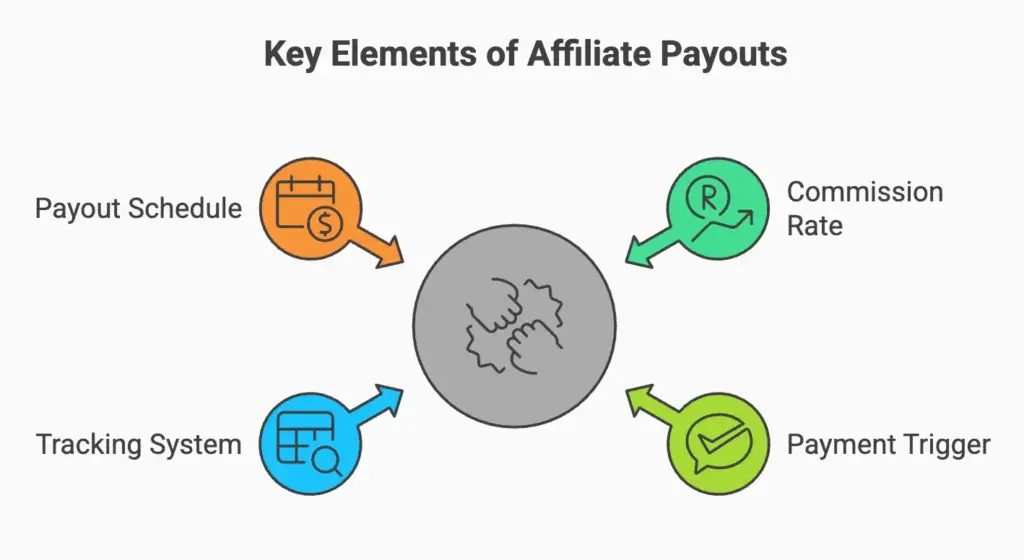
- Commission Rate: The reward affiliates earn, either a percentage (10% per sale) or fixed amount ($20 per signup).
- Payment Trigger: The action that generates commission, such as a purchase, signup, or lead.
- Tracking System: Special links or cookies that identify which affiliate referred the customer.
- Payout Schedule: When affiliates get paid, usually weekly or monthly.
Clear rules and reliable payouts help build trust with affiliates.
Example of a Simple Affiliate Commission Setup
Imagine you sell a $100 digital course and offer a 20% commission.
An affiliate shares their referral link in a blog post. A reader clicks the link and buys the course.
Commission breakdown:
Course price: $100
Commission rate: 20%
Affiliate earnings: $20
You keep $80, and the affiliate earns $20 for bringing the customer. This performance-based model is what makes affiliate marketing effective.
Why Your Affiliate Commission Structure Matters
Your affiliate commission structure is the foundation of your affiliate program. The right structure motivates affiliates, protects your profits, and helps your program grow. A poor structure, on the other hand, can drive affiliates away and limit sales.
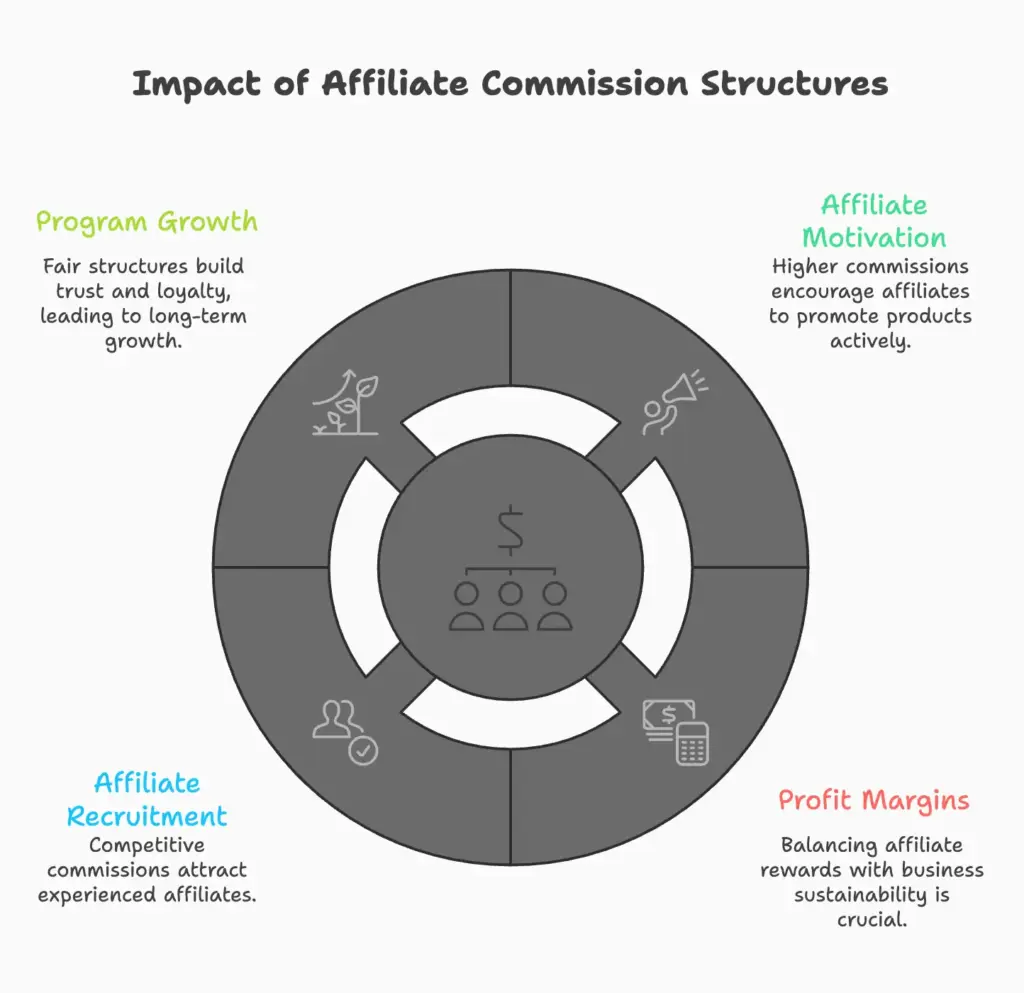
1. It Determines Affiliate Motivation
Affiliates promote products that reward their effort. Higher or competitive commissions encourage affiliates to create reviews, tutorials, and campaigns for your product. If commissions are too low, they will likely promote other programs instead.
2. It Impacts Your Profit Margins
Commissions must balance affiliate rewards and business sustainability. Offering very high payouts can reduce profitability, especially if your margins are small. A smart structure considers product price, profit margin, and customer lifetime value.
3. It Influences Affiliate Recruitment
Experienced affiliates compare programs before joining. Clear rules, competitive commissions, and reliable payouts make your program more attractive and easier to promote.
4. It Affects Long-Term Program Growth
A fair commission structure builds trust and loyalty. When affiliates feel rewarded, they promote your products consistently and help bring new customers over time.
Completely new to affiliate arena? Here’s a complete beginners guide for you!
The 7 Most Common Affiliate Commission Structures
Not all affiliate programs pay affiliates the same way. Businesses choose different commission structures depending on their products, pricing models, and marketing goals.
Some models focus on direct sales. Others reward leads, clicks, or long-term subscriptions.
Understanding these structures helps you design a program that attracts affiliates while keeping your business profitable.
Let’s explore the seven most common affiliate commission structures used by successful affiliate programs.
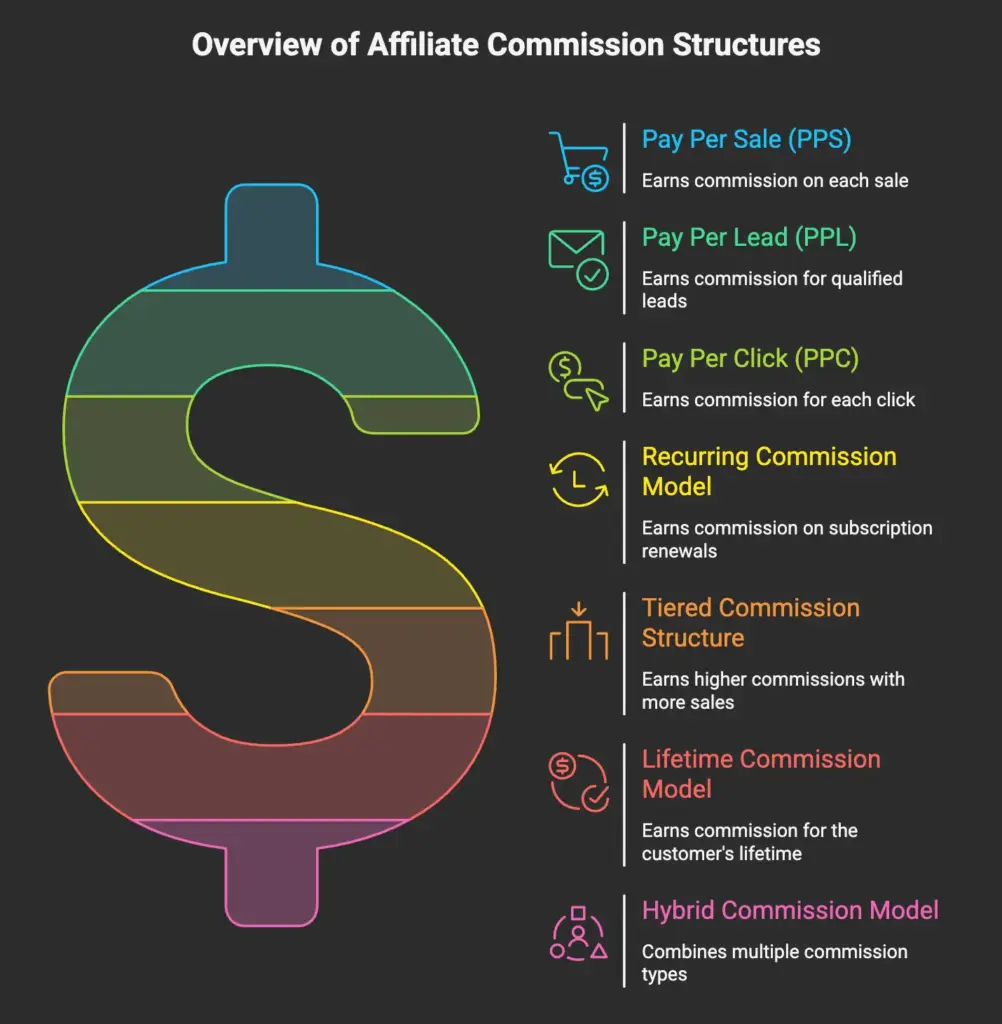
1. Pay Per Sale (PPS)
Pay Per Sale is the most common affiliate commission model. In this structure, affiliates earn a commission every time someone purchases a product through their affiliate link.
It is simple, transparent, and performance-based. Businesses only pay when a real sale happens.
Example
Imagine you sell a product for $100 and offer a 10% commission.
Product price: $100
Commission rate: 10%
Affiliate earnings: $10 per sale
Every time an affiliate generates a sale, they earn $10.
Best for
- E-commerce stores
- Digital products
- Online courses
- Software products
Pros
- Low risk for businesses
- Easy to understand
- Encourages affiliates to focus on conversions
Cons
- Affiliates may hesitate if commissions are low
- Harder to attract top affiliates in very competitive niches
2. Pay Per Lead (PPL)
In a Pay Per Lead model, affiliates earn a commission when they generate a qualified lead instead of a sale.
A lead usually means the user completes an action such as:
- signing up for a free trial
- filling out a contact form
- registering for a webinar
Businesses reward affiliates for bringing potential customers into the sales funnel.
For example, a company might pay $10 for every qualified signup.
This model reduces the pressure on affiliates because the visitor does not need to purchase immediately.
Best for
- SaaS companies
- B2B services
- insurance companies
- financial services
Pros
- Easier conversions compared to direct sales
- Helps businesses build a large lead database
- Encourages affiliates to drive more traffic
Cons
- Risk of low-quality or fake leads
- Requires strong lead verification systems
3. Pay Per Click (PPC)
In the Pay Per Click model, affiliates earn money whenever someone clicks their affiliate link.
This model focuses purely on traffic rather than conversions.
For example, a business might pay $0.50 per click sent to their website.
While this model was more popular in the early days of affiliate marketing, many companies avoid it today because it can be abused.
Some affiliates may generate artificial clicks without sending real buyers.
Best use cases
- brand awareness campaigns
- traffic generation initiatives
Pros
- Simple to understand
- Useful for increasing website visibility
- Encourages affiliates to send traffic quickly
Cons
- Higher risk of click fraud
- Businesses may pay for traffic that does not convert
4. Recurring Commission Model
The recurring commission model is common in subscription-based businesses. Instead of earning a one-time payout, affiliates receive commissions every time the referred customer renews their subscription.
For example, imagine a SaaS product that costs $50 per month and offers a 30% recurring commission.
Here is how it works:
Customer subscribes → affiliate earns $15
Customer renews next month → affiliate earns another $15
Customer stays for 12 months → affiliate earns $180 total
This model creates strong incentives for affiliates to promote products that deliver long-term value.
Benefits
- affiliates earn consistent recurring income
- encourages long-term partnerships
- motivates affiliates to send high-quality customers
Best for
- SaaS products
- membership platforms
- subscription services
5. Tiered Commission Structure
A tiered commission structure rewards affiliates based on their performance.
Instead of one fixed rate, affiliates unlock higher commissions as they generate more sales.
For example:
0–50 sales → 10% commission
51–100 sales → 15% commission
100+ sales → 20% commission
This system encourages affiliates to promote your product more actively because the rewards increase as they perform better.
High-performing affiliates often enjoy this model because it recognizes and rewards their effort.
Benefits
- motivates top affiliates to scale their promotions
- creates friendly competition among affiliates
- increases overall sales volume
6. Lifetime Commission Model
The lifetime commission model rewards affiliates for the entire lifetime of a customer.
Once an affiliate refers a customer, they continue earning commissions whenever that customer makes future purchases.
For example, imagine a customer signs up through an affiliate and buys a product for $100.
Later, the same customer buys another product from your store. The affiliate still earns a commission because they originally referred the customer.
If that customer continues purchasing over time, the affiliate keeps earning.
Best for
- SaaS companies
- online communities
- subscription services
- membership businesses
This model helps build strong loyalty between businesses and affiliates because affiliates know their referrals can generate income for a long time.
7. Hybrid Commission Model
The hybrid commission model combines multiple commission types into one structure.
A common example is offering an upfront bonus plus recurring commissions.
Example structure:
$50 signup bonus
+
20% recurring commission
Here is how it works:
An affiliate earns $50 immediately when someone signs up. Then they continue earning 20% each time the customer renews the subscription.
This approach gives affiliates both instant rewards and long-term earnings.
Benefits:
- very attractive to affiliates
- balances short term and long term incentives
- encourages affiliates to promote the product consistently
Many modern affiliate programs use hybrid models because they provide the best of both worlds for both businesses and affiliates.

Starting From Scratch? Kickstart
with Affiliate Marketing 101 Guide!
Affiliate Commission Rate Benchmarks by Industry
One of the most common questions businesses ask is: What commission rate should I offer affiliates?
The answer depends on factors like profit margins, product type, and customer lifetime value. However, industry benchmarks can give you a helpful starting point. These ranges reflect what many successful affiliate programs offer today.
Typical Affiliate Commission Rates by Industry
| Industry | Typical Commission | Why It Works |
| Ecommerce | 5% to 20% per sale | Physical products have costs like manufacturing, shipping, and inventory, which limits commission size. |
| SaaS | 20% to 40% recurring | Subscription models create long term revenue, allowing companies to share more with affiliates. |
| Digital Products & Courses | 30% to 60% per sale | Digital products have very low delivery costs, so businesses can offer higher commissions. |
| Subscription Businesses | 20% to 40% recurring | Affiliates earn ongoing commissions as customers continue paying for the service. |
Quick Examples
- Many e-commerce stores offer 10% to 20% commissions to stay competitive.
- SaaS companies often provide 30% recurring commissions to reward long-term referrals.
- Digital course creators sometimes offer 50% commissions to attract strong affiliate promotion.
These benchmarks are not strict rules, but they help you design a commission structure that attracts affiliates while keeping your business profitable.
Here’s an interesting overview of Affiliate Marketing Industryt!
How to Choose the Best Affiliate Commission Structure
Choosing the right affiliate commission structure is not about copying what other companies are doing. It is about finding a model that works for your product, your margins, and your growth goals.
Here is a simple framework you can follow to design the right commission structure for your affiliate program.
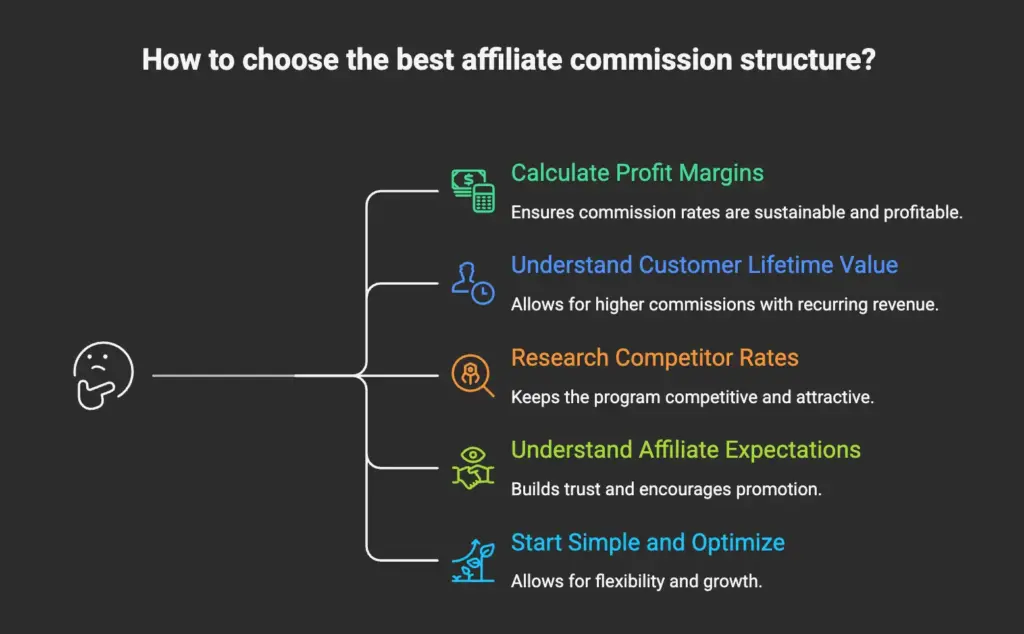
Step 1: Calculate Your Profit Margins
Before setting any commission rate, you must understand your profit margin.
Your profit margin shows how much money you keep after covering all business costs.
A basic calculation looks like this:
Product price: $100
Cost of production and operations: $60
Profit before commission: $40
Now imagine you offer a 20% affiliate commission.
Commission paid: $20
Remaining profit: $20
In this case, the commission is sustainable because you still keep part of the profit.
But if your margin is small, offering a high commission could eliminate your profits entirely. That is why your commission structure should always start with a clear understanding of your margins.
Step 2: Understand Customer Lifetime Value
Customer Lifetime Value (often called LTV) refers to the total revenue a customer generates during their relationship with your business.
If customers typically buy multiple times or stay subscribed for months, your LTV becomes much higher than the initial purchase.
This allows businesses to offer larger commissions.
For example, imagine a SaaS product that charges $40 per month.
If the average customer stays for 12 months, the total revenue becomes:
$40 × 12 months = $480 lifetime value
In this case, offering a 30% recurring commission can still be profitable because the customer generates significant long term revenue.
Businesses with high lifetime value often run very attractive affiliate programs because they can afford to share more revenue with affiliates.
Step 3: Research Competitor Commission Rates
Affiliates often compare multiple programs before choosing which products to promote. If your commission is significantly lower than that of competitors, affiliates may ignore your program.
That is why it helps to research what other companies in your industry are offering.
You can do this by:
- checking competitor affiliate program pages
- browsing affiliate marketplaces
- searching for industry commission benchmarks
For example, if most SaaS companies in your niche offer 30% recurring commissions, offering only 10% may make your program less attractive.
This does not mean you must always offer the highest commission. But staying within the competitive range makes your program more appealing to affiliates.
Step 4: Understand Affiliate Expectations
Affiliates are more likely to promote programs that offer predictable earnings and fair rules.
Top-performing affiliates usually look for three things:
Reliable payouts
Affiliates want to know they will get paid on time without complications.
Recurring earning potential
Many affiliates prefer programs that offer long-term income through subscriptions or repeat purchases.
Transparent rules
Clear commission terms, tracking systems, and payout schedules help build trust.
When affiliates trust your program, they are more willing to invest time and effort promoting your product.
Step 5: Start Simple and Optimize Later
One of the biggest mistakes businesses make is trying to design a perfect commission structure from the beginning.
In reality, the best affiliate programs evolve over time.
A smart approach is to start with a simple commission structure, launch your affiliate program, and monitor how it performs.
For example, you might begin with:
- a fixed 15% commission
- monthly payouts
- simple tracking rules
As your program grows, you can add improvements like:
- tiered commissions
- performance bonuses
- recurring payouts
Testing and refining your commission structure helps you build a program that works for both your business and your affiliates.
Common Mistakes When Setting Affiliate Commission Structures
Designing an affiliate commission plan may seem simple, but small mistakes can hurt your program’s success. Here are a few common pitfalls to avoid.
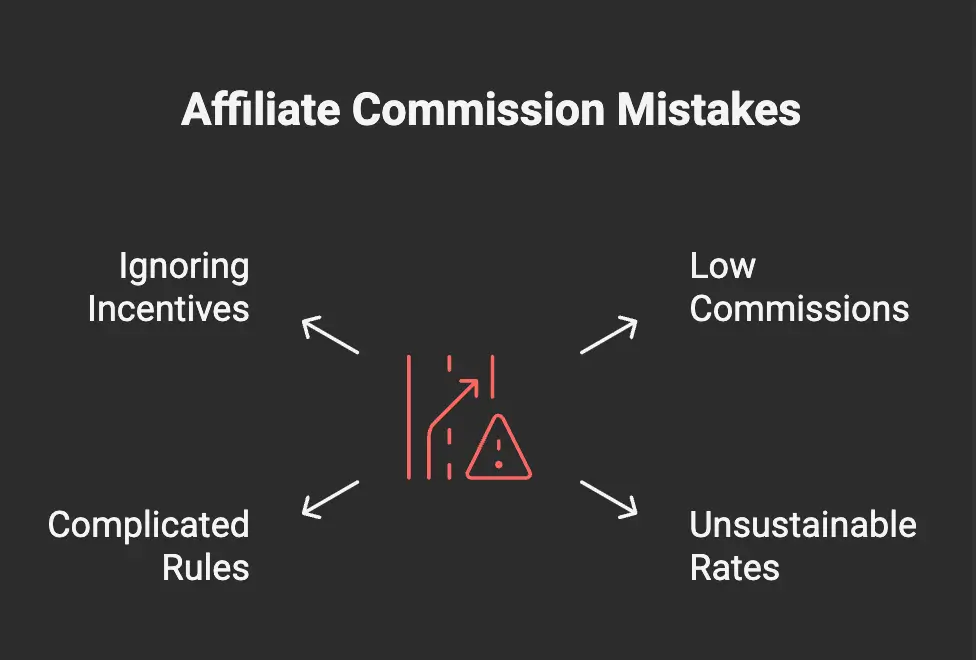
- Setting Commission Too Low: If the payout is too small, affiliates will not prioritize your program. Many will simply promote competitors with better rewards.
- Offering Unsustainable Commission Rates: Very high commissions may attract affiliates, but they can quickly destroy your profit margins if they are not aligned with your business economics.
- Complicated Commission Rules: Complex commission conditions confuse affiliates. Simple and transparent rules make your program easier to trust and promote.
- Ignoring Performance Incentives: Top affiliates often expect bonuses or higher commissions for strong performance. Without incentives, they may lose motivation.
Example of an Effective Affiliate Commission Plan
Let’s look at a practical example of how an e-commerce business might structure its affiliate commissions.
Imagine you run an online store that sells premium fitness gear, with an average product price of $120. To attract affiliates and encourage consistent promotion, you design a commission plan with three simple layers.
Base Commission
The program starts with a 10% base commission on every sale.
Example:
Product price: $120
Base commission: 10%
Affiliate earnings per sale: $12
This base rate gives every affiliate a fair and predictable reward for promoting the store.
Tier Bonus
To motivate high performing affiliates, the program introduces tier based rewards.
Monthly sales performance:
- 1–30 sales → 10% commission
- 31–75 sales → 12% commission
- 76+ sales → 15% commission
This system encourages affiliates to push harder once they get close to the next tier. A blogger who has already generated 28 sales will likely work harder to reach 31 sales and unlock the higher commission.
Seasonal Promotion Bonus
During major shopping seasons, the store offers limited time commission boosts.
Examples:
- Black Friday campaign → extra 5% bonus commission
- Holiday sales event → $10 bonus per sale
- New product launch → double commissions for one week
These temporary promotions create excitement and encourage affiliates to actively promote the store during high traffic periods.
Why This Commission Plan Works
This structure works well because it balances simplicity, motivation, and profitability.
The base commission keeps the program simple and predictable.
The tier bonuses reward top performing affiliates and encourage higher sales volume.
The seasonal incentives give affiliates extra reasons to promote products during important campaigns.
As a result, affiliates stay motivated, and the business can steadily grow its affiliate program while keeping commissions sustainable.
Final Thoughts: Build a Commission Model That Works for Everyone
Your affiliate commission structure plays a huge role in the success of your affiliate program. The right model motivates affiliates, keeps your business profitable, and helps your program grow over time.
Instead of guessing commission rates, focus on the fundamentals. Look at your profit margins, understand your customer lifetime value, and choose a structure that rewards affiliates while staying sustainable for your business.
Remember, you do not need to build the perfect commission plan on day one. The most successful affiliate programs start simple, observe results, and improve their commission models over time.
If you already run an affiliate program, this is a good moment to review your current commission structure. Small adjustments can make a big difference in affiliate motivation and program growth.
Experiment with different models, track performance, and keep refining your strategy. When affiliates win, and your business stays profitable, everyone benefits.
Frequently Asked Questions About Affiliate Commission Structures
Here are some of the most popular questions and answers you would like to explore:
What is the best affiliate commission structure?
There is no single commission structure that works for every business. The best option depends on your product type, profit margins, and customer lifetime value.
For example, e-commerce businesses often use pay-per-sale commissions, while SaaS companies prefer recurring commissions because customers pay monthly. Many modern affiliate programs also use hybrid models that combine upfront bonuses with recurring payouts.
The key is to choose a structure that motivates affiliates while keeping your business profitable.
What is a typical affiliate commission rate?
Affiliate commission rates vary widely across industries. However, most programs fall within these common ranges:
- E-commerce products: 5% to 20% per sale
- SaaS products: 20% to 40% recurring commissions
- Digital products and courses: 30% to 60% commissions
The right commission rate depends on your profit margins and market competition. Offering competitive payouts helps attract quality affiliates to your program.
Are recurring commissions better for affiliates?
In many cases, yes. Recurring commissions allow affiliates to earn long term income from a single referral.
For example, if an affiliate refers a customer to a subscription service that pays 30% recurring commission, the affiliate continues earning as long as the customer stays subscribed.
This model is very attractive to affiliates because it creates predictable passive income over time.
How do businesses calculate affiliate commissions?
Businesses usually calculate commissions using one of two methods.
Percentage based commissions
Affiliates earn a percentage of the sale price.
Example:
Product price: $100
Commission rate: 15%
Affiliate earnings: $15
Fixed commissions
Affiliates receive a set payment for each conversion.
Example:
$20 for every new signup or lead.
Many businesses combine these methods depending on their commission structure.
Can you change your affiliate commission model later?
Yes, many businesses adjust their commission structures as their affiliate programs grow.
For example, you might start with a simple 10% commission per sale, then later introduce features such as:
- tiered commission levels
- recurring commissions
- seasonal bonuses
As long as changes are communicated clearly and applied fairly, updating your commission model can help improve affiliate motivation and program performance.





Add your first comment to this post