
Complete Guide to Types of Affiliate Marketing

Affiliate marketing sounds simple.
You reward people for promoting your product. They bring sales. You pay commission. Everyone wins.
But once you decide to launch an affiliate program, reality hits.
Should you pay per sale? Per lead? Offer recurring commission?
Work with influencers or bloggers?
Here’s the thing most people miss: there isn’t just one type of affiliate marketing. There are many. And the structure you choose can either grow your revenue fast or quietly hurt your margins.
In this guide, we’ll break down the different types of affiliate marketing from A to Z so you can choose the right one for your business with confidence.
Let’s dive in.
What Is Affiliate Marketing? A Quick Refresher
Affiliate marketing is simple at its core.
You reward people for promoting your product.
Here’s how it works:
- A business creates an offer.
- An affiliate promotes it.
- A customer buys or signs up.
- The affiliate earns a commission.
Read in-detail: How Affiliate Marketing Works (Ultimate Clarity Guide)
There are three main players:
- Merchant (you, the business owner)
- Affiliate (the promoter)
- Customer
- Tracking system (the tech that tracks everything)
According to Statista, affiliate marketing spending in the US has grown steadily and continues to expand year after year, showing strong long-term potential.
In other words, this is not a trend. It’s a serious growth channel.
Now let’s break down the different types.
Read In-detail: What Is Affiliate Marketing? And What It Means in 2026
The 3 Core Types of Affiliate Marketing (Based on Relationship)
Before we talk about commission models or payouts, we need to understand something more important.
Not all affiliates promote the same way.
Some barely know your product.
Some talk about it casually.
Others swear by it and build content around it.
This difference in relationship changes everything. It affects trust, conversions, refund rates, and even the kind of affiliates you attract.
Let’s break it down.
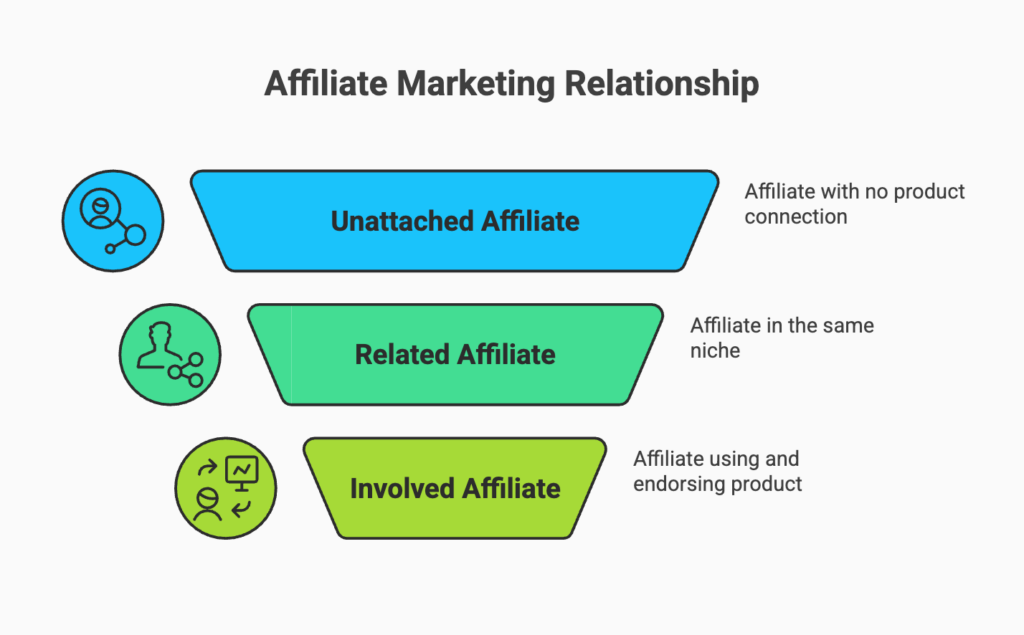
1. Unattached Affiliate Marketing
This is the most distant form of affiliate marketing.
The affiliate has no real connection to the product. They might not have used it. They may not even be in the niche. Their goal is simple: drive traffic and earn commission.
You’ll often see this with:
- Paid ads
- Coupon websites
- Large deal platforms
- Media buyers testing funnels
For example, someone might run ads to a landing page promoting a software tool they’ve never used. If the ad converts, they earn. If not, they move on.
The advantage? It can scale quickly.
The downside? There’s very little trust involved. And when trust is low, conversion rates usually suffer. Refund rates can also be higher because buyers were not warmed up properly.
This model works best when:
- Your brand is already strong
- Your sales page converts well on its own
- You have healthy profit margins
If you’re just starting out, relying only on unattached affiliates can feel like pouring water into a bucket with small holes.
2. Related Affiliate Marketing
Now we move one step closer.
In related affiliate marketing, the affiliate operates in the same niche as your product. They have an audience that trusts them, but they may not personally use your product.
Think of:
- A marketing blogger recommending tools
- A WordPress YouTuber sharing plugin suggestions
- A fitness influencer listing supplement brands
They are “related” because their audience matches your target market.
This model is extremely common today. And honestly, it’s where many affiliate programs begin.
The trust level is moderate. Higher than unattached affiliates, but not as strong as personal experience-based promotion.
The upside? You get targeted traffic.
The risk? If they promote too many similar products, their recommendations may feel generic.
Still, for most businesses, this is a very solid starting point.
3. Involved Affiliate Marketing
This is where things get powerful.
In involved affiliate marketing, the affiliate actually uses your product. They share real experiences. They show results. They create tutorials, case studies, walkthrough videos, and comparison posts.
They are not just promoting. They are endorsing.
For example:
- A blogger writing a detailed “How I Increased Sales Using This Tool” guide
- A YouTuber showing behind-the-scenes usage
- A course creator explaining how your product fits into their workflow
This type builds the highest level of trust. And trust drives conversions.
Data from Influencer Marketing Hub consistently shows that authenticity and personal experience significantly increase buyer confidence and purchase intent.
From my experience managing affiliate programs, involved affiliates often:
- Convert better
- Send more qualified traffic
- Have lower refund rates
- Stay longer in the program
The only downside? It takes time. You can’t force involvement. You earn it by having a good product and building relationships.
Read in-deatil: Affiliate Marketing for Beginners: A Complete Guide
Types of Affiliate Marketing by Commission Model
Now we’re getting into the part that really keeps business owners awake at night.
“How much should I pay?”
Because let’s be honest. Affiliate marketing sounds amazing until you realize one wrong commission structure can wipe out your margins.
This is where many programs succeed or fail.
The commission model defines how affiliates get rewarded. It directly affects:
- Your profitability
- The kind of affiliates you attract
- Your program’s long-term sustainability
Let’s walk through the major commission-based types and when each one makes sense.
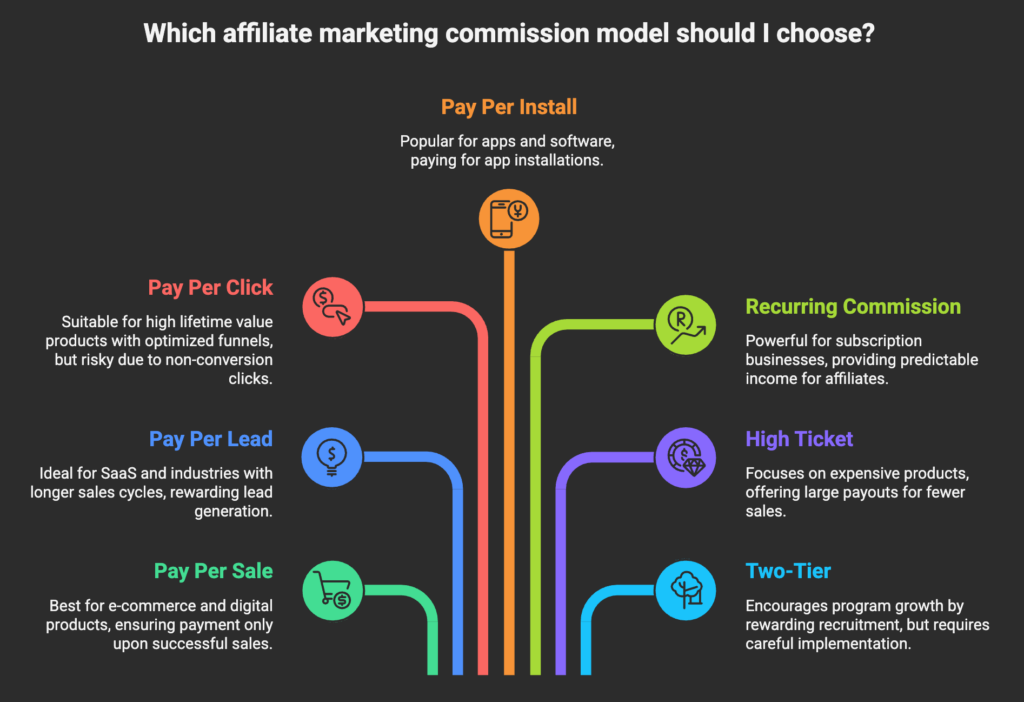
1. Pay Per Sale (PPS)
This is the most common model in affiliate marketing.
An affiliate earns a commission only when a sale happens.
Simple. Clean. Performance-based.
If you sell a $100 product and offer 20 percent commission, the affiliate earns $20 per sale. This model dominates e-commerce and digital product businesses.
Why businesses love it:
You only pay when you earn. There’s almost no financial risk.
Why affiliates like it:
If the product converts well, their earnings scale with performance.
2. Pay Per Lead (PPL)
In this model, affiliates earn when they generate a lead instead of a sale.
A lead could be:
- A free trial signup
- An email subscription
- A demo booking
- A completed form
This structure is common in SaaS, insurance, finance, and education industries.
Why use it?
Because sometimes getting the sale takes time. Especially if your product has a longer decision cycle.
Instead of waiting for revenue, you reward affiliates for bringing qualified prospects into your funnel.
But here’s the catch.
Lead quality matters. A lot.
Without proper validation, you may end up paying for fake emails or low-intent users. That’s why strong tracking and verification are essential with this model.
Used correctly, Pay Per Lead can fuel rapid growth. Used carelessly, it can quietly drain your marketing budget.
3. Pay Per Click (PPC)
This model pays affiliates for every click they send to your website.
It sounds attractive at first. More traffic, right?
Not always.
The biggest risk here is that clicks do not equal conversions. You might pay for thousands of visitors who never buy.
That’s why Pay Per Click is far less common in modern affiliate programs. It requires advanced tracking, fraud detection, and strong backend monetization.
This model works best if:
- You have a high lifetime customer value
- Your conversion funnel is well optimized
- You monetize traffic in multiple ways
Otherwise, it can feel like paying for foot traffic that never enters your store.
4. Pay Per Install (PPI)
This commission model is popular in software and mobile apps.
Affiliates get paid when someone installs your app or software.
It’s widely used in tech ecosystems and supported by large distribution networks. Even companies tracked by Statista show steady growth in app-based affiliate partnerships over the years.
The logic here is simple.
If your product makes money after installation, rewarding the install makes sense.
But again, quality matters. If users install and never engage, your retention numbers will suffer.
This model is ideal when:
- Onboarding is strong
- Monetization happens inside the app
- Retention metrics are healthy
5. Recurring Commission Model
This is where things get interesting.
Instead of paying once, you pay affiliates every time the customer renews.
For subscription businesses, this model is incredibly powerful.
Let’s say your product costs $50 per month and you offer 30 percent recurring commission. The affiliate earns $15 every month as long as the customer stays subscribed.
Now imagine that the customer stays for 24 months.
That’s $360 earned from one referral.
Affiliate networks like Awin report that recurring structures often attract more serious, long-term-focused affiliates.
Why?
Because it creates a predictable income.
For SaaS founders and membership site owners, recurring commissions can turn affiliates into true partners instead of short-term promoters.
6. High Ticket Affiliate Marketing
High-ticket programs focus on expensive products.
Think:
- Premium courses
- Coaching programs
- Annual software plans
- Consulting services
Instead of earning small commissions on volume, affiliates earn large payouts on fewer sales.
For example, a $2,000 product with 30 percent commission means $600 per sale.
That’s serious motivation.
But high ticket requires:
- Strong brand authority
- Excellent sales funnel
- High trust
This model works best with involved affiliates who can educate and nurture their audience before recommending your product.
7. Two-Tier Affiliate Model
This model adds another layer.
Affiliates earn commission not only from their direct sales, but also from affiliates they recruit.
Here’s how it works:
- Tier 1: Commission on personal referrals
- Tier 2: Smaller percentage from sub-affiliate sales
This structure encourages growth within the affiliate program itself.
However, caution is important.
The focus must always remain on product sales, not recruitment. If recruitment becomes the main incentive, the structure can lose credibility.
When implemented properly, two-tier programs can accelerate growth and community building.
Types of Affiliates (Who Promotes?)
Now let’s shift perspective.
So far, we’ve talked about commission structures. But the structure is only half the story.
The other half?
The people promoting your product.
Because not all affiliates are the same. They don’t use the same strategies. They don’t attract the same audience. And they definitely don’t convert in the same way.
Understanding who your affiliates are helps you design better commission plans, better resources, and better expectations.
Let’s look at the most common types of affiliates you’ll encounter.
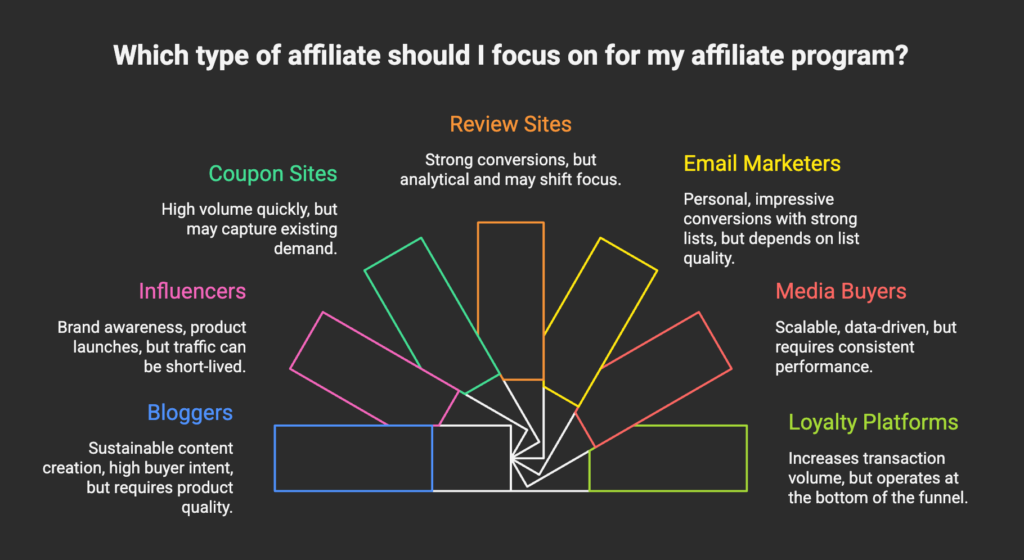
1. Bloggers and Content Creators
This is one of the strongest and most sustainable affiliate types.
Bloggers create in-depth articles, tutorials, case studies, and comparison posts. They rank on search engines. They answer questions people are already searching for.
For example:
- “Best Email Marketing Tools”
- “How to Start an Affiliate Program”
- “Top WordPress Plugins for E-commerce”
When someone lands on these posts, they usually have buying intent. They are researching. Comparing. Deciding.
That’s why blog-based affiliates often convert well over time. Their content keeps working long after it’s published.
The catch?
They care deeply about product quality. If your tool doesn’t deliver, they won’t promote it for long.
2. Influencers
Influencers operate mostly on social platforms like Instagram, TikTok, and YouTube.
They rely on personal branding and audience trust.
Unlike bloggers who focus on SEO, influencers focus on engagement. They build relationships through stories, videos, and daily content.
And here’s something interesting.
Data from Influencer Marketing Hub consistently shows that micro influencers often have higher engagement rates than mega influencers.
In other words, a smaller, niche-focused influencer with 15,000 followers might drive better results than someone with 500,000 generic followers.
Influencer affiliates are great for:
- Brand awareness
- Product launches
- Lifestyle and visual products
But their traffic can be short-lived unless supported by ongoing campaigns.
3. Coupon and Deal Sites
You’ve definitely seen these.
Websites that list discount codes, cashback offers, and limited-time deals.
These affiliates attract price-sensitive buyers. People who are ready to purchase but want the best deal.
They can drive high volume quickly, especially during sales periods like Black Friday.
However, there’s a trade-off.
Sometimes, coupon affiliates capture customers who were already planning to buy. So instead of generating new sales, they simply take credit for existing demand.
That doesn’t mean they’re bad. It just means you should use them strategically.
4. Review and Comparison Sites
These affiliates focus purely on evaluation.
They compare products side by side. Highlight pros and cons. Rank alternatives.
For example:
- “Tool A vs Tool B”
- “Top 10 Project Management Software”
- “Best Hosting Providers”
Visitors to these pages are usually close to making a decision.
Which means conversions can be strong.
But these affiliates are analytical. They will test your product. They will compare it. And if competitors offer better features or higher commissions, they may shift focus.
Building long-term relationships with review sites often requires ongoing communication and support.
5. Email Marketers
Email-based affiliates rely on their subscriber list.
They may not publish many blog posts or videos. Instead, they nurture their audience through newsletters.
This type of affiliate is powerful because email is personal. It lands directly in someone’s inbox.
If the relationship is strong, conversions can be impressive.
However, email performance depends heavily on list quality. A well-maintained, engaged list will outperform a massive but inactive one every time.
6. Media Buyers and Performance Marketers
These affiliates are more technical.
They run paid ads on platforms like Google, Facebook, or native advertising networks.
Their focus is simple: spend less on ads than they earn in commissions.
They operate based on data, testing, and optimization.
If your commission model and funnel allow room for profit, they can scale quickly.
But here’s the reality.
Performance marketers care about numbers. If your conversion rate drops or payouts shrink, they move on fast.
You need solid tracking and consistent conversion performance to attract and retain this type of affiliate.
7. Loyalty and Cashback Platforms
These platforms reward customers with cashback or points for purchases.
They work especially well in e-commerce.
Customers love the feeling of getting something back. Even a small reward can push someone to complete a purchase.
For businesses, these affiliates can increase transaction volume. But similar to coupon sites, they often operate at the bottom of the funnel.

Starting From Scratch? Kickstart
with Affiliate Marketing 101 Guide!
How to Choose the Right Type of Affiliate Marketing
Alright. This is where strategy begins.
Because knowing the types is one thing. Choosing the right one for your business is another story.
And honestly? This is where many founders rush.
They see competitors offering 40 percent commission and think, “Let’s match that.”
Or they hear recurring commissions are powerful and jump into it without checking their numbers.
That’s risky.
Choosing the right affiliate model isn’t about copying others. It’s about alignment. Alignment between your product, your margins, your customer journey, and your growth goals.
Let’s break this down in a practical way.
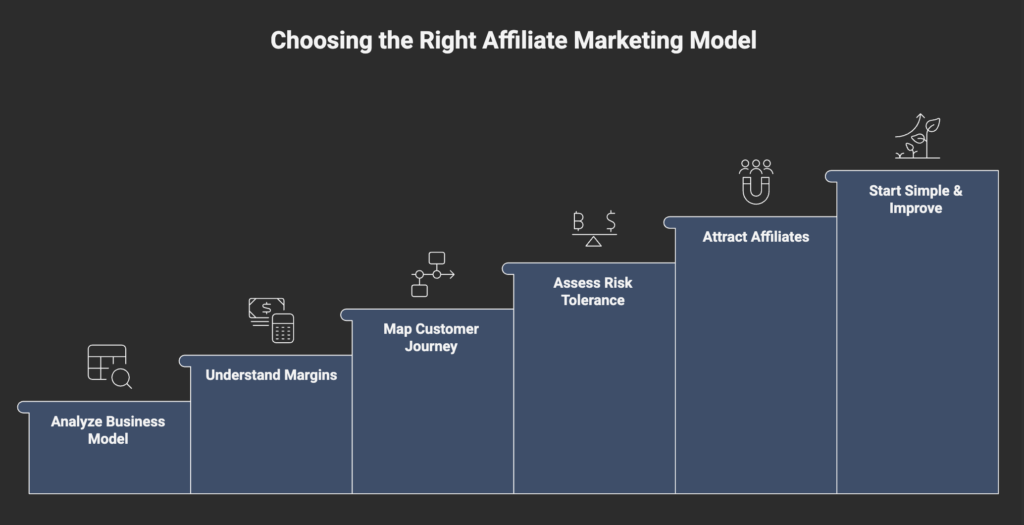
Step 1: Look at Your Business Model First
Start simple.
What are you selling?
If you run an e-commerce store selling physical products, Pay Per Sale usually makes the most sense. It’s straightforward. You only pay when revenue comes in.
If you run a SaaS or membership platform, recurring commission is often the smarter choice. It motivates affiliates to send long-term customers instead of quick, low-quality signups.
If your business depends on demos, consultations, or free trials, then Pay Per Lead might be the right fit.
Your product structure should guide your commission structure. Not the other way around.
Step 2: Know Your Margins Before You Set Any Commission
This is where emotions must leave the room.
You need numbers.
Ask yourself:
- What is my gross margin?
- What is my average order value?
- What is my customer lifetime value?
- How much can I realistically share?
For example, if your product sells for $50 but your margin is only $15, offering 30 percent commission might not be sustainable.
On the other hand, if your SaaS product retains customers for 18 months on average, recurring commission suddenly becomes very attractive because lifetime value covers it.
Many successful affiliate programs calculate commission backward from profit. Not from excitement.
Do the math first. Always.
Step 3: Understand Your Customer Buying Journey
Some products are impulse buys.
Others take weeks of research.
If your product requires education and trust, involved affiliates like bloggers, YouTubers, or educators will perform better.
If your product is simple and low-cost, coupon sites or influencers might generate quick wins.
Think about how your customers decide.
Do they compare options?
Do they read reviews?
Do they wait for discounts?
Your affiliate strategy should mirror your customer behavior.
Step 4: Decide Your Risk Tolerance
Different models carry different levels of risk.
Pay Per Sale is low risk. You only pay after revenue.
Pay Per Lead increases risk slightly because not every lead converts.
Pay-Per-Click is high risk if not carefully controlled.
Recurring commissions create long-term payout obligations. Great for growth. But you must be confident in retention rates.
Ask yourself honestly:
Are you optimizing for safe growth?
Or aggressive scaling?
There’s no wrong answer. But clarity matters.
Step 5: Think About the Type of Affiliates You Want to Attract
Commission structure signals who your program is for.
High recurring payouts attract serious content creators who invest time into tutorials.
Large one-time commissions attract high-ticket marketers.
Low flat payouts may attract coupon and cashback sites.
Your structure communicates your positioning.
If you want long-term partners, design a structure that rewards long-term performance.
Step 6: Start Simple, Then Improve
Here’s something many people overlook.
You don’t have to build the perfect affiliate system on day one.
In fact, starting simple is often smarter.
Begin with:
- A clear Pay Per Sale model
- Competitive but sustainable commission
- Transparent terms
Then watch the data.
See who joins.
See who performs.
See where conversions happen.
After that, you can introduce recurring bonuses, tiered commissions, or performance incentives.
Affiliate programs evolve. They are not static.
A Simple Decision Framework
If you’re still unsure, use this quick mental guide:
- Selling physical products → Pay Per Sale
- Selling subscription software → Recurring commission
- Selling expensive programs → High ticket commission
- Focused on rapid lead growth → Pay Per Lead
- Want affiliate-driven expansion → Two-tier structure
But remember, this is guidance. Not a rulebook.
Common Mistakes When Choosing an Affiliate Model
Let’s be honest. Many businesses mess this up. Here’s what to avoid:
- Offering high commission without margin calculation. Do the math first.
- Choosing PPC without fraud protection. Click fraud is real.
- Ignoring recurring revenue opportunities. If you’re subscription-based and not offering recurring commission, you’re missing a big incentive.
- Not defining attribution rules: Who gets credit? First click? Last click? Define it clearly.
Final Thoughts: Which Affiliate Model Wins?
Here’s the honest answer.
There is no universal winner.
Pay Per Sale is safe and simple. Recurring commissions are powerful for subscription businesses. High ticket works beautifully for premium offers. Pay Per Lead can fuel fast growth if quality is controlled.
The real winner is the model that aligns with your margins, product type, and long-term vision.
Affiliate marketing is not about copying competitors. It’s about building a structure that is profitable, sustainable, and attractive to the right partners.
Choose smart. Then refine as you grow.



Add your first comment to this post