
Affiliate Marketing for Beginners: A Complete Guide
Ever wondered how people earn money while they sleep? You see screenshots of “affiliate income” online and think… is this real, or just internet hype?
Let’s be honest. Affiliate marketing sounds simple. Share a link. Someone buys. You earn money. But once you start digging, things get confusing fast. What is an affiliate link? How does tracking work? Do you need a website? Is it even legit?
If you are feeling overwhelmed, you are not alone. Most beginners struggle at the start!
In this guide, I will break everything down step by step. By the end, you will understand exactly how affiliate marketing works and how you can start safely without wasting time or money.
What Is Affiliate Marketing? In Simple Words
Affiliate marketing is a simple idea.
You recommend a product or service to someone. If they buy using your special link, you earn a commission.
That’s it.
Think of it like a referral bonus. Imagine you tell your friend about a great coffee shop. They visit, buy a latte, and the owner gives you $5 as a thank you. Affiliate marketing works the same way, just online and automated.
Now, let’s break down the four key players involved.
1. Merchant
This is the business that sells the product.
It could be a big company like Amazon or a small e-commerce store selling handmade products. The merchant creates the affiliate program and decides how much commission to pay.
2. Affiliate
This is the person who promotes the product.
It could be a blogger, YouTuber, social media creator, or even a niche website owner. The affiliate shares a unique tracking link with their audience.
3. Customer
This is the buyer.
They click the affiliate link, purchase the product, and usually never pay anything extra. The commission comes from the merchant’s profit, not the customer’s pocket.
4. Tracking Platform
This is the system that tracks clicks, sales, and commissions.
Without tracking software, affiliate marketing would be chaos. The platform records who referred the customer and ensures the right affiliate gets paid.
Real World Examples
One of the most popular beginner-friendly programs is Amazon Associates. You sign up, get a unique link to any product on Amazon, and earn a percentage when someone buys through your link.
Another example is SaaS affiliate programs. Many software companies offer recurring commissions. For instance, when someone promotes an email marketing tool or WordPress plugin, they can earn monthly commissions as long as the customer stays subscribed.
So in simple terms, affiliate marketing is digital word of mouth with built-in tracking and automatic rewards.
Explore in-depth: What Is Affiliate Marketing? And What It Means in 2026
How Affiliate Marketing Actually Works (Step by Step)
Now let’s break this down into simple steps. No jargon. No confusion.
Here’s exactly what happens behind the scenes.
Step 1: A Business Creates an Affiliate Program
First, a business decides it wants more sales.
Instead of paying upfront for ads, the business creates an affiliate program. It sets rules like:
- How much commission affiliates will earn
- How long tracking cookies last
- When payouts happen
This program can be hosted in house or through an affiliate network.
Step 2: An Affiliate Joins the Program
Next, a blogger, YouTuber, or website owner signs up.
Once approved, they get access to a dashboard where they can generate special tracking links.
This is where things start getting interesting.
Step 3: The Affiliate Gets a Unique Tracking Link
The system generates a unique link just for that affiliate.
It might look long and messy, but inside that link is an ID. That ID tells the tracking system:
“This sale belongs to this person.”
Without that unique link, there is no way to track commissions properly.
Step 4: A Customer Clicks the Link
Now the affiliate shares the link inside:
- A blog post
- A YouTube video description
- An email newsletter
- A social media post
A customer clicks the link and lands on the merchant’s website.
Step 5: The Tracking System Records the Sale
When the customer clicks, something small but important happens.
A cookie is placed in their browser.
What Is Cookie Duration?
A cookie is just a tiny piece of data stored in the user’s browser. It remembers who referred them.
Cookie duration means how long that tracking lasts.
For example:
- 24 hour cookie → You only get credit if they buy within 24 hours
- 30 day cookie → You get credit if they buy anytime within 30 days
Longer cookie duration usually means a better chance of earning commission.
Step 6: Commission Is Paid
If the customer buys within the cookie window, the system records the sale.
The affiliate dashboard updates. The commission is calculated.
Later, the business pays the affiliate according to the payout schedule.
That’s the full cycle.
Simple. Transparent. Performance-based.
Explore in-depth: How Affiliate Marketing Works: A to Z
Understanding Attribution Models (Made Simple)
Now here’s something beginners often miss.
What if a customer clicks multiple affiliate links before buying? Who gets paid?
This depends on the attribution model.
Last Click Attribution
This is the most common model. The last affiliate link the customer clicked before purchasing gets the commission.
Example:
- You click Affiliate A’s link today
- Tomorrow you click Affiliate B’s link
- Then you buy
Affiliate B gets paid.
First Click Attribution
In this model, the first affiliate who introduced the customer gets the commission. Using the same example:
Affiliate A would get paid because they brought the customer first.
Some advanced programs even use shared or multi-touch attribution, but as a beginner, you only need to understand first click and last click.
That’s it.
Once you understand these moving parts, affiliate marketing stops feeling mysterious. It becomes a simple system built on tracking, timing, and trust.
Why Affiliate Marketing Is So Popular
Affiliate marketing is not just a trend. It is a massive industry that keeps growing every year.
Let’s look at some numbers.
According to industry reports, the global affiliate marketing industry is worth over 17 billion dollars and continues to grow steadily year after year. In the United States alone, spending on affiliate marketing has crossed 8 billion dollars, and it keeps rising as more businesses move online.
Now pair that with e-commerce growth.
Global e-commerce sales have surpassed 6 trillion dollars, and that number is expected to grow in the coming years. More online stores mean more products to promote. More products mean more affiliate opportunities.
Here’s something even more interesting.
Studies show that affiliate marketing drives around 15 to 20 percent of all online sales for many businesses. That means a significant chunk of e-commerce revenue comes from affiliates recommending products.
That’s huge. So why is it so popular?
Let’s break it down.
1. It Is Low Risk
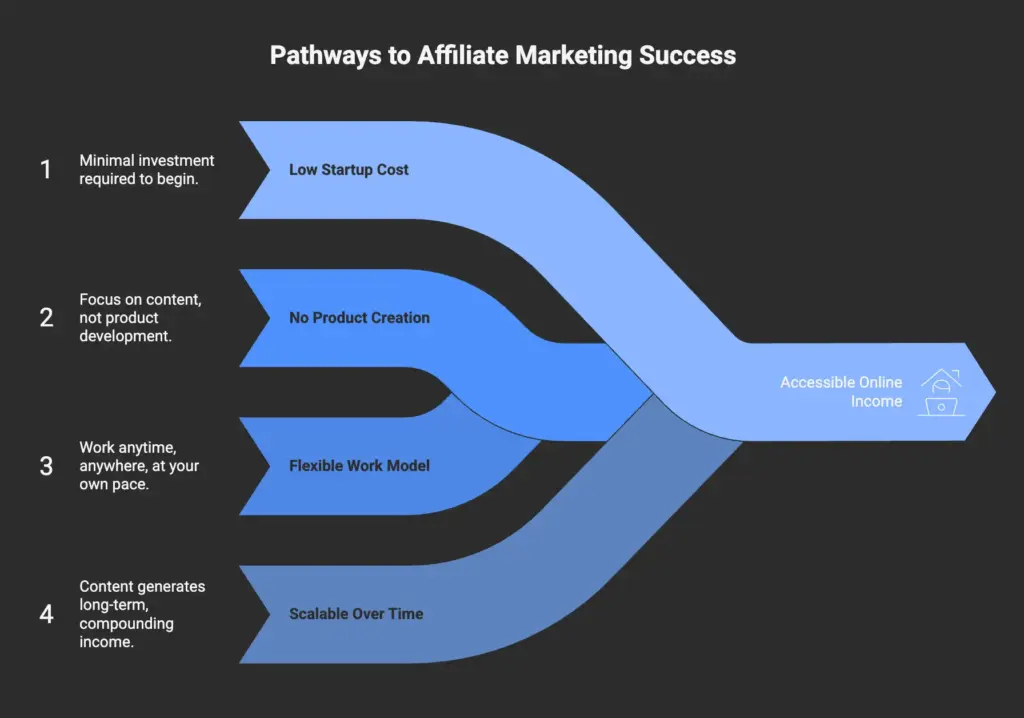
For businesses, affiliate marketing is low risk.
- They do not pay for impressions.
- They do not pay for clicks.
- They only pay when a real sale happens.
For affiliates, the financial risk is also low. You do not need inventory. You do not need customer support. You do not need to build a product.
You focus on content and traffic.
2. It Is Performance Based
This is what makes affiliate marketing powerful. Everyone gets paid based on results.
If you generate sales, you earn commissions. If you do not generate sales, you do not earn.
It is simple and fair.
Businesses love it because they can measure every click and conversion. Affiliates love it because their income can scale with effort and strategy.
3. It Is a Win-Win Model
Think about it.
- The business gets more customers.
- The affiliate earns commission.
- The customer discovers useful products.
No one loses.
When done honestly and transparently, affiliate marketing creates a healthy ecosystem built on trust and value.
That is why bloggers, YouTubers, ecommerce brands, and SaaS companies all use it. And that is why beginners keep getting attracted to it.
It is accessible. It is scalable. And if done right, it can become a long term income stream.

Starting From Scratch? Kickstart
with Affiliate Marketing 101 Guide!
Types of Affiliate Marketing (Beginner Friendly Breakdown)
Not all affiliate marketing looks the same.
Some people promote products they have never used. Others build entire brands around products they truly believe in. And the results can be very different.
Let’s break it down into three simple types.
1. Unattached Affiliate Marketing
This is the most hands-off approach.
You promote a product without having any real connection to it. You may not have used it. You may not even know much about it.
This usually happens through:
- Paid ads
- Coupon websites
- Generic product comparison sites
The goal is simple. Drive traffic. Get clicks. Earn commission.
It can work. But trust is usually low because there is no personal experience behind the recommendation.
Think of it like recommending a movie you have never watched. It feels a bit… empty.
2. Related Affiliate Marketing
This is one level deeper.
Here, you promote products that are related to your niche or audience, but you may not have personally used all of them.
For example:
- A fitness blogger promoting protein powder
- A tech YouTuber promoting web hosting
- A WordPress blogger recommending plugins
You have some authority in the topic. Your audience trusts your knowledge. Even if you have not used every single product, it still makes sense for your content.
This model is very common among bloggers and niche website owners.
3. Involved Affiliate Marketing
This is the strongest and most powerful type.
You personally use the product. You share real experiences. You show results. You talk about pros and cons honestly.
Your recommendation feels authentic.
For example:
- Writing a detailed review after using a tool for months
- Showing real screenshots
- Sharing your own case study
This approach builds serious trust. And trust drives conversions.
If you are a beginner, this is the safest long-term strategy. It may take more effort, but it builds a real brand.
Now Let’s Talk About Product Types
Affiliate marketing is not just about physical products. There are different categories you can promote.
Physical Products
These are tangible products people can touch.
Examples:
- Electronics
- Clothing
- Home appliances
- Books
Programs like Amazon Associates mainly focus on physical products.
Commissions are usually lower, often between 1 percent to 10 percent. But volume can be high because people shop on ecommerce platforms every day.
Digital Products
These include:
- Online courses
- Ebooks
- Software licenses
- Membership sites
Digital products usually offer higher commissions. Sometimes 30 percent, 40 percent, even 50 percent.
Why? Because there are no manufacturing or shipping costs.
This makes them attractive for affiliates.
Recurring SaaS Commissions
This is where things get interesting.
SaaS stands for Software as a Service. These are subscription-based tools like email marketing software, project management tools, or WordPress plugins.
Instead of earning commission once, you earn every month as long as the customer keeps paying.
For example:
- You refer someone to a 50-dollar-per-month software
- The program offers 30 percent recurring commission
- You earn 15 dollars every month from that one referral
Multiply that by 50 customers.
Now you see the power.
Recurring commissions are often considered one of the most stable affiliate income models because they create predictable monthly revenue.
So as a beginner, you have choices.
- You can promote physical products for volume.
- You can promote digital products for higher payouts.
- Or you can focus on recurring SaaS programs for long term income.
The key is not choosing what pays the highest commission. The key is choosing what fits your audience and what you genuinely believe in.
How to Start Affiliate Marketing as a Beginner
Alright. Now we get practical. You understand what affiliate marketing is. You know how it works. The big question is:
How do you actually start?
Let’s break it down into simple, beginner friendly steps.
Step 1: Choose Your Niche
Before you promote anything, you need a focus.
A niche is simply a specific topic or audience you want to target.
For example:
- Fitness for busy moms
- Budget travel
- WordPress tutorials
- Home workouts
- Personal finance for beginners
Do not try to promote everything to everyone. That rarely works.
Pick something:
- You are interested in
- You can talk about for months
- People are actively searching for
If you hate the topic, you will quit. Simple as that.
And here’s a tip: niche down at the beginning. It is easier to grow from small and specific than from broad and crowded.
Step 2: Pick a Platform
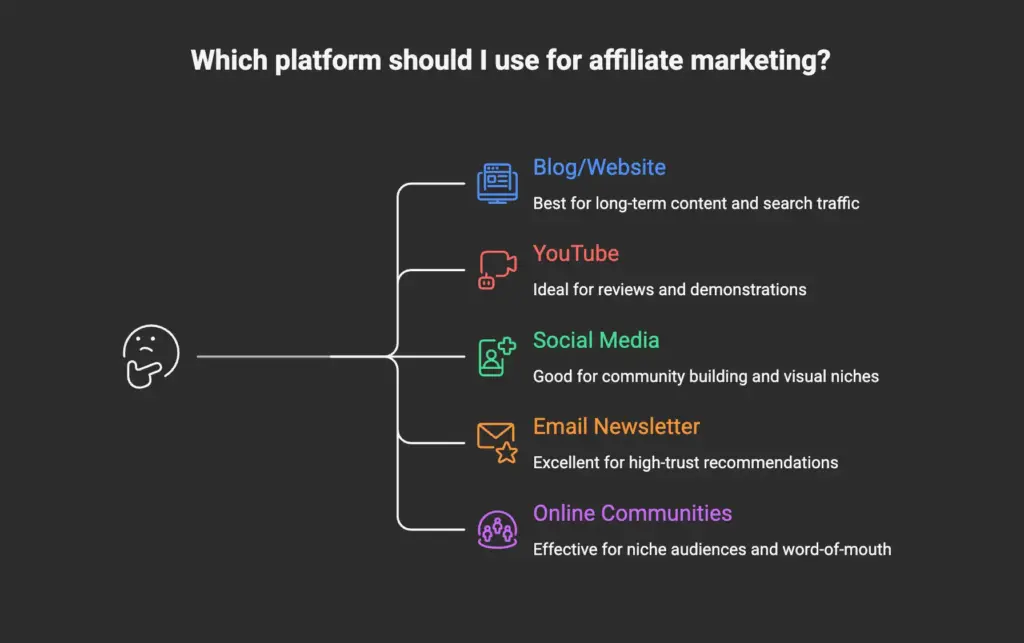
You need a place to share your affiliate links. Here are the most common options.
- Blog
This is one of the most powerful long term platforms. You create helpful articles that rank on Google. Over time, those articles bring consistent traffic.
Pros:
- Long term traffic
- High trust
- Great for SEO
Cons:
- Takes time to grow
If you are patient, blogging can be a strong foundation.
If you are comfortable on camera, YouTube is powerful. People love product reviews and tutorials in video format.
- YouTube
Pros:
- High engagement
- Builds strong personal trust
Cons:
- Requires editing and consistency
- Social Media
Platforms like Instagram, TikTok, or X can work well. But remember, social media traffic can disappear quickly if the algorithm changes. It is fast. But less stable than a blog or email list.
- Email List
This is often overlooked by beginners. An email list lets you communicate directly with your audience. No algorithm in between. Even if you use a blog or YouTube, building an email list from day one is smart.
Because you own that audience.
Step 3: Join Affiliate Programs
Now you need products to promote. There are two main ways.
- Affiliate Networks
These platforms host multiple affiliate programs in one place. You apply once and get access to many offers. Good for beginners because everything is organized in one dashboard.
- Direct Affiliate Programs
Some companies run their own affiliate programs directly from their websites. You usually find a link in the footer that says:
- Affiliate Program
- Partners
- Refer and Earn
Direct programs sometimes offer higher commissions since there is no middleman. Before joining any program, check:
- Commission rate
- Cookie duration
- Payout method
- Reputation of the company
Promote quality products. Your reputation depends on it.
Step 4: Create Helpful Content
This is where most beginners go wrong. They focus on links instead of value. Do not just drop affiliate links everywhere.
Instead:
- Write honest reviews
- Create tutorials
- Compare products
- Solve real problems
For example:
Instead of saying “Buy this hosting,” write:
“How to Set Up WordPress in 20 Minutes” and naturally recommend hosting inside the guide.
Helpful content builds trust. Trust builds clicks. Clicks build commissions.
Step 5: Drive Traffic
No traffic means no sales. You can get traffic from:
- Search engines through SEO
- YouTube search
- Social media
- Email marketing
As a beginner, focus on one main traffic source. Trying to master everything at once leads to burnout. Start simple. Get good at one channel. Then expand.
Step 6: Track and Improve
Affiliate marketing is not guesswork. Check your dashboard regularly.
Look at:
- Which links get clicks
- Which content converts
- Which products perform best
If something works, create more content like that. If something does not work, adjust your approach. Improvement is slow but powerful.
Here is the honest truth.
Affiliate marketing is simple, but not instant.
It takes:
- Consistency
- Patience
- Learning from mistakes
But if you follow these steps and focus on helping people first, you are already ahead of most beginners.
And honestly? Starting messy is better than never starting at all.
How to Start an Affiliate Program for Your Business
So far, we have talked about becoming an affiliate. But what if you run an e-commerce store?
What if instead of earning commissions, you want to pay commissions and grow your sales?
Let’s flip the perspective.
Why E-commerce Stores Need Affiliate Programs
Running paid ads is getting expensive. Cost per click keeps rising. And honestly, not every ad converts.
An affiliate program gives you another growth channel.
Instead of paying for traffic upfront, you reward people only when they generate real sales.
Here is why that matters.
- You turn customers into promoters
- Bloggers and creators market your product for you
- You expand your reach without hiring a big sales team
- You only pay when money comes in
It is like building a remote sales force that works on commission only.
That is powerful.
Benefits Over Traditional Ads
Let’s compare quickly. With paid ads:
- You pay for impressions
- You pay for clicks
- Conversions are not guaranteed
With affiliate marketing:
- You pay only for successful sales
- Risk is lower
- ROI is easier to calculate
Also, affiliates often create content that ranks on search engines. That means long-term visibility for your brand without constant ad spend.
And here is something many store owners overlook.
Affiliate marketing builds trust faster than ads.
Why?
Because people trust recommendations from creators they follow more than they trust banner ads.
Basic Setup Overview (Simple and Practical)
Starting an affiliate program is not as complicated as it sounds. Here is the basic process.
Step 1: Choose Affiliate Tracking Software
You need a system that can:
- Generate unique referral links
- Track clicks and conversions
- Calculate commissions
- Manage payouts
This can be done through an affiliate network or through a WordPress-based affiliate management solution if your store runs on WordPress.
The key is reliable tracking. Without that, affiliates will not trust your program.
Step 2: Define Your Commission Structure
Decide:
- Percentage or fixed amount per sale
- One-time or recurring commission
- Cookie duration
Make it competitive but sustainable.
For physical products, margins may be lower. For digital or subscription products, you may offer higher or recurring commissions.
Step 3: Create Clear Program Guidelines
Be transparent. Include:
- Payment schedule
- Promotional rules
- Prohibited traffic sources
- Refund policies
Clarity prevents future disputes.
Step 4: Recruit the Right Affiliates
Start small. Invite:
- Existing customers
- Industry bloggers
- Niche influencers
- Email newsletter partners
Quality matters more than quantity. Ten engaged affiliates can outperform one hundred inactive ones.
Step 5: Support and Optimize
Do not just launch and disappear. Provide:
- Banners and promotional materials
- Product updates
- Special discount codes
- Performance insights
Affiliate programs grow when relationships grow.
Here is the honest truth.
If you run an e-commerce store and rely only on ads, you are leaving money on the table.
An affiliate program adds a performance-based growth engine to your business. Low risk. Measurable results. Scalable over time.
And the best part?
You reward partners only when they help you win.
Common Beginner Mistakes (And How to Avoid Them)
Let’s be real for a second.
Most beginners do not fail because affiliate marketing does not work. They fail because of avoidable mistakes.
The good news? Once you know these mistakes, you can dodge them easily.
1. Chasing High Commissions Only
This is the classic beginner trap.
You see a product offering 50 percent commission and think, “This is it. I’ll get rich.”
But here’s the problem. High commission does not mean high conversion. If the product:
- Is low quality
- Has poor reviews
- Does not match your audience
You will struggle to make sales.
Instead of asking, “How much does it pay?”
Ask, “Will this genuinely help my audience?”
A product that pays 10 percent but converts well can earn more than a 50 percent product nobody trusts.
2. Promoting Too Many Products
Another common mistake?
Promoting everything.
One day, you recommend hosting. Next day crypto. Then skincare. Then a random online course.
This confuses your audience.
When people do not know what you stand for, they stop listening.
Focus on:
- A clear niche
- A small set of trusted products
- Consistent messaging
It is better to deeply promote 3 solid products than casually promote 30.
3. Ignoring Trust
Affiliate marketing runs on trust. If people do not trust you, they will not click your links. Some beginners:
- Copy generic product descriptions
- Write fake reviews
- Promote tools they have never used
That might bring a few clicks. But long term? It damages your credibility.Instead:
- Share honest pros and cons
- Use products before recommending them when possible
- Be transparent about your experience
Trust takes time to build. But once built, it becomes your biggest asset.
4. Not Disclosing Affiliate Links
This one is serious.
In many countries, including the United States, you are required to disclose affiliate relationships. The Federal Trade Commission expects affiliates to clearly inform readers when they may earn a commission.
This is not just about rules. It is about honesty.
A simple line like:
“This post contains affiliate links. I may earn a commission at no extra cost to you.”
That is enough. Transparency builds credibility. Hiding affiliate links destroys it.
5. Expecting Instant Money
This is probably the biggest mistake of all.
Many beginners think:
“I’ll publish 3 blog posts and start earning next week.”
Affiliate marketing is not a lottery ticket. It takes:
- Time to build traffic
- Time to gain trust
- Time to test what works
Some people see results in a few months. For others, it takes longer. But those who stay consistent and keep improving often see steady growth.
The key is patience. Treat affiliate marketing like building a small business, not chasing quick cash.
Here is the honest truth.
If you avoid these five mistakes, you are already ahead of a large percentage of beginners.
Keep it simple. Focus on value. Play the long game.
That is how affiliate marketing becomes sustainable.
Is Affiliate Marketing Legit or a Scam?
Let’s address the elephant in the room.
You have probably seen bold claims like:
“Make $10,000 in 30 days with affiliate marketing.”
And that naturally makes people suspicious. So, is affiliate marketing legit?
Yes. Affiliate marketing is a real, performance-based marketing model used by major global brands. But like anything involving money, it can be misused by dishonest people.
Let’s clear up the confusion.
- Is Affiliate Marketing a Pyramid Scheme?
No. And this is a common misunderstanding.
A pyramid scheme usually requires you to:
- Pay to join
- Recruit other people
- Earn mainly from new member fees
Affiliate marketing does not work like that.
In affiliate marketing:
- You promote real products or services
- You earn commission only when a real customer makes a purchase
- There is no requirement to recruit others
The focus is on product sales, not member recruitment. That is a big difference.
- The Role of Transparency
Affiliate marketing becomes questionable only when transparency is missing.
For example:
- Fake reviews
- Hidden affiliate links
- Exaggerated income claims
These practices damage trust and make the industry look bad.
But ethical affiliate marketing is simple:
- Recommend helpful products
- Be honest about pros and cons
- Clearly disclose affiliate relationships
When done properly, it is just digital word of mouth with tracking.
- What About FTC Disclosures?
In many countries, affiliate disclosures are legally required.
In the United States, the Federal Trade Commission expects affiliates to clearly state when they may earn a commission from recommendations.
This protects consumers.
A clear disclosure like:
“I may earn a commission if you purchase through my link at no extra cost to you.”
That is enough.
If someone hides affiliate relationships or makes unrealistic income promises, that is a red flag.
- Setting Realistic Expectations
Here is the truth most “gurus” will not tell you.
Affiliate marketing is not instant money. It is not passive from day one. It is not a magic button.
It is a business model.
It requires:
- Content creation
- Traffic generation
- Testing and improvement
- Patience
Some affiliates earn a few hundred dollars per month. Some earn thousands.
A small percentage earn very large incomes.
But those results usually come after consistent effort, not overnight success.
So is affiliate marketing legit?
Yes.
Is it easy?
Not always.
Is it possible to build real income from it?
Absolutely, if you approach it with honesty, patience, and a focus on helping people first.
That is the difference between hype and reality.
How Much Money Can Beginners Realistically Make?
This is the question everyone wants answered.
“How much can I actually earn?” Let’s talk honestly. No hype. No fake screenshots.
- Realistic Income Ranges for Beginners
In the beginning, most affiliates earn:
- $0 in the first few weeks
- $50 to $300 per month after a few months of consistent effort
- $500 to $1,000 per month once traffic starts growing
Of course, results vary.
Some people move faster. Some take longer. A small percentage scale to several thousand dollars per month. But that usually happens after building systems, traffic, and trust over time.
Affiliate income is directly tied to:
- Traffic volume
- Conversion rates
- Commission rates
- Content quality
More targeted traffic plus strong trust usually equals better earnings.
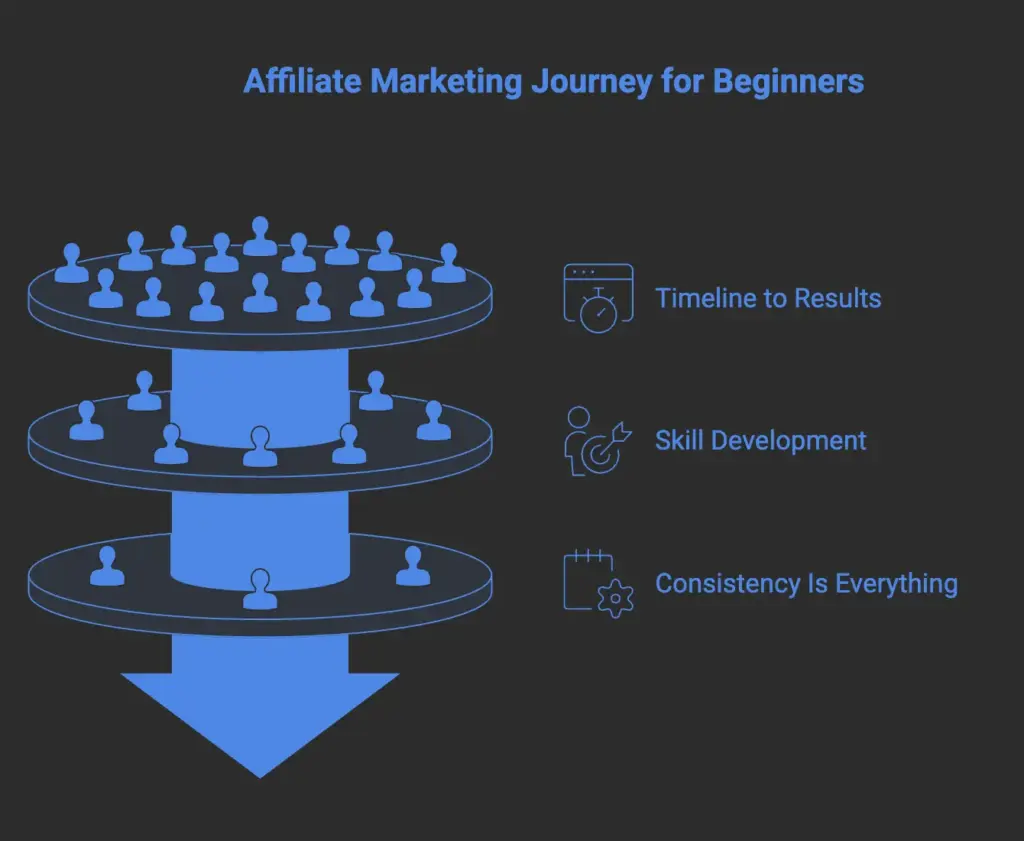
- Timeline Expectations
Here is what most beginners experience:
Month 1 to 3:
Learning phase. Setting up a platform. Creating content. Very little income.
Month 3 to 6:
First commissions start coming in if traffic begins to grow.
Month 6 to 12:
Momentum builds. Content ranks. Email lists grow. Income becomes more consistent.
This is not a strict rule. But it is a realistic pattern.
If someone promises you life changing income in 30 days with zero effort, that is a red flag.
- Effort vs Reward
Affiliate marketing rewards effort, but not always instantly.
You put in work upfront:
- Writing articles
- Recording videos
- Learning SEO
- Testing products
The reward comes later.
This is called delayed gratification. And honestly, many people quit before they reach this stage.
Those who stay consistent often see compounding results. One good article can bring traffic for years. One helpful video can generate recurring commissions month after month.
But it starts with effort.
- The Passive Income Myth vs Reality
Let’s clear this up. Affiliate marketing can become semi passive. But it is not passive at the beginning.
At first, it looks like:
- Research
- Writing
- Editing
- Optimizing
- Promoting
Later, once content ranks and systems are in place, income can come in without daily work.
That is when people say they earn “while sleeping.”
But what you do not see is the months of effort that built that foundation. Affiliate marketing is more like planting trees than flipping a switch. You water them consistently. You wait. Then eventually, they grow and bear fruit.
So how much can beginners realistically make?
Enough to cover small bills in the early stages.
Enough to replace a full-time income if done seriously over time.
Enough to become a scalable online business if treated professionally.
The key is not chasing fast money. The key is building something that grows steadily.
Read More: Is Affiliate Marketing Worth It in 2026?
2026 Trends Beginners Should Know
Affiliate marketing is evolving fast.
What worked five years ago may not work the same way today. If you are starting now, you actually have an advantage. You can build using modern tools and smarter strategies from day one.
Here are the key trends shaping 2026.
1. AI-Powered Affiliate Analytics
Artificial intelligence is no longer a buzzword. It is becoming part of everyday marketing tools.
Affiliate platforms are now using AI to:
- Detect fraud and fake clicks
- Predict high-converting traffic sources
- Suggest better commission structures
- Analyze which content drives the most sales
For affiliates, this means better data and smarter decisions.
Instead of guessing which product might work, you can analyze:
- Click-through rates
- Conversion patterns
- Audience behavior
For beginners, this lowers the learning curve. You can improve faster because the data is clearer.
But remember, AI helps with analysis. It does not replace trust and quality content.
2. First Party Tracking Is Becoming Essential
Privacy rules are getting stricter.
Browsers are limiting third-party cookies. Ad blockers are more common. That means traditional tracking methods are changing.
This is where first-party tracking comes in.
First-party tracking uses data collected directly from the website itself rather than relying on external cookies.
For businesses running affiliate programs, this improves:
- Accuracy
- Transparency
- Reliability
For affiliates, it means fewer lost commissions due to tracking issues.
In simple words, tracking is becoming cleaner and more trustworthy.
3. The Rise of the Creator Economy
In 2026, creators are not just influencers. They are mini media brands.
Bloggers, YouTubers, newsletter writers, and niche community builders are building loyal audiences.
Affiliate marketing fits perfectly into this model.
Instead of random banner ads, creators integrate recommendations naturally into:
- Tutorials
- Product walkthroughs
- Case studies
- Personal stories
Audiences trust creators more than traditional ads.
If you are starting today, focus on becoming a helpful creator, not just a link sharer.
4. Micro Influencers Are Driving Higher Conversions
Bigger is not always better. Brands are now working more with micro influencers. These are creators with smaller but highly engaged audiences.
Why?
Because engagement matters more than follower count.
A creator with 5,000 loyal followers in a specific niche can generate more sales than someone with 200,000 passive followers.
For beginners, this is good news.
You do not need millions of followers. You need a focused audience that trusts you.
5. Recurring Commissions Are Gaining Popularity
More companies are shifting to subscription models.
- Software tools.
- Membership communities.
- Online platforms.
This means more recurring affiliate programs.
Instead of earning once per sale, affiliates earn every month as long as the customer remains subscribed.
This creates predictable income. In 2026, smart affiliates are focusing more on:
- SaaS tools
- Subscription services
- Membership-based products
Because stable monthly commissions reduce income volatility.
Here is the bigger picture. Affiliate marketing is becoming:
- More data-driven
- More transparent
- More creator-focused
- More relationship-based
If you start now and build with these trends in mind, you are not late. You are early to the smarter version of affiliate marketing.
Read More: 25 Affiliate Marketing Trends You Should Know in 2026
Wrapping Up
Affiliate marketing is not magic. It is not a shortcut to instant wealth. But it is a real, proven way to build income online when done the right way.
You now understand what affiliate marketing is, how it works, the common mistakes to avoid, and what realistic results look like. More importantly, you know that trust, patience, and helpful content matter more than hype.
If you are just starting out, keep it simple. Pick one niche. Choose one platform. Promote a few products you genuinely believe in. Then stay consistent.
Start small. Learn as you go. Improve step by step.
And if you have questions or feel stuck, drop your thoughts in the comments. Let’s grow together.
Need full-fledged foundational knowledge on Affiliate Marketing?
Here’s our Affiliate Marketing 101 guide that covers everything you need to understand the industry as a whole!



Add your first comment to this post