
How Affiliate Marketing Works (Ultimate Clarity Guide)
Affiliate marketing is one of those terms that floats around everywhere online. You’ve probably seen it mentioned in blog posts, YouTube videos, and social media. But when you try to actually understand how it works, things get murky fast.
Terms like “conversion tracking,” “cookie windows,” and “commission structures” pop up, and suddenly what seemed like a simple idea feels overwhelming.
Here’s the truth: affiliate marketing is actually straightforward once someone explains it clearly.
This guide does exactly that. No jargon. No hype. No skipping the important parts. By the time you finish reading, you’ll understand the full process from start to finish, whether you’re thinking about becoming an affiliate or planning to run an affiliate program for your own business.
Let’s start from the very beginning.
Affiliate Marketing in One Simple Sentence
Affiliate marketing is a system where a business pays other people a commission for sending customers their way.
That’s it. That’s the whole thing.
Someone recommends a product. A person buys it using that recommendation. The recommender earns a cut of the sale. The business gets a new customer they might not have reached otherwise. Everyone benefits.
Everything else, the tracking, the links, the payment schedules, is just the mechanics that make this simple idea work reliably at scale.
The 4 Key Players in Affiliate Marketing
Before walking through the process step by step, it helps to know who’s involved. There are four main players in every affiliate marketing arrangement.
1. The Business (Also Called the Merchant or Advertiser)
This is the company or individual selling the product or service. They create an affiliate program to let others promote their offerings in exchange for a commission.
Example: A software company that offers project management tools.
2. The Affiliate (Also Called the Publisher or Promoter)
This is the person who promotes the business’s product to their audience. They earn a commission when their promotion leads to a sale (or another desired action).
Example: A productivity blogger who reviews tools and recommends them to readers.
3. The Customer
The customer is the person who clicks the affiliate’s link and makes a purchase. They usually don’t pay anything extra because of the affiliate arrangement. The commission comes out of the business’s side, not the customer’s pocket.
4. The Affiliate Tracking System
This is the behind-the-scenes technology that connects everything. It records who referred whom, tracks sales, calculates commissions, and handles payouts. Without this system, there’d be no way to know which affiliate deserves credit for which sale.
Think of it like the record-keeper for the whole operation.
How Affiliate Marketing Works: Step-by-Step
Now let’s walk through the entire process from the moment an affiliate program is created to the moment an affiliate gets paid.
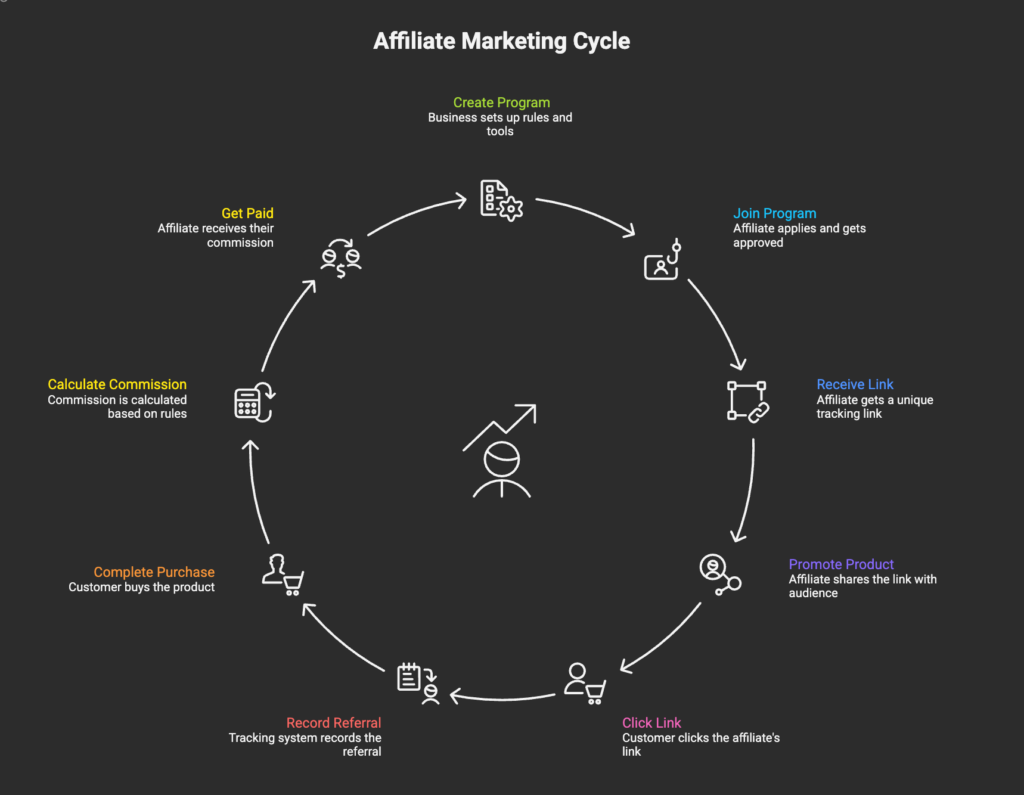
Step 1: The Business Creates an Affiliate Program
A business decides to grow through affiliate marketing. They set up a program that defines the rules: how much commission affiliates earn, what actions qualify (a sale, a signup, a trial), and how and when affiliates get paid.
They either use affiliate management software, join an affiliate network, or build this into their own platform.
Step 2: The Affiliate Joins the Program
Someone who wants to promote the product applies to join the program. The business reviews the application and either approves or declines it. Some programs are open to anyone. Others are selective.
Once approved, the affiliate gets access to their account, promotional materials, and most importantly, their unique tracking link.
Step 3: The Affiliate Receives a Unique Tracking Link
This is one of the most important parts of the process. The affiliate receives a special URL that’s tied specifically to their account. It looks like a regular link, but it contains a unique code that identifies the affiliate.
Every time someone clicks that link, the tracking system knows exactly which affiliate sent them.
Step 4: The Affiliate Promotes the Product
The affiliate shares their unique link wherever they connect with their audience. This could be in a blog post, a YouTube video description, a social media caption, or an email newsletter.
They’re essentially recommending the product to people who already trust their opinion. The more genuine and relevant the recommendation, the more likely people are to click and buy.
Step 5: The Customer Clicks the Link
A reader, viewer, or follower sees the recommendation and clicks the affiliate’s link. This takes them to the business’s website, just like any other link would.
But that click triggers something important behind the scenes.
Step 6: The Tracking System Records the Referral
The moment that link is clicked, the tracking system captures the referral. It records which affiliate sent this visitor and usually stores a small file called a cookie on the customer’s browser.
This cookie acts like a timestamp. It means that even if the customer doesn’t buy immediately and comes back a few days later to complete the purchase, the affiliate still gets credit for the referral, as long as the cookie is still active.
Step 7: The Customer Completes the Purchase
The customer browses the business’s website and decides to buy. They complete the purchase just as they normally would. They don’t see anything different about their experience.
Step 8: The Commission Is Calculated
Once the purchase is confirmed, the tracking system calculates how much commission the affiliate earned. This is based on the commission structure the business set up.
For example, if the product costs $100 and the commission rate is 20%, the affiliate earns $20 from that sale.
Step 9: The Affiliate Gets Paid
The commission is added to the affiliate’s account balance. Once they reach the minimum payout threshold (more on this later), the business sends payment through the affiliate’s chosen payment method.
And that’s the full cycle. A recommendation becomes a click, a click becomes a sale, and a sale becomes a commission.
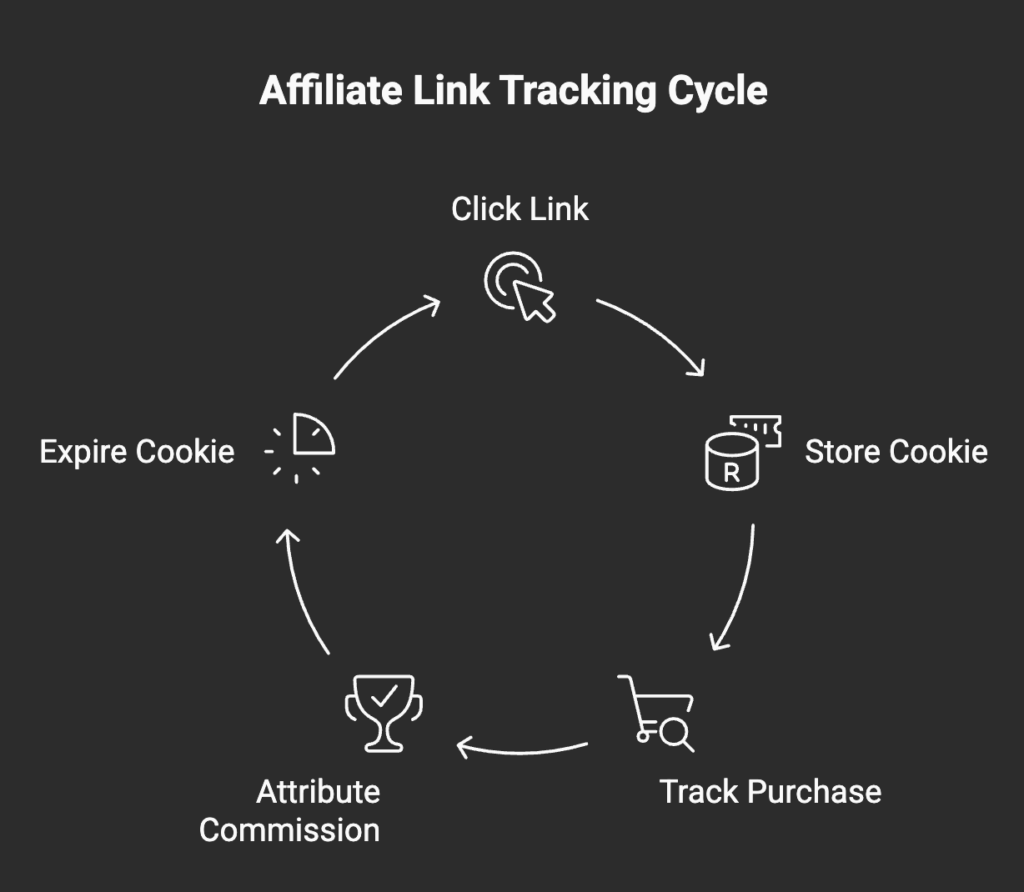
How Affiliate Links Actually Work
Affiliate links might look like normal URLs, but there’s a bit of smart technology packed into them. You don’t need to understand the technical details to use them, but knowing the basics helps everything make more sense.
A. Unique Affiliate IDs
Every affiliate gets a unique identifier, usually a combination of letters and numbers. This ID gets added to the product’s URL. When someone clicks the link, the system reads that ID and knows exactly which affiliate to credit.
It’s similar to a referral code at a physical store. When someone gives the code at checkout, the system knows who sent them.
B. Cookies and Tracking
When someone clicks an affiliate link, a small file called a cookie gets stored on their device. This cookie carries the affiliate’s ID and has an expiration date, often called the cookie window or cookie duration.
If the cookie window is 30 days and the customer buys within 30 days of clicking the link, the affiliate gets the commission. If the customer buys on day 31, the cookie has expired and the affiliate typically doesn’t receive credit.
Cookie windows vary by program. Some are 24 hours. Some are 90 days. Some are lifetime.
C. Attribution
Attribution is the process of deciding which affiliate gets credit when multiple affiliates send the same customer. Most programs use last-click attribution, meaning the affiliate whose link was clicked most recently gets the credit. Some programs use first-click or split-credit models, but last-click is the most common.

Starting From Scratch? Kickstart
with Affiliate Marketing 101 Guide!
How Affiliate Commissions Work
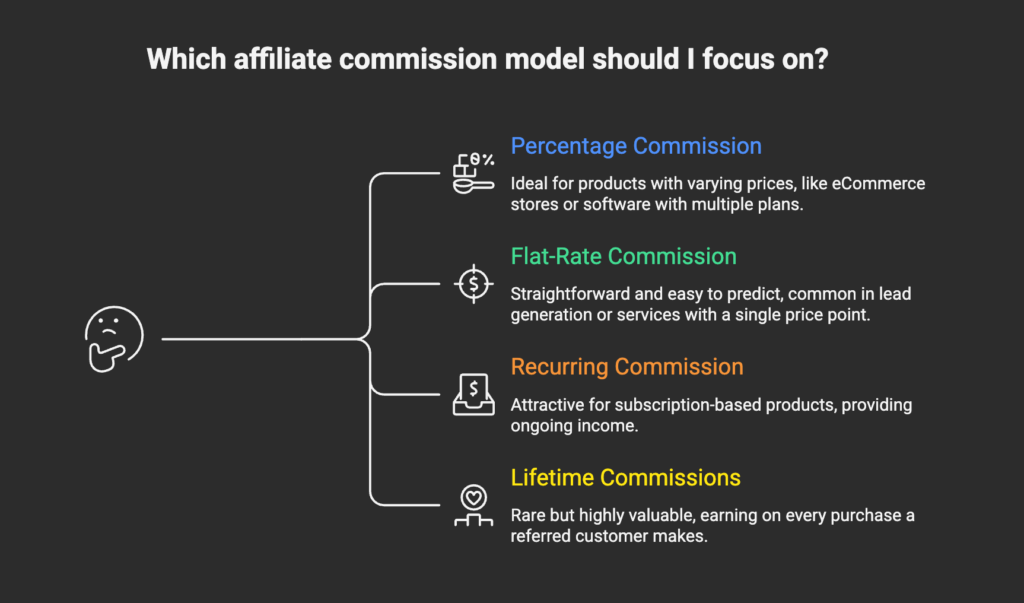
Not all affiliate programs pay the same way. The commission structure varies depending on the business, the product type, and the program’s goals. Here are the main models you’ll encounter.
1. Percentage Commission
This is the most common model. The affiliate earns a percentage of the sale price. If a product sells for $200 and the commission is 30%, the affiliate earns $60.
This model works well for products with varying prices, like eCommerce stores or software with multiple plans.
2. Flat-Rate Commission
Instead of a percentage, the affiliate earns a fixed amount per sale. For example, $25 for every customer who signs up, regardless of which plan they choose.
This model is straightforward and easy to predict. It’s common in lead generation programs or services with a single price point.
3. Recurring Commission
This is a particularly attractive model for affiliates. Instead of earning once per sale, the affiliate earns a commission every time the customer pays their subscription.
If someone signs up for a $50/month software tool through an affiliate link, and the program offers 20% recurring commissions, the affiliate earns $10 every month that customer stays subscribed. Over a year, that’s $120 from a single referral.
4. Lifetime Commissions
Some programs offer lifetime commissions, meaning the affiliate earns on every purchase that referred customer ever makes, not just the first one. This is rare but extremely valuable for affiliates when offered.
How Affiliates Get Paid
Earning a commission and receiving payment are two separate things. Here’s how the payment side of affiliate marketing typically works.
Payout Thresholds
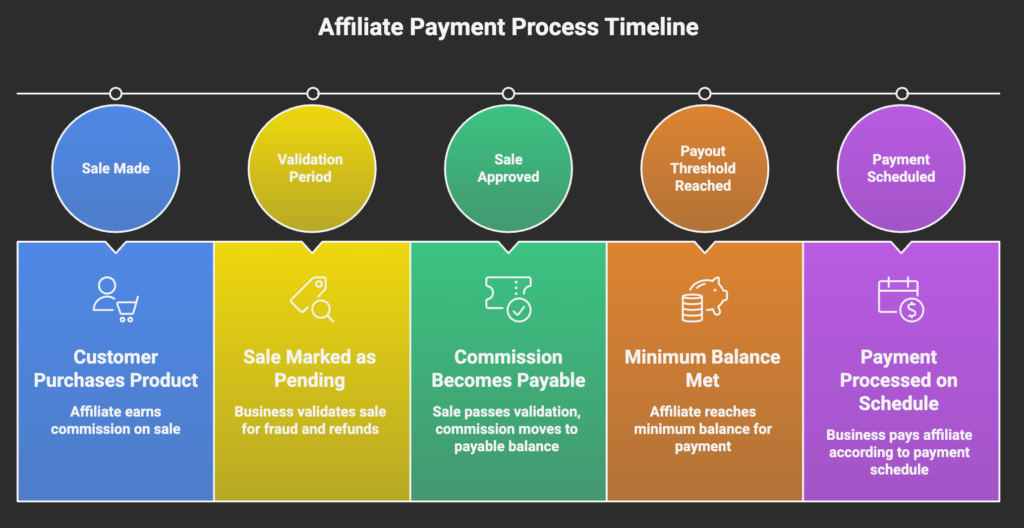
Most programs don’t send payments after every single sale. Instead, they set a minimum balance you need to reach before a payment goes out. A common threshold is $50 or $100.
This reduces transaction fees and administrative work for the business. It means affiliates just starting out may need to wait until they’ve accumulated enough commissions.
Payment Schedules
Businesses pay affiliates on a schedule, not immediately after each sale. Common schedules include:
- Monthly payments (the most common)
- Bi-monthly payments
- Net-30 or Net-60 terms (payment sent 30 or 60 days after the earning period)
The delay exists partly because of refund windows. If a customer buys and then refunds within 30 days, the affiliate shouldn’t keep the commission for a sale that was reversed.
Common Payment Methods
Affiliate programs typically offer payment through:
- PayPal
- Bank transfer (ACH or wire)
- Check
- Stripe or other payment platforms
- Store credit (less common but exists)
Approval and Validation
Many programs include a validation period where sales are marked as “pending” before they become “approved.” This protects the business against fraud and refunds. Once a sale passes the validation window, the commission moves to the affiliate’s payable balance.
Where Affiliate Marketing Happens Today
Affiliate marketing isn’t limited to one type of content or platform. It happens across nearly every corner of the internet.
1. Blogs and SEO Content
This is one of the most established channels. Bloggers write helpful, search-optimized articles that rank on Google. Readers find the content while searching for answers, read the article, click an affiliate link, and make a purchase.
A personal finance blog reviewing credit cards, a tech site comparing laptops, or a recipe blog linking to kitchen tools, these are all examples of affiliate marketing through SEO content.
2. YouTube and Video Creators
YouTube creators include affiliate links in their video descriptions. A tech reviewer, a beauty creator, or a fitness coach can earn commissions from products they genuinely use and recommend to their subscribers.
3. Social Media
Instagram, TikTok, Pinterest, and Twitter/X are all active affiliate channels. Creators share discount codes, product links, and honest reviews with their followers.
4. Email Newsletters
Email is a high-converting channel for affiliate marketing. Someone who has built a newsletter audience that trusts their recommendations can drive significant sales through a single email mentioning a product.
5. Communities and Memberships
Online communities, forums, Slack groups, and membership sites are increasingly becoming affiliate channels. A trusted community member recommending a tool carries weight, especially in niche communities.
Affiliate Marketing From the Business Side
If you run a business, affiliate marketing offers a compelling model for growth. Here’s why so many companies invest in it.
1. Performance-Based Growth
With most forms of advertising, you pay whether or not you get results. With affiliate marketing, you only pay when a sale actually happens. This makes it one of the most cost-effective acquisition channels available.
2. Lower Risk Than Paid Ads
Paid advertising requires budget upfront with uncertain returns. Affiliate programs shift that risk. Affiliates invest their time and effort promoting your product, and you reward them only when it works.
3. Scalable Partnerships
One affiliate manager can oversee dozens or hundreds of affiliates, each one independently driving traffic and sales. As the affiliate base grows, so does the reach, without a proportional increase in cost.
4. Trust Through Third Parties
Customers are increasingly skeptical of direct advertising. When a trusted blogger or creator they follow recommends a product, that recommendation carries more weight than a banner ad. Affiliate marketing puts your product in front of audiences through voices they already trust.
Common Questions People Ask About Affiliate Marketing
Here are some of the frequently asked questions people ask about affiliate marketing.
Q1. Is affiliate marketing free to start?
For affiliates, yes, joining an affiliate program is free. You may invest in tools like a website, email platform, or content creation equipment over time, but the barrier to entry is low compared to most business models.
For businesses setting up an affiliate program, there are costs involved, whether through software subscriptions, network fees, or staff time. But these are offset by the performance-based nature of the model.
Q2. Do you need a website to become an affiliate?
Not necessarily. You can promote affiliate products through social media, YouTube, or email newsletters. That said, having a website gives you more control, more ways to capture search traffic, and a more professional presence. It’s worth building one as you grow.
Q3. How long does it take to earn commissions?
There’s no universal answer. Some affiliates earn their first commission within days. Others spend months building an audience before seeing results. It depends on your existing audience size, the quality of your content, your niche, and how much consistent effort you put in.
Expect a learning curve. Treat it like building any skill, it gets easier and faster over time.
Q4. Is affiliate marketing saturated?
Every popular niche has competition. But saturation is often used as an excuse. Better content, stronger trust, and more helpful advice consistently win out over older, lower-quality content. If you can serve your audience better than existing affiliates, there’s room for you.
Q5. Can beginners actually succeed?
Yes. Most successful affiliate marketers started with zero experience. What separates those who succeed is consistency, a willingness to learn, and a focus on genuinely helping their audience rather than just chasing commissions.
Common Mistakes Beginners Make
Knowing what not to do can save you months of wasted effort.
1. Promoting Too Many Products
Beginner affiliates often sign up for dozens of programs and scatter links across their content. This rarely works. Focused, intentional recommendations of a few well-matched products build more trust and convert better than a scattershot approach.
2. Ignoring Trust
Affiliate marketing only works when your audience trusts you. If you recommend products you haven’t used or don’t believe in, readers notice. Damaged trust is hard to rebuild. Always prioritize your audience’s interests over short-term commission earnings.
3. Expecting Fast Income
Affiliate marketing is not a quick-money scheme. Building an audience, creating helpful content, and establishing credibility takes time. Expecting results in the first few weeks almost always leads to burnout and quitting too early.
4. Not Understanding Audience Fit
Promoting products that don’t match your audience’s needs is a common and costly mistake. A personal finance blog promoting luxury fashion products will see terrible conversion rates. The best affiliate promotions feel natural because the product genuinely solves a problem the audience already has.
Realistic Expectations for Affiliate Marketing
Affiliate marketing is a legitimate way to earn income online. But it’s not passive income from day one. Here’s a more honest picture of what to expect.
1. Time Investment
Building to meaningful affiliate income typically takes 6 to 18 months of consistent effort. Some people get there faster. Many take longer. The timeline depends on your starting point, your niche, and how much time you invest each week.
2. Learning Curve
You’ll learn as you go. SEO, content writing, audience building, and conversion optimization are all skills that improve with practice. There are resources to accelerate learning, but no shortcut replaces doing the work.
3. Long-Term Growth Mindset
The affiliates earning significant recurring income built it over years, not weeks. They created content that compounds over time, built audiences that grow through word of mouth, and developed genuine authority in their niche. If you commit to the long game, the results are real and sustainable.
Wrapping Up
Affiliate marketing is not complicated. It is a straightforward exchange: you help someone find a product, they buy it, you earn a share of the sale.
The confusion usually comes from jumping into the technical details before understanding the basics. Now that you have the full picture, the details make sense. Tracking links, cookie windows, commission structures, payout thresholds, these are just tools that make a simple idea work at scale.
Whether you’re an affiliate building an audience or a business looking to grow through partnerships, the foundation is the same: create genuine value, earn real trust, and the commissions follow naturally.
Start simple. Pick one product, one audience, one channel. Do that well before adding more. The people who overcomplicate it from day one are usually the ones who quit before it pays off.


Add your first comment to this post